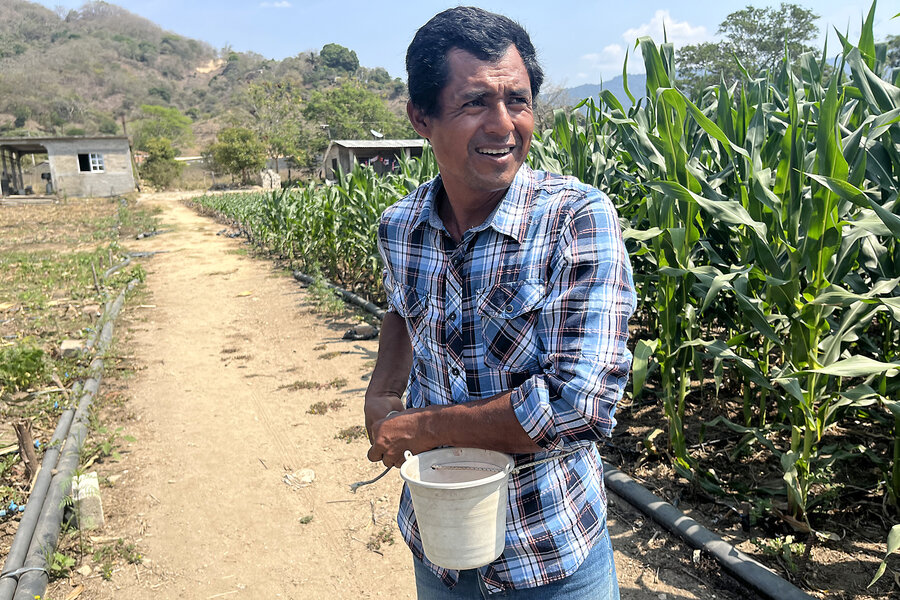
Photo: Whitney Eulich.
Fernando Matus Hernández ties a small bucket filled with heirloom corn kernels around his waist before planting them on his family’s farm in Oaxaca, Mexico. Small farms like his are an endangered species.
Agricultural capitalism is making it hard for small farms to survive, but so are some environmental regulations, normally a public good. How can we protect both the environment and the small farms that feed us?
At the Christian Science Monitor, Erika Page, Whitney Eulich, and Srishti Jaswal have an in-depth report on the challenges facing farmers today.
“Julie De Smedt tries not to picture her future too often. When she does, she has trouble imagining herself anywhere but here, planted on this stretch of fertile land that runs from her childhood home to the River Scheldt.
“Her family’s cattle ranch is the last farm left on this sleepy Belgian country road. If she were a statistic, she would have left for the city. But at 21 years old, she’s made up her mind.
“ ‘I want to take over the farm,’ says Ms. De Smedt, who lives doors down from her grandparents and cousins on both sides. ‘I don’t want to be anywhere else.’
“But she knows how unlikely her dream is. Sometime soon, all her family farm’s land will be converted into a nature reserve. The European Union is pushing to restore ecosystems in the face of widespread environmental degradation, which contributes to climate change, so the state has expropriated their land.
“The family is not against green policies. ‘There has to be nature, and there have to be people who defend nature,’ says Wendy Vasseur, Ms. De Smedt’s mother, looking through the back door of a cow barn at the line of trees that marks the boundary of the future reserve. But nobody seems to care what will become of their family and the life they have built on this land, they say. …
“Small-farm owners around the globe, in fact, are feeling that same sense of helplessness. From Germany and Spain to India and Canada, farmers are rising up to protest not only burdensome new environmental regulations but also the impact of corporate mega-farms and cheap food imports, which have caused their costs to rise and their profits to fall dramatically. So, many around the world have driven their tractors into capital cities, sometimes spraying manure on city streets and sidewalks. They’ve blocked major freeways, set fires in urban metro stations, and demanded changes to policies that, to them, feel like death sentences.
“ ‘What they want is a decent living,’ says Morgan Ody, general coordinator of La Via Campesina, an international small-farmers organization. ‘What they want is respect for their work.’
It would be a mistake, she says, to see the latest wave of protests as simply right-wing backlash against the green agenda.
“True, some farmers oppose green policies on political grounds, but many support them. As rural areas lose population, farmers on every continent say they are being sacrificed to meet the demands of a society that no longer values the people who feed it. …
“A cow and a pig were all Ms. De Smedt’s grandfather needed to open this farm in the 1950s. As agriculture intensified and industrialized, the farm, too, grew. Today, the wooden barns the family built itself hold 250 cattle, whose meat is sold mainly to French grocery chain Carrefour.
“They fatten their cows on corn and beets they grow on the land destined for the nature reserve. And they will continue for as long as they can, Ms. Vasseur says. But it is a perpetual battle to keep the farm going, and Ms. Vasseur has to work a full-time job at a nearby factory to make ends meet.
“The price they can charge for their beef has not kept up with the rising costs of inputs such as fertilizer and pesticides needed to keep poisonous weeds at bay. Now, the family business has to deal with rules governing crop rotation and fallow land. …
“Their story has repeated itself around the world for decades, says Timothy Wise, a researcher and senior adviser at the Institute for Agriculture and Trade Policy, an international nonprofit that promotes sustainable food production. ‘Bigger farms get bigger, and smaller farms disappear. Rural communities just get hollowed out.’
“Between 2005 and 2020, the EU lost nearly 40% of its farms and over 5 million farmers, most of them smallholders. At the same time, the amount of land being farmed has stayed the same. …
“That isn’t how Lieven Nachtergale wants things to end. As coordinator of the Sigma Plan, the project responsible for Belgium’s new nature reserve, Mr. Nachtergale does not enjoy removing farmers from their land. He does, however, think it’s necessary: Natural habitats in the densely populated region of Flanders have been badly degraded, and floods pose a growing risk. In such cases, the needs of the land, if not the planet, must take precedence.
“But the real problem he sees is a model of intensified agriculture that has become so disconnected from the natural world. Fields treated with herbicides, pesticides, and heavy doses of fertilizer leave native species next to no room to thrive, he says.
“The EU’s Nature Restoration Law requires countries to restore 30% of their natural ecosystems by 2030 and 90% by 2050. Mr. Nachtergale’s team is helping Flanders establish 36,000 hectares (almost 90,000 acres) of nature reserve, the equivalent of 5% of the land area being farmed.
“Over the years, he has grown increasingly interested in figuring out how nature and agriculture might better work together. He is working on a pilot project that would give farmers who want to produce in a ‘nature-inclusive’ way 2 hectares of land (5 acres) for every hectare of their own that they contribute. The goal is to restore ecosystems while keeping family farmers on the land.
“ ‘We will need farmers in the future to do this kind of management,’ he says. But he recognizes the challenge of competing with bigger industrialized farms. ‘If we want to change the system and give the farmers a better future, I think we should pay more for what they are producing.’ “
More from farmers around the world at the Monitor, here. No paywall. Subscriptions welcome.

 Suzanne's Mom's Blog