Feeds:
Posts
Comments

Posts Tagged ‘resistant’

Photo: David Swanson/AFP/Getty Images.
The hillside along the Pacific Coast Highway burns in front of the driveway to the Getty Villa in the Pacific Palisades neighborhood in Los Angeles on Jan. 7.  

Planning, courage, and commitment saved California’s Getty Museum in the last big conflagration, but how long can it escape what few others did?

Kelsey Ables at the Washington Post explained how the famous art collection was protected in January.

“As wildfires ravaged greater Los Angeles … the J. Paul Getty Museum faced encroaching flames on two fronts. Blazes nearly surrounded the Getty Villa in Pacific Palisades, coming within six feet of its walls. Days later, ominous red clouds were visible from the Getty Center in Brentwood, hovering on the horizon like a warning.

“The fire at the Villa was the closest flames had ever come to either building. But through it all, the institution made no evacuation plans. On the most intense nights at each location, a team of more than a dozen people at the Villa and 28 at the Center waited it out, and the museums’ vaunted artworks — the ancient sculptures, the Gentileschis, the Manets and Monets — remained inside.

“This was no gamble, though. Those familiar with the Getty describe it as a place one would evacuate to, rather than from.

“With the fire about a mile away from the Center on Jan. 10, a security staff member suggested to J. Paul Getty Trust chief executive Katherine Fleming that she might want to leave. ‘I was thinking, “I actually feel really good here,” ‘ she said in an interview. ‘This feels like a very safe place to be.’

“That is by design. … As the fires have killed more than 20 and razed swaths of the Los Angeles region, the Getty — with its more than $8 billion endowment — has emerged as a beacon of fire preparedness as well as a symbol of the defenses that wealth can build.

“From its grounds to the museum’s core, the $1.3 billion Getty Center, which was designed by architect Richard Meier and opened in 1997, was built to resist flames. …

“High on a hilltop, the campus has sprawling plazas made of fire-resistant travertine imported from Italy. Open spaces surround imposing, elevated buildings that boast walls constructed from reinforced concrete or fire-protected steel. The roofs are covered with stone aggregate, which is fire-resistant. Inside, the buildings are equipped with special doors that prevent flames from traveling. Temperature and humidity are closely monitored during red-flag warnings.

“Outside, the grounds are routinely cleared; the plants, selected for their drought-resistant qualities, are pruned regularly to prevent them from becoming fuel. During a previous fire, the museum said: ‘There is no need to evacuate the art or archives, because they are already in the safest place possible.’

“ ‘It’s very much like a fortress,’ said [Todd Cronan, an L.A. native and art history professor at Emory University in Atlanta], who briefly lived at the Center as a fellow. …

“To Cronan, though, the Getty’s unassailable features say ‘more about privatization and their … endowment than anything else,’ he wrote [by email].

“While the Getty stresses that it does not hire private firefighters or seek special treatment, it maintains its own water tanks — including a 1 million gallon tank at the Center — year-round. …

“When the Villa emerged largely unscathed last week, the museum in a press release credited its own ‘extensive efforts to clear brush from the surrounding area,’ noting that it also stores water on-site and that the grounds were irrigated ahead of the blaze. …

“Fleming, the CEO, said they were confident in their preparations but described a nail-biting evening watching the fire move closer as 15 staff members remained on-site. … The next day, with staff unharmed and the Villa still standing, Fleming found a strange calm in the collections. The galleries were ‘cleaner than an operating room.’ “

More at the Post, here.

Update April 4, 2025. The Getty is selling bonds to raise money for more protection. Article here.
Read Full Post »

Photo: West Virginia University.
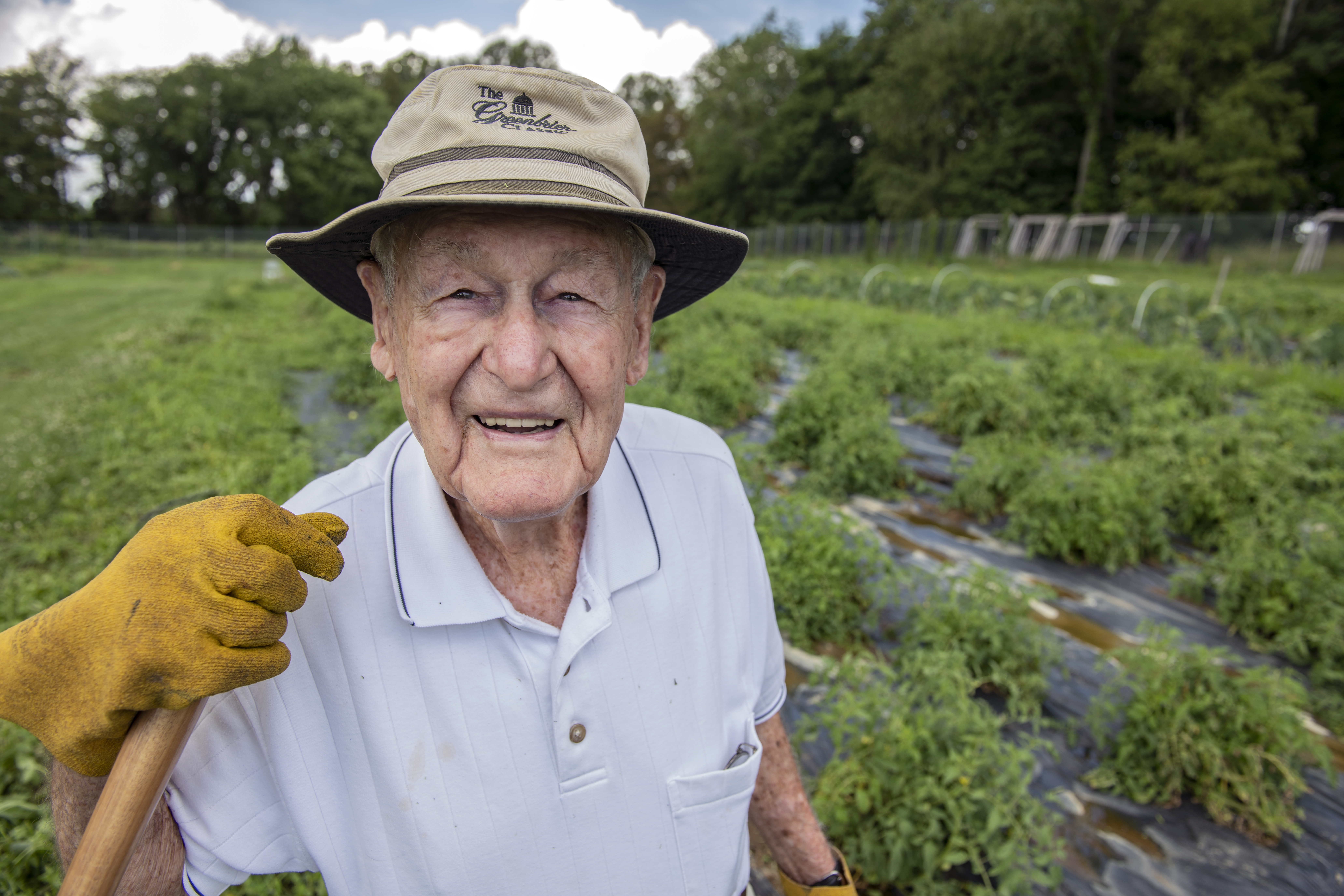
Mannon Gallegly, WVU plant pathology professor emeritus, has created four tomato varieties, including his last, “Mannon’s Majesty,” free to West Virginians.

For a short time in my childhood, I was a member of a 4-H club and won a $0.75 check for a tomato that my father really grew — a check I failed to cash before it expired!

I still love tomatoes. This is the time of year for gorgeous tomatoes. Ashley Stimpson writes at the Washington Post about the 101-year-old West Virginia professor who brought four special varieties into the world, including one he made free to West Virginians.

“You may not have heard of Mannon Gallegly, but chances are you’ve eaten one of his tomatoes, and perhaps even grown one in your garden. More than 60 years ago, Gallegly bred the first tomato that could stand up to Phytophthora infestans, otherwise known as tomato blight. The West Virginia ’63, sometimes called ‘the people’s tomato,’ is still a seed-catalogue superstar and beloved around the world, gracing gardens from Alabama to Africa.

“This year marks the first time since 1949 that Gallegly, who moved into a nursing home after falling ill in the spring, has missed the annual planting. … This morning’s planters are a mix of graduate students from WVU’s Davis College of Agriculture — where Gallegly worked for 38 years — and volunteers who have known the plant pathologist for decades. Gallegly developed three more hardy tomato varieties since 1963, each of which has claimed a spot in this year’s field, including his latest and likely his last.

“After the college publicized the release of the tomato, called Mannon’s Majesty, earlier this year — noting that it was free for any West Virginian who wanted seeds, per Gallegly’s insistence — WVU’s greenhouse manager Whitney Dudding came to work the next Monday morning to find 2,000 email orders waiting in her inbox, a number that far outstripped availability. …

“Until very recently, Dudding held out hope Gallegly might make it to the organic farm for the occasion. … ‘Every year, even last year, he’s been out there on the soft soil, out there in the heat, walking around, right there with us,’ she says. ‘I really don’t know how he does it.’

“The son of a carpenter and a school dietitian, Gallegly grew up in the rural southwest corner of Arkansas. ‘We were pretty poor people,’ he says. During the Great Depression, his parents grew cotton on rented land, where Gallegly logged the first of many hours spent walking between crop rows.

“A teacher from Future Farmers of America inspired Gallegly to attend college, and a Sears Roebuck scholarship made it financially feasible. After graduating from the University of Arkansas with a degree in agriculture, Gallegly went to the University of Wisconsin to get his master’s in plant pathology, working on a rice disease called white tip.

“In June 1949, Gallegly arrived in Morgantown. … ‘That was my favorite month,’ he recalls. ‘I had a new job, I had a new wife, I had a new baby.’ He also had a new three-acre research farm on the grounds of the nearby medium-security prison, where he could conduct trials on plant diseases, including tomato blight.

“By the following summer, Gallegly’s fields swayed with potato and tomato plants of all different varieties. Then disaster struck. ‘The disease farmers and gardeners feared most’ arrived, he says: late blight. The pathogen leaves ugly brown bruises stretching across the leaves, stem and fruit until the plant looks like it’s been blasted with a blow torch.

“That year, Gallegly lost nearly his entire crop of tomatoes to late blight — except for a few wild varieties with tiny fruit that showed a curious resistance to the disease.

“In the 1950s, late blight was more than just an annoyance for the home gardener. In the right conditions, Phytophthora infestans, which is Greek for ‘plant destroyer,’ can wipe out entire food supplies, as it did during the 1840s, when about 1 million people starved during the Irish Potato Famine. …

“For 13 years, Gallegly worked on developing an indestructible tomato, crossing those initial wild varieties that showed genetic resistance to blight with popular commercial tomatoes. …

“Finally, he stumbled upon a variety that was both blight-resistant and delicious. ‘Good things happen sometimes,’ he says.

“Gallegly, who primarily views himself as a public servant, called his creation ‘the people’s tomato.’ When it was released to the public in 1963 as part of the state’s centennial celebration it was given a new name: the West Virginia ’63. …

“Gallegly retired in 1986, but that didn’t stop him from coming into work every day. …

“In addition to writing books and breeding tomatoes, Gallegly has mentored countless plant pathologists getting their start in Morgantown. Dudding, who has helped Gallegly with cultivating diseases (to test for resistance in plants) and crossbreeding, ‘because my hands were smaller and steadier than his,’ says the scientist ‘is never in a hurry. He has always had time to talk to me and teach me.’

“WVU graduate student Inty Hernández, who’s been working with Gallegly on breeding new tomatoes, agrees, saying: ‘He’s very supportive all the time. It has been very inspiring to work with him. Sometimes you feel tired, you know, and then you arrive to the greenhouse and there’s a 100-year-old man hard at work.’ ”

More at the Post, here. Is your garden producing tomatoes right now?

Read Full Post »

Photo: Delaware Agriculture
Mark VanGessel, Professor of Weed/Crop Management at the University of Delaware, with an invasive palmer amaranth plant.

Agribusiness presents all sorts of challenges these days. For one, weeds are becoming resistant to Roundup, the herbicide that has received so much attention for causing cancer. And having a huge number of acres makes it hard to find a paying crop to plant on alternative years, which can help improve the soil.

A report at Civil Eats, rebroadcast by Public Radio International, got me interested in Australia’s superweed problem. In it, Virginia Gewin explained how near-desperation was causing to farmers to get creative.

“In December, C. Douglas ‘Bubba’ Simmons III left his corn and soybean farm in northwest Mississippi to visit the dryland wheat fields in Western Australia, a region considered to be the herbicide resistance capital of the world. Plagued with unwelcome intruders such as annual ryegrass and wild radish that have evolved resistance to several herbicides, Australian farmers have been forced to develop new approaches to manage weeds — and their seeds. It hasn’t been easy. Farmers there are paying roughly 27 percent more per acre due to increased management and yield loss, according to Bayer.

“Simmons visited several farms in the southern half of the state of Western Australia with three other U.S. farmers and a weed scientist. … Simmons, eager to learn from growers who have faced similar weed concerns, was inspired by Aussie ingenuity. It remains to be seen whether their mechanical and cultural solutions will work in the U.S., given Australia’s much drier landscape. …

” ‘I think Mississippi might even be considered ground zero for the number of herbicide-resistant weeds we have,’ he says. ‘It’s a constant battle from mid-March to mid-November.’

“The long growing season and warmer climates in some parts of the South allow noxious weeds to thrive. But ‘superweeds’ that refuse to die when sprayed with herbicides have been taking over crop land across the U.S. farm belt and beyond. Globally, 255 different weeds have developed resistance to 163 different herbicides, but the most concerning are the 43 that have developed resistance to glyphosate (the main chemical in the widely used weed killer Roundup). These weeds compete with crops for space, water, and nutrients in the soil — and they’re beginning to impact many farmers’ yields. …

“Palmer amaranth, an aggressive pigweed that has devastated crops in the South and Midwest, is one of the worst. Each plant can produce at least 100,000 seeds, and, when left unchecked, they can grow to be taller than some people. …

“ ‘We really need to think about other methods,’ says [Christy Sprague, a Michigan State University professor and weed extension specialist who also traveled to Australia]. It won’t be easy. Farms have gotten larger and larger, so it’s unclear what physical approaches can be incorporated into current farming systems. Cover crops also show promise in suppressing weeds, for example, University of Arkansas weed scientist Jason Norsworthy found that a cereal rye cover crop suppressed roughly 83 percent of palmer amaranth. But their use among farmers is only growing slowly. …

“ ‘Our mantra—keep the weed seed bank as low as possible,’ says Lisa Mayer, manager of the Australian Herbicide Resistance Initiative and WeedSmart at the University of Western Australia. In other words, control these seeds, and keep them from turning into new weeds. To that end, farmers have developed a number of approaches to catch and destroy the seeds. Some pile the wheat chaff into lines behind the combine, which can be collected or burned. They also use the Harrington Weed Seed Destructor, a device that pulverizes weed seeds as the grain is harvested.

“These methods have proven to kill 95-99 percent of the annual weed seed produced. In combination with some herbicides, weed populations have been reduced to around 1 plant per square meter, which lowers the potential for resistance. …

“Simmons says the big takeaway he learned from his Australian counterparts was the need for farmers to help develop new tools for the fight against weeds. Despite the often-intense pressure to continue buying herbicides, Simmons says growers can’t continue as if there’s only a single tool in the toolbox.” More here.

I can’t help thinking smaller farms are the answer, but can they feed a planet that already has too much hunger?

Photo: University of Delaware Carvel REC
The root structure of the invasive palmer amaranth weed makes it almost impossible to eradicate. And it produces a huge number of seeds.

Read Full Post »