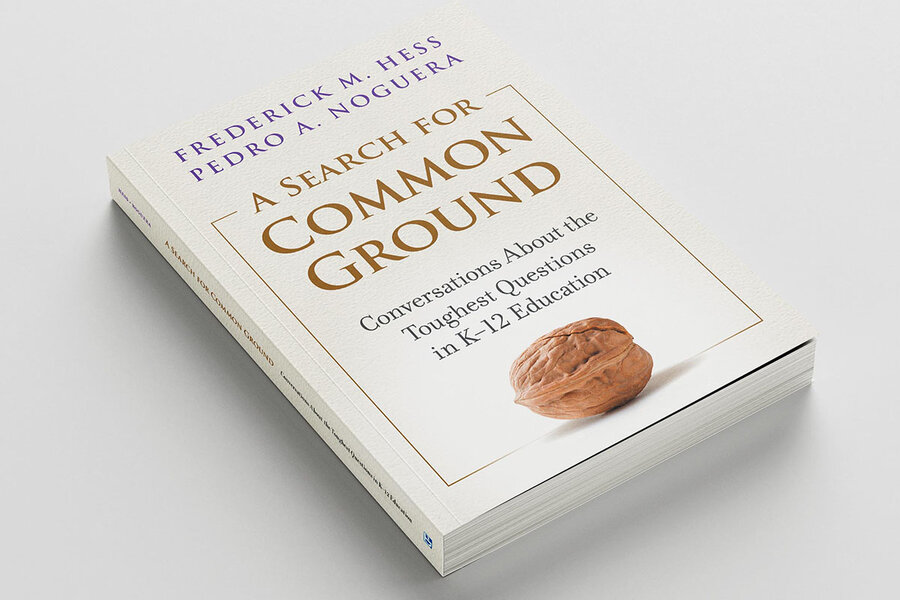
Frederick Hess and Pedro Noguera turned their correspondence into a book, “A Search for Common Ground: Conversations About the Toughest Questions in K-12 Education,” published by Teachers College Press.
Back in the days before Covid, my friend Nancy bravely participated in a political discussion group organized by the town’s Council on Aging. The idea was to bring together people on different sides of the divide to listen respectfully and express their views calmly. She found it fascinating, but the respectful and calm aspect ultimately disintegrated and the group is no more. The lesson, I think, is that it can be hard work to do this and everyone needs to remember that an opponent is still a human being.
Chelsea Sheasley has a story at the Christian Science Monitor about two educators who managed the challenge well enough to publish a book on it.
“Rancor over COVID-19 policies, diversity and equity initiatives, and school choice,” she writes, “has divided communities and supercharged school board meetings. Is there any way to find common ground about education amid such divisions? Some people say yes.
“Frederick Hess and Pedro Noguera, two education policy leaders, published a book [in 2021] – A Search for Common Ground: Conversations About the Toughest Questions in K-12 Education – made up of in-depth emails they shared over seven months to better understand each other’s beliefs and unearth hidden agreement. They currently host a podcast, Common Ground, with recent episodes tackling the role of parents in education and anti-racist education.
“The authors describe themselves in the book’s preface as having ‘spent much of the past few decades on opposing sides of important educational debates, with Pedro generally on the Left and Rick mostly on the Right.’ Dr. Hess is director of education policy studies at the American Enterprise Institute, a conservative Washington think tank, and Dr. Noguera is dean of the Rossier School of Education at the University of Southern California in Los Angeles.
The goal of their exchange, the two write in the book, is to offer a model for those who ‘desire to disagree with grace and explore differences without rancor.’ …
“Fred Campos, from Bedford, Texas, is an elected school board member of the Hurst-Euless-Bedford Independent School District. He was assigned to read the book for a leadership training program he’s participating in with the Texas Association of School Boards (TASB).
“Mr. Campos listened to the audio version of the book twice and says he ‘loves the premise that we should not go to the extremes.’ As a second-term board member, he’s adjusting to a ‘new era’ of more polarization and increased attendance after a fairly quiet first term. The book helped him better understand why some in his community wanted a mask-optional policy – which differed from his position in favor of mask mandates.
“ ‘One thing I think both authors did well is they were complimentary of one another, respectful, and that modeling is huge, whether you’re dealing with parents, other board members, or staff,’ Mr. Campos says. …
“One November night in 2019, Dr. Hess says he was sitting in his office, staring into space, and pondering how to actually model a different style of conversation. He started thinking about who was someone who disagreed with him on major issues and might be willing to engage in a civil dialogue.
“ ‘Education is supposed to be about teaching kids how to wrestle with things, how to look past our differences, and it felt like rather than leaning on this, we’ve been as bad as anyone,’ he says in a phone interview. ‘So I finally said, “I’m a big fan of ‘light a candle rather than curse darkness,’ ” … so I picked up the phone and called Pedro, and he was great about it.’
” ‘I immediately said yes because I appreciated the need for dialogue on these issues, and like him, I was frustrated by the tenor of the debate and the kind of paralysis that I would say characterize the field,’ says Dr. Noguera.
“The two wrote emails to each other from January through July 2020, on 11 hot-button education topics such as school choice, the achievement gap, testing and accountability, diversity and equity, and teacher pay. They also addressed major events that hit while they were writing, such as COVID-19, the shuttering of schools, and the murder of George Floyd.
“Both men say they were provoked at various times by each other’s viewpoints. Because they were communicating in writing, they had time to reflect before responding and gather evidence to back their points. The two found areas of common ground on nearly every topic, especially on teacher pay and testing, after airing their differences.
“In a joint Zoom interview with the Monitor, the pair easily banter with each other, but say it took time to develop rapport. They’re often asked for advice on how to start difficult conversations. Dr. Hess says he thinks anyone can do it, but it takes certain skills.
‘It takes an interest in listening to one another. It takes the habit of pausing on your first “that’s wrong” in order to listen, hear them, and ask a question instead of pushing back,’ he says. …
“Kay Douglas is a former school board member, a senior consultant at TASB, and the instructor who assigned Common Ground to the leadership cohort that Mr. Campos is a part of. She says the book offers a valuable example of intentionally trying to understand and work with others.
“ ‘Otherwise, we are going to self-destruct. People are so stressed and the stress level keeps going up,’ she says.
“For Dr. Noguera, learning how to debate respectfully was something he learned around his kitchen table. When he was growing up, his dad, an immigrant from Trinidad, was a police officer in New York City. He would sometimes bring home friends with conservative views on crime.
“ ‘I was a kid and I’d listen to these conversations and get angry, but because they were adults and I was a kid and I wanted to engage, I had to figure out how to do that respectfully because my parents insisted on respect,’ he says.
“As a professor, Dr. Noguera has invited people who disagree with him on policy to debate him in his classes, because he thinks it makes his ideas stronger and shows that people can disagree ‘without attacking an individual’s personhood.’ Conjuring up the worst intentions about other people, he says, is unproductive and unhealthy for democracy.”
More at the Monitor, here. Although it is not mentioned here, perhaps because the book is based on emails, I’m thinking that tone of voice matters a lot, too.

 Suzanne's Mom's Blog