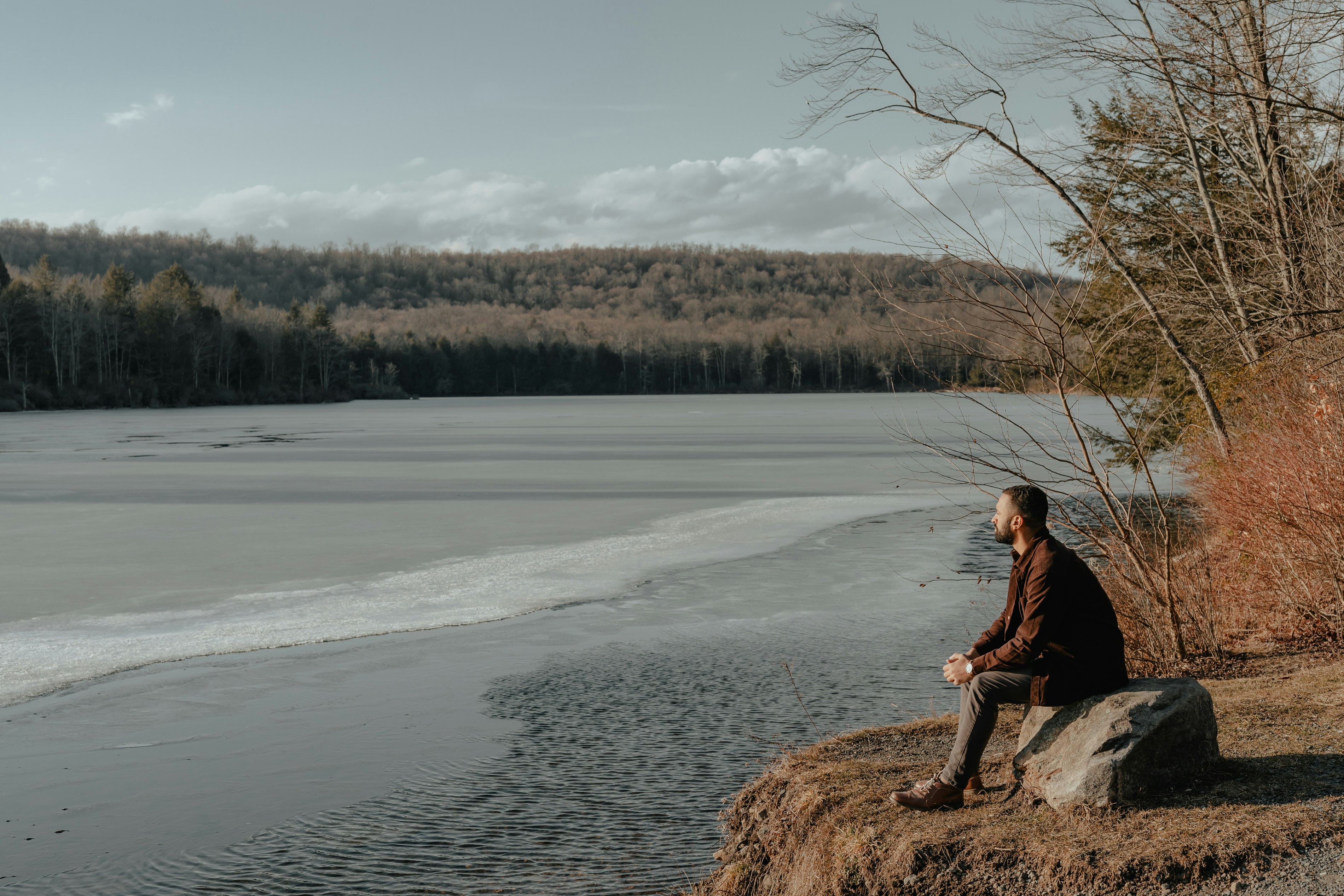
Photo: Clay Banks/Unsplash.
It’s important to know when to be active and when to just do nothing.
I’m worried about the election. I just made more donations to the get-out-the-vote groups I trust. It’s important to do more than worry. It’s important to do something.
But there are also times when it’s important to stop tying yourself up in knots and just do nothing. Maybe not for a solid year as described in today’s article, but when you need renewal.
Holly Williams writes at the BBC about the “slow-living” movement.
“How does the idea of doing nothing for a year sound? No work, no emails, no career progression, no striving or achieving or being productive. For many of us, such a thought might once have brought its own anxiety attack – surely, work is status, earning money is achievement, and being busy is a brag? But these days, a year of nothing is more likely to sound dreamy, even aspirational – there has been, as they say, a vibe shift.
“Millennials are embracing the concept of #SlowLiving – the hashtag has been used more than six million times on Instagram (despite posting on Insta being fairly antithetical to its principles of a mindful, sustainable lifestyle, with much reduced screen-time). Gen Z, meanwhile, have pioneered quiet quitting and ‘lazy girl jobs,’ where one does the minimum at work to preserve your energy for the more meaningful parts of your life. …
“This is something Emma Gannon knows all about: the prolific author, podcaster, and Substack entrepreneur published A Year of Nothing – her account of taking an entire 12 months off – earlier this year. It quickly sold out when published earlier this summer, and has proved so popular it will now be reprinted and available to buy in November.
“Not that it was, initially, a lifestyle choice: Gannon suffered such extremely bad burnout, she had no choice but to stop working. Her account of her year of rest and recuperation is now published in two small, sweetly readable volumes by The Pound Project, charting her journey back to health via gentle activities such as journaling, watching children’s TV, birdwatching, and the inevitable cold-water swimming. …
“Having been fully on-board with the girl-boss culture of the 2010s, Gannon had already stepped away from that with her last book, The Success Myth: Letting Go of Having It All, which explored how relentlessly striving for success rarely brings true happiness. But it was experiencing complete burnout that forced her to really confront the importance of rest.
” ‘Looking back, there were lots of red flags – feeling very confused, pulsating headaches, not being able to focus on things in the room, quite scary stuff. But I over-rode it, [thinking]: “I’m busy, I’ve got to crack on,” ‘ she recalls. Suddenly, in 2022, her body went into a forced shut-down mode. ‘Couldn’t look at a phone, couldn’t look at a screen, couldn’t walk down a street without feeling fragile. …
” ‘Many people with chronic burnout have to get to that point before they’ll take time off [work], because we’re so conditioned in this society to push through at all costs.
” ‘But we were designed to have naps, and [walks in] the park. To go for a swim, and look at the sky. That stuff’s really important,’ Gannon insists. And she’s determined to carry the lessons from her burnout, and her recovery, into a slower, more spacious life. …
“Jenny Odell’s How to Do Nothing: Resisting the Attention Economy became a sensation in 2019, linking our frazzled brains to how profit-hungry technology and social media use up our attention and distract us. She advocated re-wiring our awareness to the natural world around us, and to our own interiority.
“Odell is also part of a wave of writers encouraging active resistance to the relentless ‘goal-oriented’ expectation that, ‘in a world where our value is determined by our productivity,’ every hour and minute of our time should be put to good use – if not at work, then in self-improvement. Resisting the pressure to always be optimizing can also be found in Oliver Burkeman’s surprisingly comforting 2021 book Four Thousand Weeks – which reminds us that life is brief, and we will never get everything on our to-do list done. Rather than seeking to be ever-more efficient, he argues that we should focus on what really matters … and live more fully in the present.
“And it seems the idea of doing nothing is catching on: you may have noticed the recent proliferation of titles about niksen, the Dutch term for ‘doing nothing, intentionally.’ Olga Mecking’s book Niksen clearly chimed with readers when published in the pandemic, and has been followed by a wealth of others, many in the Little Book of Hygge mold. …
“Even the word ‘rest’ itself has become something of a buzz term. Published in 2022, Pause, Rest, Be by yoga teacher Octavia Raheem helps readers going through big changes or periods of uncertainty to slow down and turn inwards. Rather than using yoga to sweat your way to Instagrammable tight abs, she emphasizes what the practice can tell us about self-knowledge, peace and stillness.
“The Art of Rest by Claudia Hammond also has a practical bent: its chapters lay out the 10 most relaxing activities identified in global research, as well as arguing for the importance of intentional winding down – whether that be taking a bath or reading a book or spending time in nature. ‘Rest is not a luxury,’ Hammond writes, but ‘a necessity.’ Meanwhile Katherine May’s book Wintering has the subtitle The Power of Rest and Retreat in Difficult Times, and forms a lyrical account of the author learning to accept the seasonality of life: that there are fallow periods when, rather than pushing on through, we need to step back and nurture ourselves.”
Lots more at the BBC, here. No firewall.

 Suzanne's Mom's Blog