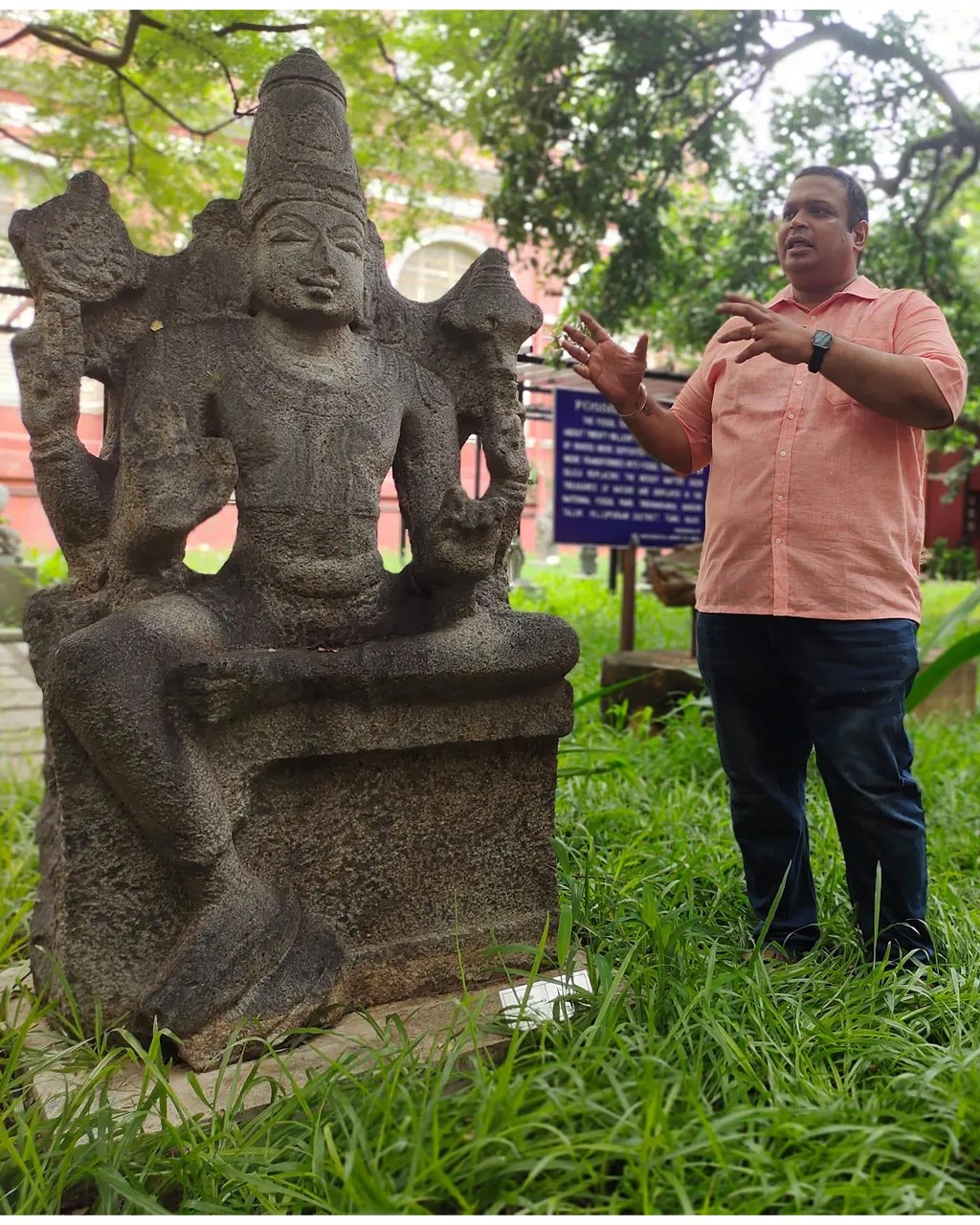
Photo: IPP [India Pride Project].
S Vijay Kumar, above, “travels through India, documenting artifacts and investigating the trail of missing objects online,” says the BBC.
For how many millenia have travelers thought it was perfectly fine to pick up local art objects and take them home, perhaps eventually donating them to museums? Today the looted countries are saying, “Wait a minute–that’s mine.”
Charukesi Ramadurai writes at BBC “Culture” that volunteers in India have started doing something about these thefts.
The story starts with recent speculation concerning the coronation of King Charles III, when many eyes in India were turned toward the Queen Consort and the “the contentious Koh-i-Noor diamond.” Would she wear it? She did not.
“While the palace has not made any official statement about the reason,” Ramadurai reports, “there were worries about it causing diplomatic issues with India, if it had been used, given the country’s claims to be its rightful owner. …
“The Koh-i-Noor, first found in written records in 1628, has long been the subject of acrimony between India and its former colonizer, with a persistent demand by the Indian government and its citizens for its return. As this piece in India’s Mint newspaper explains bluntly, ‘The main controversy around the diamond is that the British give an impression to its younger generation that the Koh-i-Noor was a gift from India and make no official mention of the violent history behind acquiring it.’
“The renewed uproar about the Koh-i-Noor has also led to intensifying questioning of all the other resources – not just the sparkly stones – taken away from the Global South by western powers over centuries of trading and ruling. ‘Wear the diamond, give back the rest,’ suggests this op-ed piece in The Indian Express.
“Among the ‘rest’ are priceless cultural artifacts – and this is what the India Pride Project concerns itself with. This citizen movement for the restitution of stolen and smuggled antiques (particularly statues) from public museums and private collectors across the world was started in 2013 by shipping executive S Vijay Kumar and public policy expert Anuraag Saxena from Singapore. …
“These sleuths, with the help of a small, anonymous global team of volunteers from various fields – who communicate mostly online – have brought back to India several millions worth of antiquities from countries like Australia, Singapore, Germany, UK and the US.
“Most recently, they made the news when their efforts aided the investigation that prompted the National Gallery of Australia to return antiques worth $2.2 million – stolen by art smuggler Subash Kapoor – to the Indian government. Their targets include both artifacts taken forcibly out of India during the British colonial era, and those more recently stolen and smuggled from temples and public collections.
“Kumar, who is now based in Chennai in south India, and Saxena, who remains in Singapore, talk with ease about field trips to document missing idols and sting operations with auction houses. … This is not to suggest they are some kind of gung-ho art vigilante group, given the amount of plodding through paperwork and complex negotiation work they do. Their work involves advocacy, activism and coordinating between governments and law enforcement agencies such as Customs, Europol and Homeland Security within India and outside. Kumar says, ‘In the past when they reached out to India, nobody replied, so now we are doing that job.’
India Pride project is more of a network than an organization – we have no money, no employees and no authority,’ admits Saxena candidly, even a tad proudly.
“Art expert and former Egyptologist at the British Museum, Lewis McNaught, who now runs Returning Heritage, an online resource about cultural restitution, thinks the IPP model of citizen activism is intriguing. ‘They go out and actively source information using a social network of supporters. And only when they are able to confirm that the object has been stolen, do they approach the government, which in turn applies pressure on the museum or other governments where the object is being held.’
“There has been an established pattern of theft and trafficking of valuable art and artifacts from poorer countries in Asia and Africa to richer nations in the West – either directly by colonizing forces or in more recent times, through a sophisticated network of smugglers.
“In his book The Anarchy: The East India Company, Corporate Violence, and the Pillage of an Empire (and in various other places), writer and historian William Dalrymple has called out the looting of thousands of priceless objects from India to Britain by the employees of the trading East India Company. …
“Long after the colonizers have retired, there still remains a flourishing multi-billion-dollar black market in stolen antiquities. Serendipitous discovery is rare, such as this story from the 2018 Met Gala when Kim Kardashian took a photo in her sparkling gold gown twinning with a resplendent golden mummy. The photo drew attention to, well, the mummy, which was then detected to have been smuggled out of Egypt unnoticed in the chaos of the 2011 Arab Spring, making its way into New York’s august Metropolitan Museum of Art. The ensuing media outcry forced the Met – which had paid $4 million for fake documents – to return said mummy to Egypt.
“And before anyone feels too sorry for this museum’s loss, it is important to know that despite the 1970 Unesco Convention aimed at ending the illicit trade of antiquities, museums including big ones like the Met and The British Museum (the largest receiver of stolen goods, some say) have continued to buy from art thieves such as the now-convicted Subhash Kapoor. Kumar, who has written about his long pursuit of Kapoor in his book The Idol Thief, says this is simply because of the standard market economics of supply and demand. In a 2020 piece for the New Indian Express entitled: ‘When the buying by museums stops, the looting stops,’ Kumar called out museums for turning a blind eye to the origins of coveted antiquities.”
More at the BBC, here. No firewall.

 Suzanne's Mom's Blog