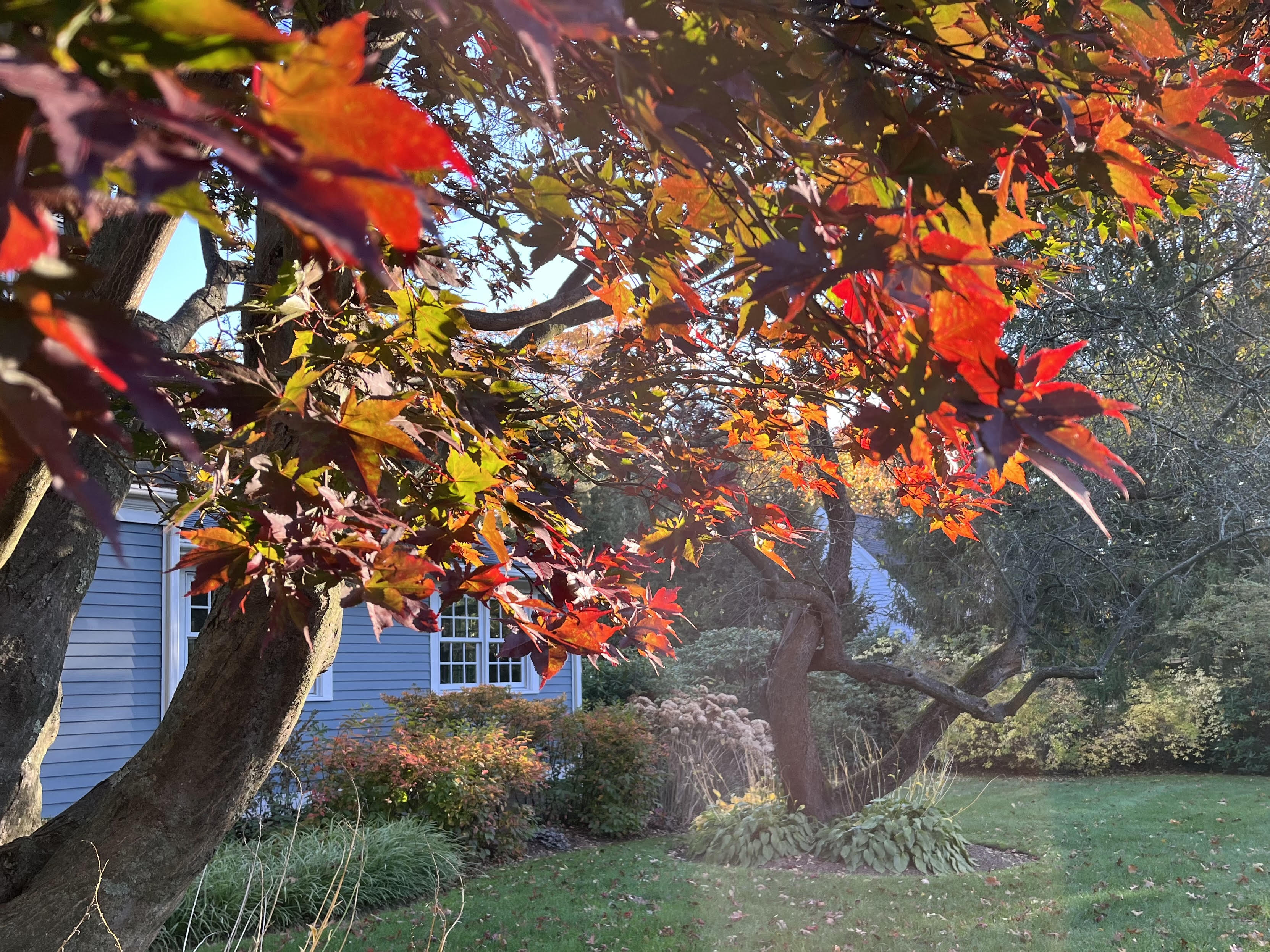
I’m taking it a bit easy as I recover from Covid, but I wanted to show you how things have looked around here lately. The photos are mostly from my routine walks along the road by the golf course. Sometimes I take golf course pictures and send them to Lynn in Florida, where she can play all year. I love the long early-morning shadows. Soon the hills and sand traps will be covered in snow.
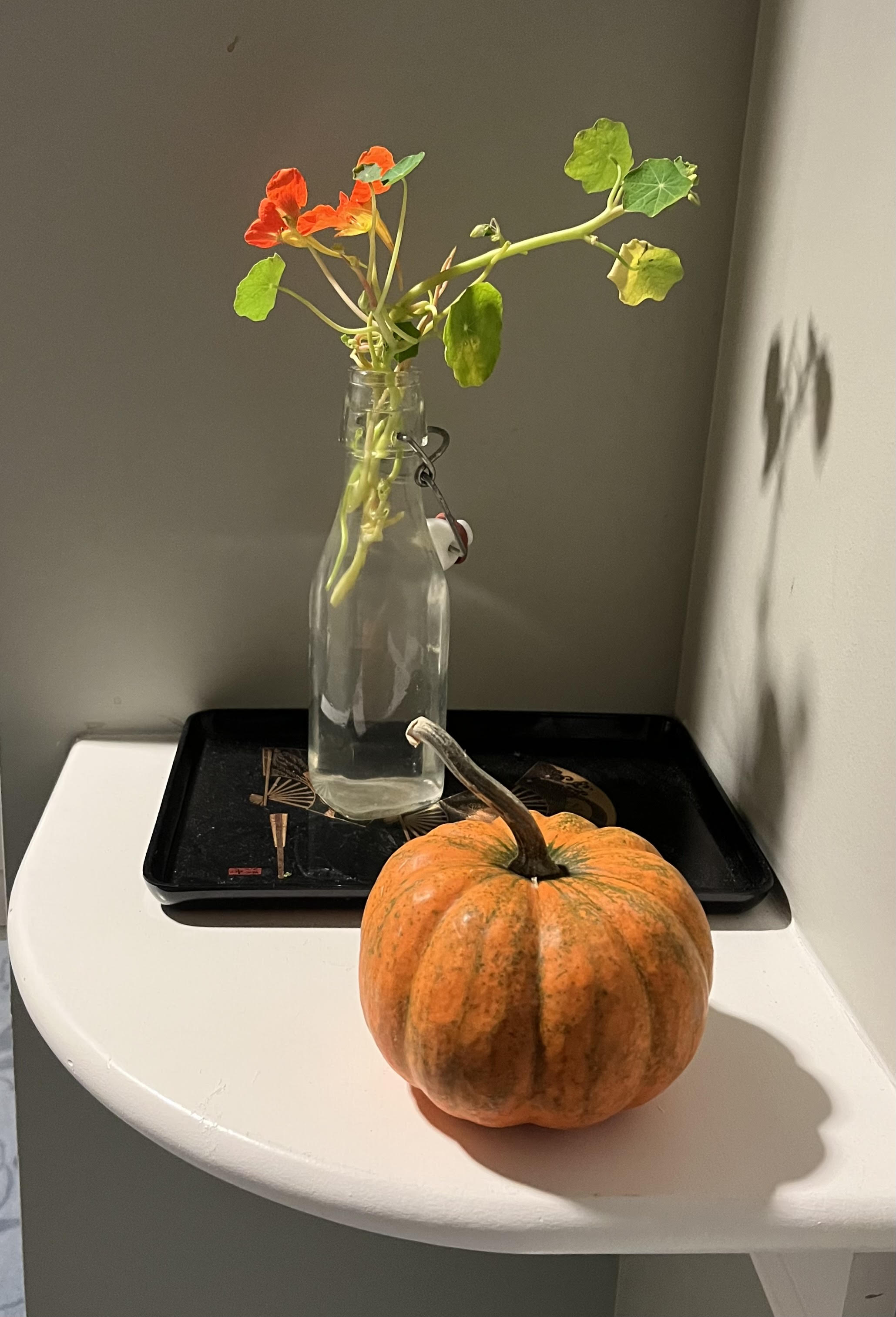
The other photos include samples of fall color that came late this year, the foggy river, wet leaves, a last nasturtium, and feathery grasses.
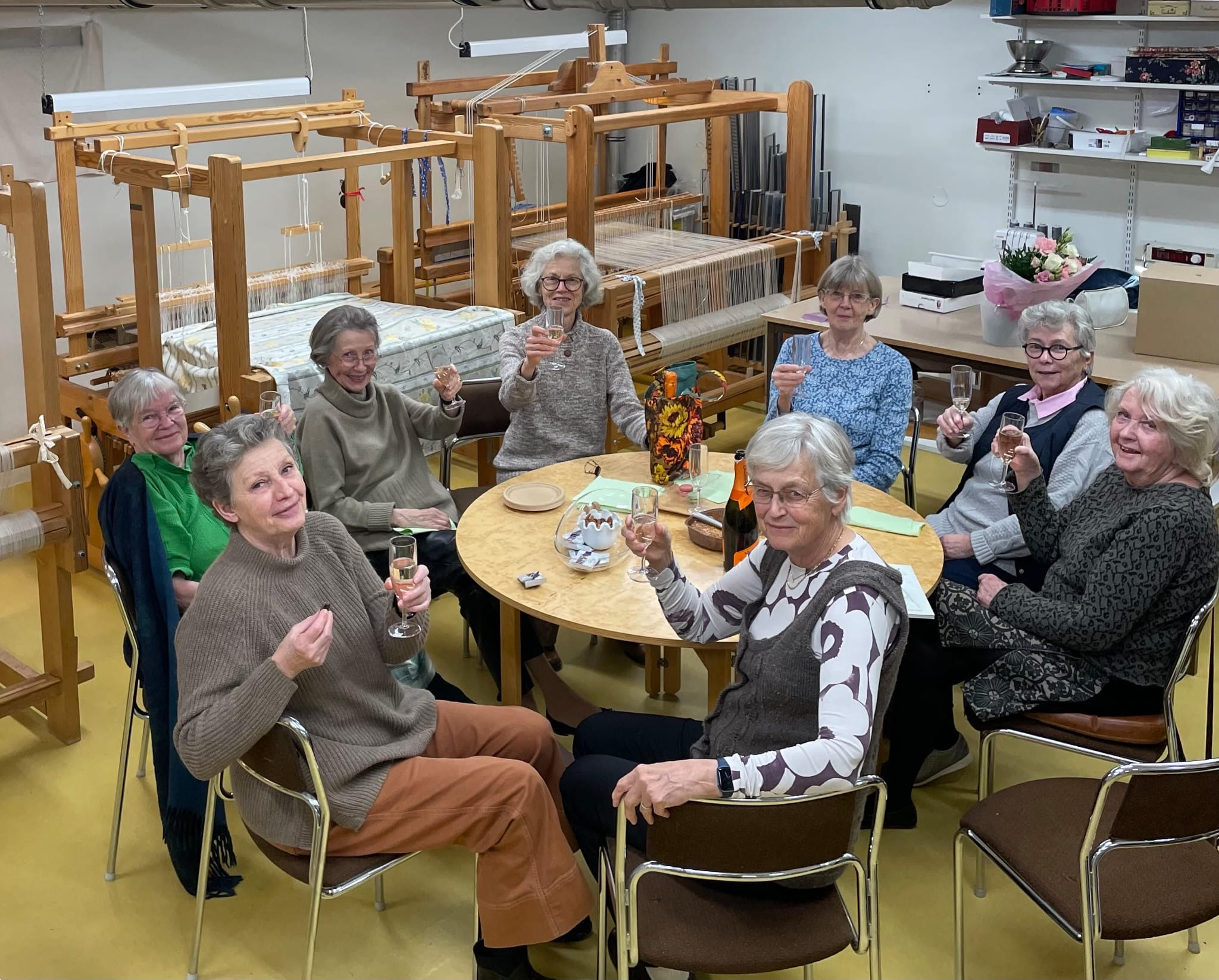
Erik’s mom sent the last picture. She, too, has moved into a retirement place, but in Sweden. The photo shows her lifting a glass with other residents celebrating their 80th year. Don’t you love the looms?
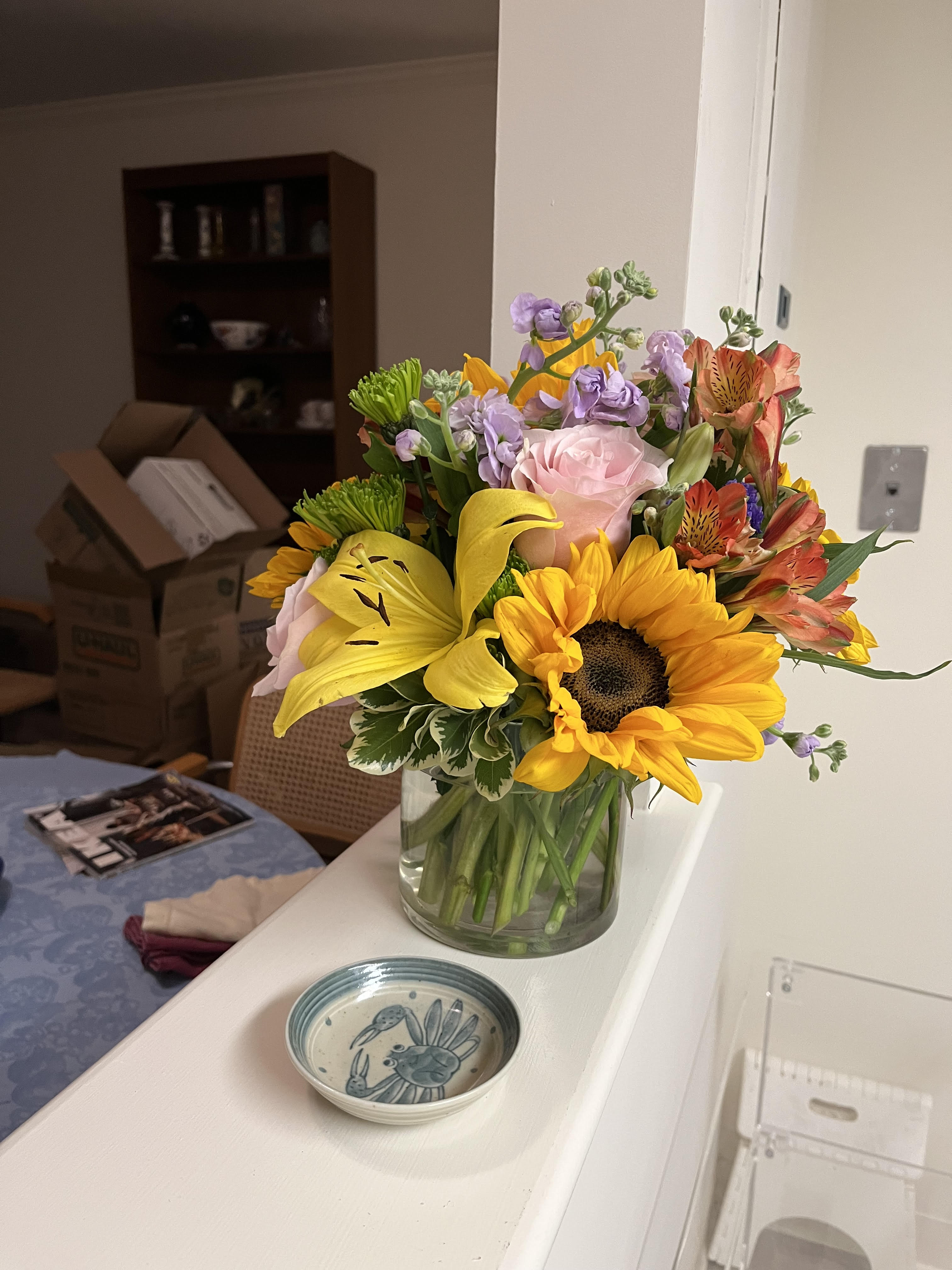
Photo: Suzanne and John’s Mom. Flowers from some staff to inaugurate our move. Note the packing boxes in the background.
A story could be written about the move to a retirement community. But what kind of story? Richard Osman of Thursday Murder Club fame saw the possibilities of all the aging expertise in such places for solving crimes, so he launched a mystery series.
Maybe something more literary would be in order, along the lines of Katherine Mansfield or the late Edith Pearlman, who sometimes wrote stories about aging.
Some folks might see the Twilight Zone aspect — but in a good way.
I better explain. When you go to a Place, you pretty much know it’s your last stop. It’s the place where you will decline, get more hard of hearing, have trouble walking, break a bone, get it fixed, and eventually die. The look of new people arriving there is invariably both anxious and relieved. The relieved end is more prominent for me right now.
You get introduced at a new-resident party, and longtime residents need no encouragement to step up and welcome you, talking about cool events (and committees), and helping you figure out how things work. I was delighted to find someone who maintains a garden plot and told me where I could compost my vegetable scraps.
These folks have already gotten used to the idea that it’s the last stop, and they are really happy to be in a place with lots of friends, interesting things to be part of, and — when trouble arises — all kinds of help. I observed an impressive level of comfort with infirmities. No one blinks if you have to ask a couple times for someone to repeat, and I saw folks with fairly severe infirmities who are still in charge of various things.
I knew one person here, only slightly, and she was very welcoming. I did see lots of familiar faces as we have lived in the town more than 40 years. Blogger/singer Will McMillan performs at this place several times a year with pianist Joe Reid, and he paved the way for me to make another friend.
Although boxes still aren’t unpacked and lots of things still feel kind of up in the air, we are doing OK. The dinners are very good. I don’t think I will be having to use our new kitchen much, and that is welcome.
PS. I am awkward with using Google photos but want you to see a funny video of our young movers. Can you figure out how this works?
My move manager took it, so in case it is locked or something, I will tell you that the three moving guys admired a big gong in the house and I told them each to take a turn with the mallet. It was pretty cute.
Photo: Folger Theatre. Actor/director Holly Twyford got interested in a new kind of theater project during the pandemic.
How many of us began pandemic activities that we liked enough to keep? In my case, being obliged to do my volunteering via Zoom showed me there is often a greater feeling of individual connection when I can see English students’ faces up close on screen instead of in a large room. What new way of doing things did you decide to keep?
In one example, an actress was invited to teach elderly shut-ins during the down time and found she liked it. Peter Marks reported the story for the Washington Post.
“In the courtyard of an independent living residence in Rockville, Md., Holly Twyford brought her acting class to order. With the script of Spoon River Anthology in front of them, one of her students, 93-year-old Shelly Weisman, recited the words of Lucinda Matlock, a character who speaks of a marriage that lasted seven decades.
“ ‘I spun, I wove, I kept the house, I nursed the sick. I made the garden, and for holiday rambled over the fields where sang the larks,’ Weisman declaimed, as Twyford — long one of Washington’s premier actors — listened.
“ ‘I love that piece,’ Twyford said at last.
“ ‘I do, too,’ Weisman replied. ‘I love her.’
“And so it went for an hour with Twyford and several residents of Ring House, in the Charles E. Smith Life Communities, off Rockville Pike. Organized by Theater J, an arm of the Edlavitch D.C. Jewish Community Center, the class wasn’t just an exercise to nourish the artistic spirits of theater-loving seniors. It was an invigorating lifeline, too, for Twyford. Sidelined by the pandemic from pursuing her customary evenings-and-matinees vocation, the actress was hired by Theater J Artistic Director Adam Immerwahr to teach enrichment courses and earn some needed cash.
“ ‘The pandemic has been a nightmare for us who depend on large, live audiences,’ said Twyford, a ubiquitous presence on Washington stages, in everything from Shakespeare to Sondheim. When covid-19 collapsed the theater industry, Twyford lost two acting and two directing jobs.
‘I can only say Adam subsidized many out-of-work actors and directors by saying, “Hey, you should teach a class.” … That’s what he did for me.’ …
“Theater J, with only a handful of full-time staffers, took on a sizable mission, hiring dozens of theater folk to teach more than 50 classes, most of them virtual. …
“Angela Hughes, a die-hard theatergoer who lives in Northern Virginia, has enrolled in 16 of Theater J’s virtual classes. ‘It was a way to have theater in my life,’ she said in a phone interview. …
“The combination of pandemic isolation, audience fascination and artist deprivation created highly favorable circumstances for Theater J’s initiative: From July 1, 2020, to June 30, more than 700 people from 23 states and Israel, Canada and Australia took the company’s Zoom courses, according to Immerwahr. During that period, he has paid out more than $40,000 in fees to his improvised faculty.
“That might not boil down to a king’s ransom — national philanthropic organizations, such as the Actors Fund, have doled out millions. But every extra paycheck helps when one is scrambling.
“ ‘At times, it’s been serious,’ Immerwahr said of the need in the D.C.-area theater community. ‘We’ve had people who couldn’t qualify for unemployment, because they worked in seven different states.’
“Naomi Jacobson, another familiar talent to Washington theatergoers, has taught six courses for Theater J, including ‘Inside the Actor’s Process’ and ‘Inside the Rehearsal Room: “Collected Stories,” ‘the latter with actor Emily Whitworth and Immerwahr. ‘I had nine months of work lined up, and it all went away,’ she said, noting that she took her pension early to make sure she and her husband, actor John Lescault, could pay their mortgage.
“While Lescault carried on in the recording booth in their basement for his side business, narrating books for the Library of Congress, Jacobson built up a coaching practice for actors and public speakers in other professions. How she’ll balance the pedagogical pursuits with her acting life remains an open question: She is scheduled to return to the stage in September to portray Ruth Westheimer in Mark St. Germain’s one-person Becoming Dr. Ruth at Theater J. …
“It so happens that Twyford is directing Jacobson in the piece, a process they began before the shutdown. When that assignment abruptly ended, Twyford [says] ‘I did apply for a job at a hardware store, and I was turned down,’ she said. ‘I know tools and I build things, and it was really harsh to get that rejection.’
“But Immerwahr came calling, which was why on this warm August day, Twyford had driven to Rockville to teach the weekly sessions of her monologue-preparation class to students in their 80s and 90s, one at Ring House and another at its sister building, Revitz House. …
“The students had been asked to choose speeches from the script, a compendium of the more than century-old poems that make up Edgar Lee Masters’s cycle of ordinary townsfolk, narrating their personal tales from the afterlife.
“Weisman wasn’t sure at first about the material. ‘I said, “Why on earth did you pick this? It’s people speaking from the grave! We’re close to the grave!” ‘ The teacher thereby learned quickly that these pupils were not shy about speaking up. …
“Over several weeks of talking and rereading, though, she came to understand the value of immersing herself in the persona and hardships of her character. ‘As I was reading it over and over, it became much more real to me,’ Weisman said. ‘Every life has disappointment and tragedies. Lucinda didn’t dwell on it.’ …
“[Says Twyford] ‘Shelly asked me, “What have you learned about 90-year-olds?” I gotta say, talk about some role models! … These folks, they just haven’t stopped learning.’ “







 Suzanne's Mom's Blog