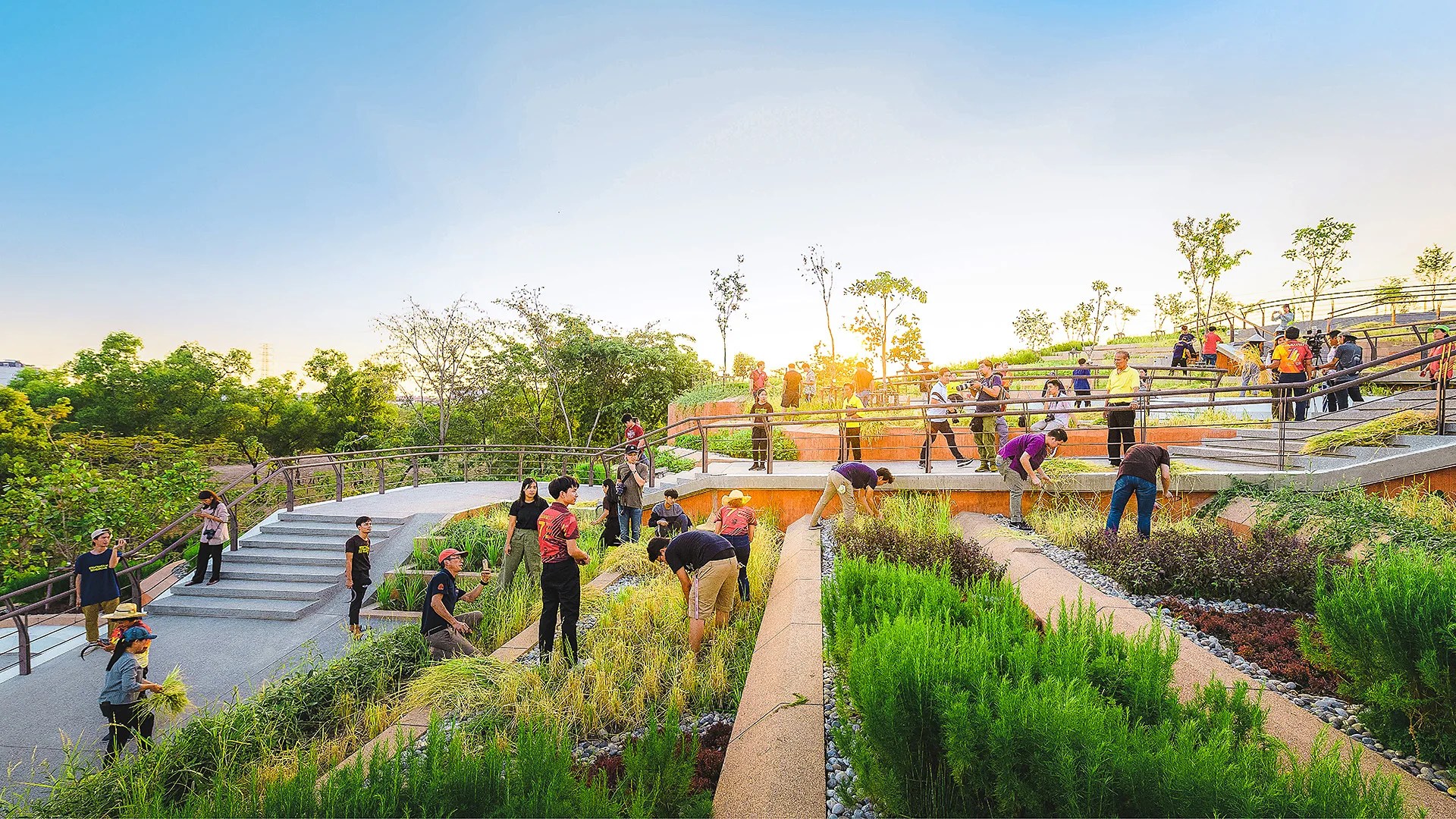
Photo: Panoramic Studio/Landprocess.
Thammasat University’s rooftop farm features cascades of rice paddy-style terraces used to grow organic crops.
Here in the US, we are all preoccupied with floods because we’re in the midst of an extreme hurricane season. So it seems strange to think of places where a certain amount of flooding is desired — rice paddies.
Xiaoying You at the BBC writes about what can be learned from ancient techniques for controlling rice-paddy flooding.
“One of Kotchakorn Voraakhom’s most memorable moments growing up in Bangkok in the 1980s was playing in floodwaters in a small boat built by her father in front of her home.
” ‘I was so happy that I didn’t need to go to school because we didn’t know how to get to it,’ recalls Voraakhom, a landscape architect based in the Thai capital.
“But nearly 30 years later, flooding turned from a fun childhood recollection to a devastating experience. In 2011, Voraakhom and her family – along with millions of others in Bangkok – found themselves ‘displaced and homeless‘ when floods plowed through swathes of Thailand and poured into the metropolis. …
“The disaster deeply shook Voraakhom, who believed it was time to use her expertise to do something for her hometown. She founded her own landscape architecture firm, Landprocess, which over the past decade has designed parks, rooftop gardens and public spaces in and around the low-lying city to help its people increase their resilience to flooding.
“Perhaps her most intriguing design so far has been an enormous nature-laden university roof inspired by rice terraces, a traditional form of agriculture that has been practiced in Asia for some 5,000 years. …
“The university roof designed by Voraakhom is part of a wider trend in Asia that is seeing architects seek inspiration from the region’s rice terraces and other agricultural heritages to help urban communities reduce waterlogging and flooding. …
‘The answers to the future of climate change, many of them are actually in the past,’ says Voraakhom.
“At Thammasat University, north of Bangkok, tiers of small paddy fields cascade down from the top of the building along Voraakhom’s green roof, allowing the campus to collect rainwater and grow food.
“There are four ponds around the building to catch and hold the water flowing down. On dry days, this water is pumped back up using the clean energy generated by the solar panels on the roof and used to irrigate the rooftop paddy fields. …
“Compared to a design made of concrete, the green roof can slow down runoff – excess rainwater that flows to the ground, a big problem for Bangkok – by about 20 times, according to estimates from Voraakhom. It can also lower the temperature inside the building by 2-4C (3.6-5.4F) during Bangkok’s notoriously hot summer, she says.
“Rice terraces are layer upon layer of paddy fields usually created by smallholder farmers along the sides of hills and mountains to maximize the use of land. They can be found in many Asian countries. …
“While their shapes and sizes may vary, all rice terraces are built to follow natural contor lines, which means each layer has equal elevation above sea level. This feat enables them to collect and hold rain and use it to nurture the soil and crops. Some rice terraces, such as those of the Hani people in southern China, overlook rivers, allowing the tiered soil to reduce, decelerate and purify excess rainwater washing down from the top of the mountain before it flows into the valley.
“Such indigenous know-how, passed down by generations of small-scale farmers, can hugely benefit Asian cities when it comes to handling rainstorms, according to Yu Kongjian, a professor of landscape architecture at Peking University in Beijing and the brains behind China’s ‘sponge city’ concept. …
“Chinese cities – as well as many others in Asia – have a monsoon climate, which is characterized by rainy summers and drier winters. … Huge downpours mean their flood-control measures need to be based on localized ways of adaptation tested and proven over thousands of years, he argues.
“Rice terraces are one of the pillars of Yu’s spongy city theory, which urges cities to turn to soil and greenery – not steel or cement – to solve flooding and excess rainfall problems. According to him, rainwater should be absorbed and retained at the source, slowed down in its flow and then adapted to where it ends up. Rice terraces deal with mitigating floods at the source, Yu says. …
“The Yanweizhou park, for example, completed in 2014 in Jinhua, Yu’s hometown, has a rice-terrace-like bank planted with grasses that can adapt to an underwater environment. The spongy feature is capable of reducing the park’s yearly maximum flood level by up to 63%, compared with a concrete one, a 2019 paper found.
“Such designs can also filter floodwater, which is often contaminated by sewage, chemicals and other pollutants. Another of Yu’s projects, Shanghai Houtan Park, is situated on a piece of once highly polluted land that used to house a landfill site for industrial waste. Since its establishment in 2009, each hectare of the park, which also features Yu’s terracing element, is capable of purifying 800 tons of heavily polluted water per day.”
Read about related flooding projects at the BBC, here. Fascinating photos.

 Suzanne's Mom's Blog