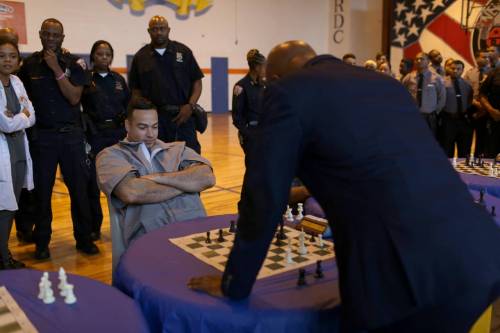
 Photo: Bess Adler for The Wall Street Journal
Rikers Island inmate Camilo Arcelay faced off against chess grandmaster Maurice Ashley at the Rikers Island jail complex.
I like articles about better ways to prepare prison inmates for a return to society. In this 2015 post, for example, I wrote about a jailhouse debate club that beat Harvard, raising the spirits and aspirations of prisoners at the Eastern New York Correctional Facility.
Today’s story concerns a serious chess competition in a notorious New York City prison.
Zolan Kanno-Youngs at the Wall Street Journal writes, “On a rainy afternoon at the Rikers Island Jail Complex [in October] five men and one woman wearing tan uniforms sat in front of chess boards surrounded by an audience of correction officers and fellow inmates.
“Maurice Ashley, a 2003 U.S. Chess Federation grandmaster of the year walked from one board to the next, simultaneously playing six games. One by one, he eliminated the inmates — except for Camilo Arcelay, 37 years old, who used his king to take Mr. Ashley’s last pawn. That left Mr. Arcelay and Mr. Ashley with a king as their last piece.
“The result was a draw — enough for Mr. Ashley, who also judged the event, to name Mr. Arcelay the winner of the first chess tournament, which is slated to become an annual event at Rikers Island.
“ ‘To be in a situation that I’m in right now in jail, it leaves me speechless,’ Mr. Arcelay said, referring to his chess victory. ‘Because I’ve made so many bad decisions to be here.’
“The final round of the 2-month tournament is part of a series of programming designed to educate and reduce idleness funded by a $38.9 million New York City initiative.
” ‘It teaches them how to think, how to strategize, in an environment that is conducive to those things,’ said James Walsh, department of corrections deputy commissioner of adult programming & community partnerships.
“While this was the first official tournament at Rikers, chess has long been popular behind bars. Carl Portman, 53, the author of Chess Behind Bars, and the manager of prisons chess for the English Chess Federation, said the game’s history in prisons dates to World War II, when inmates would create chess pieces from scrap materials, and differentiate the two sides by using coffee powder to dye some pieces. …
“At Rikers, the seed for the tournament was planted two years ago when corrections officer Gregory Lamb bought a chess set so he could play with 16- and 17-year-old inmates. Prison officials soon asked him to organize sessions with adult inmates twice a week. That evolved into the tournament organized by the corrections’ Adult Programs Unit that began two months ago with 800 inmates participating.
“ ‘Inmates are probably the best chess players because they play all day,’ Mr. Lamb noted. …
“During the games, inmates stood on bleachers cheering, critiquing and moving their arms on imaginary boards as if they, too, were participating.
“ ‘Society wastes so much when we don’t channel the energy and capabilities of those who have been incarcerated,’ Mr. Ashley said.”
More at the WSJ, here.


 Suzanne's Mom's Blog