Feeds:
Posts
Comments

Posts Tagged ‘rodeo’

Photo: Jeff McIntosh/Associated Press.
Emma Eastwood stretched before competing in women’s ranch bronc during rodeo action in Alberta.

I’ve mentioned before how interesting it was to me that my husband’s director of manufacturing at the Maple Grove company was a bull rider on the side. We told Craig we’d love to see a Minnesota rodeo, and he sent us off to nearby Buffalo, where we had a wonderful time.

In today’s story, we learn about the rising numbers of women getting a kick out of riding bucking broncos.

The Associated Press (AP) reports, “Sophia Bunney launched the first time she tried ranch bronc riding, landing ‘quite a ways away from the horse.’

“ ‘I’m very stubborn, and I don’t like being defeated,’ said the 18-year-old from Cessford, Alberta.

“In other words, the teenager was hooked on a sport that pits women against bucking horses for eight seconds.

“ ‘I always kind of wanted to hop on a bronc,’ Bunney told the Canadian Press. ‘In Grade 3 … I said I wanted to be a female bronc rider.’

“Unlike saddle bronco riding, a rodeo mainstay, ranch bronc uses a regular western saddle — not a specialized one — and riders hang on with two hands instead of one. A hand is on a rein and the other on a strap wrapped around the saddle horn.

“Pearl Kersey, who won the Canadian women’s ranch bronc title [recently] in Ponoka, Alberta, is president of Women’s Ranch Bronc Canada and teaches it at clinics.

“ ‘I’ve got teenagers, 20-year-olds, 30-year-olds, and this year a woman in her 50s. I was like, “You sure?” ‘ Kersey said. ‘She doesn’t want to compete. She wants to try it before she gets too old. We have bucking machines. She doesn’t necessarily need to get on a horse’. They can go through all the drills and the bucking machine, and if they’re comfortable enough, they can get on a horse.’ …

“It took a while for 19-year-old Blayne Bedard, who grew up cow riding in the Canadian Girls Rodeo Association, to master keeping her feet forward toward the horse’s shoulders.

“ ‘If they come back, I’m like a pendulum and I just go head over teakettle,’ Bedard said. … She’s improved to the point where Bedard has competed in the last two Canadian championships.

“ ‘I like the look of it, too,’ Bedard said. ‘You get cool pictures.’

“One of the lessons Bedard picked up at a Kersey clinic had nothing to do with riding form — and everything to do with what goes inside a boot.

“ ‘I put baby powder in my boots every time before I ride, and I wear my mom’s boots that are a size too big for me, because if you get your foot stuck in a stirrup — which I’ve had a few times — you need your boot to be able to come off so you’re not being dragged by the horse,’ she said. …

“Kersey, 36, has qualified for the world finals July 19-20 in Cheyenne, Wyoming, where she won in 2019 and has twice finished second. Kersey intends to retire from competition after this year, but continue teaching.

“One of her students, Calgary’s Emma Eastwood, picked it up quickly thanks to years of riding horses and a stint as an amateur jockey. She attended Kersey’s clinics last fall and this spring, and won an event in just her third time competing.

“ ‘It is difficult to try and think through your ride and hang on through all that adrenaline,’ said the 27-year-old massage therapist. ‘Things kind of get a little blurry, and it’s hard to process everything going on so quickly.’ …

“Kersey said … ‘Women have come up to me and said, “Thank you for doing what you’re doing.” They might not go into ranch broncs, but it just gave them the power in themselves to go pursue something that they wanted that they didn’t think they could because they were women,’ Kersey said. ‘Other girls tell me, ‘” saw you ride at Ponoka,” and they’re like, “I want to try it.” Sometimes it’s a confidence-booster thing. Sometimes they want to see if they’ll like it and some are like, “Yeah, I’m doing this.” ‘

More at the Associated Press via the Boston Globe, here.

Read Full Post »

Photo: Estaban Bustillos/GBH News.
A rider mounts a bull at New England Rodeo in Norton, Massachusetts, in September.

I have seen rodeos in Madison Square Garden and in Buffalo, Minnesota, and in the Southwest. But I never expected to hear there were rodeos in Massachusetts. I should have given a little more thought to the welcome variety of national cultures that have taken root here.

Esteban Bustillos reports at GBH News, “Drivers who pull onto the small road leading them to the New England Rodeo in Norton might well feel like they’ve arrived on a different planet.

“Located about an hour from Boston, the parking lot is a sea of cowboy hats, boots and pickup trucks. And as Kelly Pina, who helps with the behind-the-scenes paperwork for the rodeo, jokes, it’s New England’s best-kept secret. …

“The event is the only weekly event in the commonwealth to feature bull riding and barrel racing, making it a lifeline for rodeo culture that’s far from home. That’s especially important for Brazilians, who make up the vast majority of the bull riders at the rodeo. It makes for a swirl of English and Portuguese, Americans and Brazilians all coming together for a sport and lifestyle they love.

“Jullia Oliveira manages the rodeo’s bull riding — and she also speaks fluent Portuguese, a crucial skill given the high number of Brazilian bull riders in the sport. …

“Since Massachusetts has one of the largest Brazilian communities in the country, Norton’s rodeo is a natural hub. The owner, Elias DaSilva, hails from Brazil, too.

“ ‘It’s nice to have a place where they can come and feel comfortable and feel welcomed,’ Oliveira said. ‘Especially since they’re coming from another country, usually without being able to speak English.’ …

“As welcoming as the rodeo may be, the back of a bull is no place for the timid. As soon as the gate to the pen opens, it’s man versus nature. And for a few electrifying seconds, the riders are locked in a mesmerizing dance that shakes the earth beneath them as supporters scream and holler.

“But gravity and thrashing bulls have a way of getting the cowboys to hit the ground. As terrifying as it looks, they all dust themselves off and hop back up. Some even do so with a smile.

“Wesley Goncalves, Oliveira’s uncle, has been riding bulls most of his life. He says bull riding and soccer are the big sports in his home country of Brazil, so having the rodeo in Norton has been very important to him. … Walter Oliveira, Jullia’s father, is a bull rider as well. And having a local rodeo has been a game changer.

“ ‘We used to travel like six hours, seven hours, eight or more, sometimes sixteen hours, to go for a ride,’ he said. ‘And to have the New England Rodeo here, for us is great. For me, it’s one hour from my house.’

“Today’s established New England Rodeo is a long way from its humble beginnings. Tim Lee, one of the rodeo’s announcers, used to be a bullfighter — the type that helps wrangle a bull after it’s thrown a rider, not the matador-with-a-cape kind.

“ ‘Sometimes rodeo can be like a dying breed, but we’re never gonna let it die,’ Lee said. “There’s just nothing like rodeo, man. You bring so many people together like that, how could you have a bad time?’

“For Pina, the rodeo is a personal affair. Along with helping to run it, she’s a professional barrel racer, zooming through the dirt of the arena and weaving through barrels on horseback. And her husband, Ed Pina, is the other half of the rodeo’s announcing duo. …

“ ‘You come here a few times, you’re family. You work with us, you’re blood, no matter what,’ he said. ‘It’s about building our family bigger and teaching the next generation how to do our sport and to make sure our sport keeps going.’ ”

Shout-out to Craig, the bull rider who ran manufacturing for my husband’s former company. Despite bones repeatedly broken, he truly loved the sport. And he provided enthusiastic support to the many little kids who got their start by riding rams!

More at GBH, here.

Read Full Post »

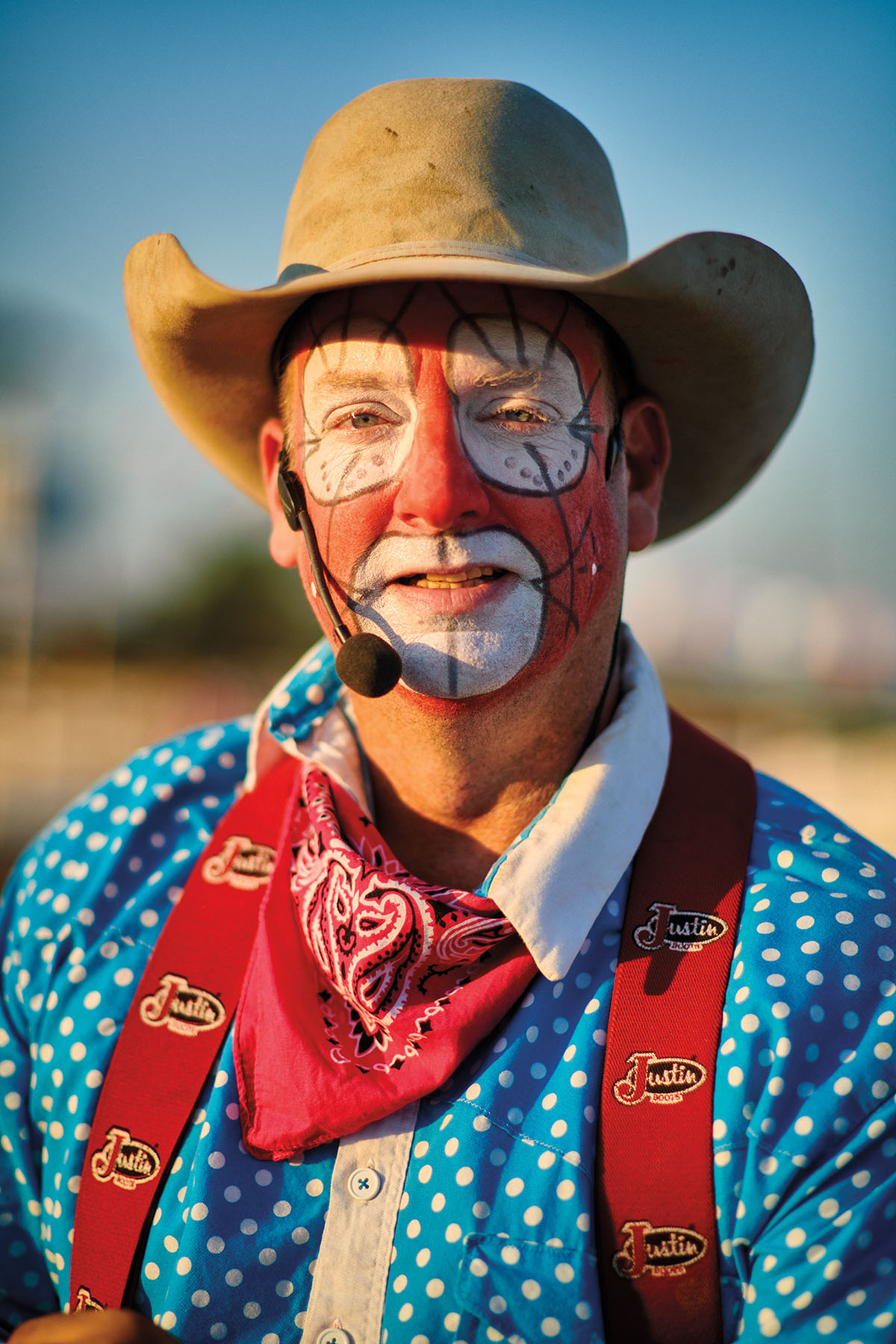
Photo: Dave Shafer.
Rodeo clown and “barrelman” Brandon Dunn.

When my husband worked in Minnesota, the colleague who ran manufacturing was in his free time a bull rider. He seemed impervious to danger and injury, but he was young. Eventually, he was obliged to retire.

As dangerous as bull riding is, those in the know might tell you that the role of rodeo clown is more so.

W.K. Stratton says at Texas Highways, “This was one of the rodeo axioms my mother taught me as I was growing up. … Always respect rodeo clowns: They’re the best athletes in the arena, and they save lives.

“[That] perplexed me when I was young. Clowns were the guys who strutted around dusty small-town rodeos in ragged outfits while carrying out groanworthy banter with the event announcer. Sometimes they performed tricks with dancing burros or hoop-jumping dogs. Other times, they might drive around in a tricked-up old car with an exploding muffler and a radiator that could spew water like Old Faithful.

“The athleticism of rodeo clowns was lost on me until I got older and realized their work is just as dangerous and exciting as the bull riders they’re employed to protect. Working in teams, their job is to distract an enraged bull from attacking the rider who’s just been catapulted to the dirt. The clowns working on foot — as opposed to manning a barrel — have come to be known as bullfighters. …

” ‘A human’s instinct is to run away,’ says Weston Rutkowski, of Haskell, one of the best bullfighters in the business. ‘That’s the worst thing you can do in this particular sport. A bull’s got four legs. We’ve got two. So they’re going to run you down in a straight line.

‘You have to be ready to move in the moment a rider starts to fall off. If you don’t come in until they hit the ground, you’re four steps late.’

“While their job has little in common with the matadors of Mexico and Spain who share the ‘bullfighter’ name, rodeo bullfighters must also overcome basic safety impulses. …

“Bullfighting runs in the family for Brandon Dunn, a rodeo clown from the North Texas town of Petrolia. Dunn fought bulls until injuries from a car wreck in 2003 robbed him of his speed. Now he entertains audiences as a clown and barrelman, working in tandem with his 17-year-old son, Brendall Dunn, a bullfighter. The father-son team works about 20 rodeos a year.

“ ‘It got to where I was put together by bailing wire and duct tape, and I just couldn’t fight bulls anymore,’ Dunn says. But that didn’t dissuade Brendall, who worked his first rodeo at age 12. Brandon says he has coached his son carefully.

” ‘There’s a mental maturity you have to reach, no matter how athletic you are,’ he says. ‘We would bring him up with some slower and older bulls and transition him to faster bulls. Now he’s fighting anything that comes out of the chute.’ …

“As a hotbed for rodeos, Texas has produced a prominent line of influential clowns. Ralph Fulkerson, a bull rider from Midlothian, 25 miles southwest of Dallas, changed the game when he switched to bullfighting in the 1920s. He developed a cornball humor act that involved his mule, Elko. After numerous injuries, Fulkerson came up with a way to protect himself by introducing the clown’s barrel to bull riding. His first barrels were made of wood reinforced with metal. Fulkerson would draw the bulls away from the bull riders and toward the barrel. Then he’d hop inside the barrel and allow the bull to bang away at it with its horns. …

“The sport went through a radical change in the early 1990s when [Tuff Hedeman, a four-time world champion bull rider] and other top bull riders broke away from the Professional Rodeo Cowboys Association (PRCA) to form the Professional Bull Riders (PBR). The speed as well as the bucking and spinning ability of the bulls increased dramatically.

“Bullfighters have adapted accordingly. At some rodeos, the trappings of the rodeo clown have disappeared. Bullfighters’ work has become so refined that it developed into a sport itself—freestyle bullfighting, in which bullfighters show their stuff while challenging real fighting bulls. The Bullfighters Only (BFO) tour showcases their skills — no bull riders involved. … Judges score fighters on technique and wow factors, including leaps over the bull.

“The jalopy-driving rodeo clowns of my childhood in the 1960s would be dumbfounded by what occurs at BFO events. These bullfighters practice acrobatics reminiscent of the Minoans: They’ve been known to jump completely over a bull and perform flips. Though some of the participants wear clown makeup in homage to the past, freestyle bullfighting has an X Games vibe.”

See some great photos at Texas Highways, here. And if you are interested in the rodeo life, try getting a copy of the wonderful Chloé Zhao movie The Rider.

Read Full Post »