Feeds:
Posts
Comments

Posts Tagged ‘roof’

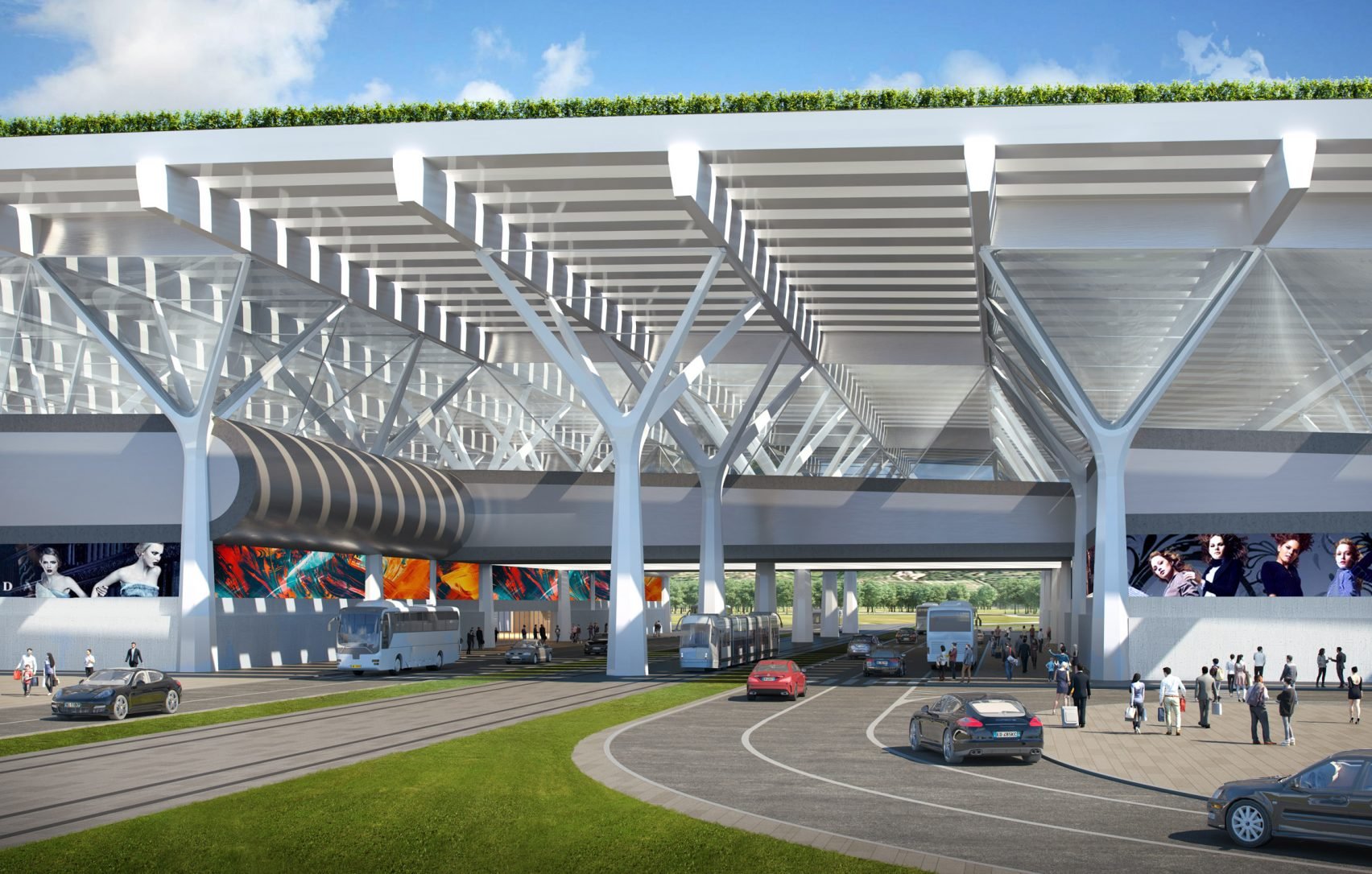
Photo: Rafael Viñoly Architects.
This airport in Italy will incorporate “multi-modal transport” links as well as … a vineyard.

No matter how innovative and complicated an architectural design is, it’s the quirkiest little thing that captures the attention of the public. As a member of the public, I am really hoping that the plans for a working vineyard on the roof of an airport in Florence will work out.

Lizzie Crook writes at Dezeen, “US studio Rafael Viñoly Architects has unveiled its plans for an international terminal at Florence Airport in Italy that will be crowned by a 7.7-hectare [19 acre] vineyard.

“The airport terminal will encompass 50,000 square meters [538,196 square feet] and is expected to be used by more than 5.9 million passengers annually. …

“The terminal’s main feature will be a vast sloping roof, which will be lined with skylights and 38 rows of usable vineyards.

“According to Rafael Viñoly Architects, this is a nod to Florence’s reputation as ‘the heart of Italy’s renowned wine country. … A leading vintner from the region will cultivate the vineyards, and the wine will be crafted and aged in specialized cellars beneath the terminal’s roof.’

“Inside, the terminal will feature a large piazza-like space at its centre, which will be flanked by the arrivals and departures areas on opposite sides. This central space will be linked to transport, parking and retail spaces open to both passengers and local people, and is hoped to streamline circulation for the terminal.

“Other key elements of the proposal include the reorientation of Florence Airport’s, formerly Aeroporto Amerigo Vespucci, existing runway by 90 degrees. This move will turn the runway away from the surrounding hills and lengthen it to better suit modern aircraft.

“The plans will also improve the airport’s links to the city and wider region through ‘multi-modal transport options including a new light rail system,’ the studio said. [The] construction of the airport terminal will be carried out in two phases, with the first slated for completion in 2026 and the second in 2035.”

The architects’ website adds this: “Linear structures of precast concrete contain the soil and irrigation to sustain the vineyard and are held aloft by a network of branching columns that preserve layout flexibility for the terminal’s internal components. …

“Between each of these sloping, elevated structures [are] insulated skylights that flood the interior with natural light. The structures’ trapezoidal section (narrower on the bottom than the top) increases the view angle of the sky from below. In all there are 38 rows of productive vineyards that will grow on the building’s roof while providing excellent thermal insulating characteristics that contribute to the building’s targeted LEED Platinum sustainability rating. …

“The wine will be crafted and aged on-site in specialized cellars below the area where the ground begins to slope up to become the terminal’s roof. This enormous surface, which hides the airport terminal when viewed from Brunelleschi’s Duomo and other prominent vantage points in the city, will not only serve as a new landmark for the city’s sustainable future, but also as a symbol of the traditions, history and innovative spirit that continue to drive the Italian economy into the 21st Century.” More here.

More at Dezeen, here.
Read Full Post »

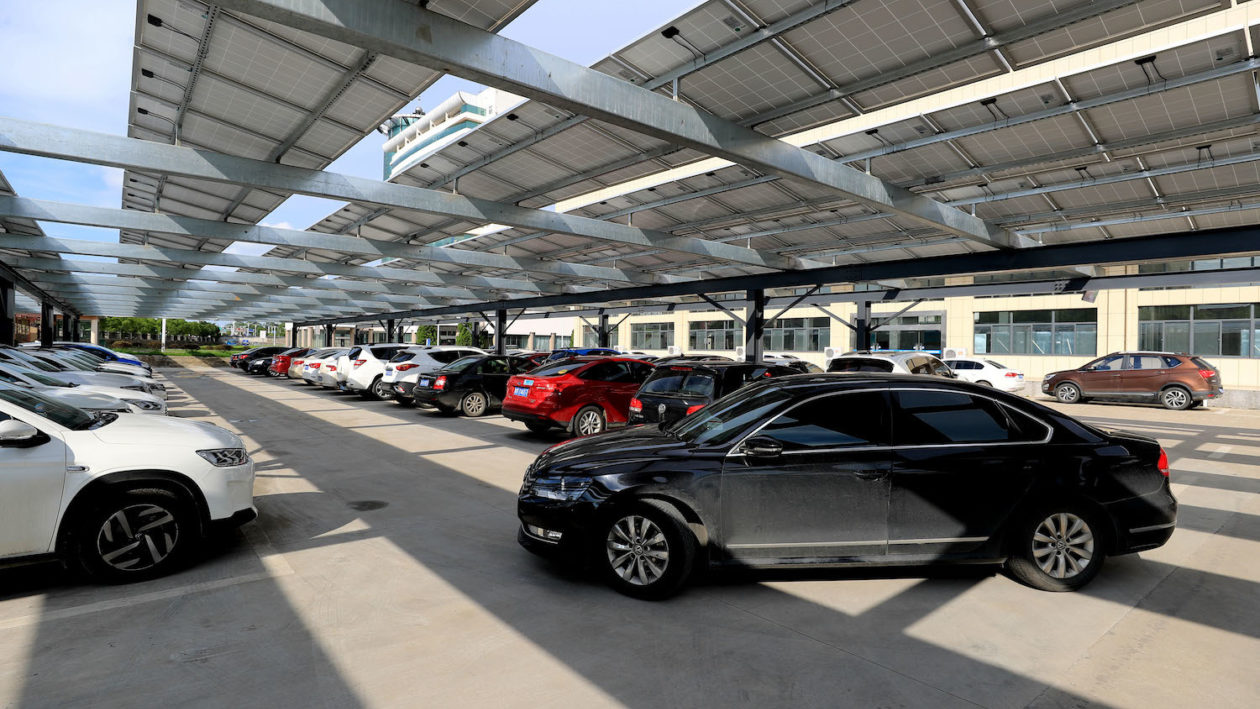
Photo: Imagine China via AP Images.
A solar-covered parking lot at the plant of Anhui Quanchai Engine Co., Ltd. in Chuzhou, China.

We have to keep a close watch on our innovations, even the ones we think are good. Take solar. Sometimes you read about aggressive solar companies decimating wooded lots to build an array. What? Trees are even better than solar at fighting global warming.

Let’s consider places where solar doesn’t harm anything. How about over a parking lot?

Richard Conniff writes at YaleEnvironment 360, “Fly into Orlando, Florida, and you may notice a 22-acre solar power array in the shape of Mickey Mouse’s head in a field just west of Disney World. Nearby, Disney also has a 270-acre solar farm of conventional design on former orchard and forest land. Park your car in any of Disney’s 32,000 parking spaces, on the other hand, and you won’t see a canopy overhead generating solar power (or providing shade) — not even if you snag one of the preferred spaces for which visitors pay up to $50 a day.

“This is how it typically goes with solar arrays: We build them on open space rather than in developed areas. That is, they overwhelmingly occupy croplands, arid lands, and grasslands, not rooftops or parking lots, according to a global inventory published last month in Nature. In the United States, for instance, roughly 51 percent of utility-scale solar facilities are in deserts; 33 percent are on croplands; and 10 percent are in grasslands and forests. Just 2.5 percent of U.S. solar power comes from urban areas.

“But that doesn’t necessarily make it smarter. Undeveloped land is a rapidly dwindling resource, and what’s left is under pressure to deliver a host of other services we require from the natural world — growing food, sheltering wildlife, storing and purifying water, preventing erosion, and sequestering carbon, among others. And that pressure is rapidly intensifying. By 2050, in one plausible scenario from the National Renewable Energy Laboratory (NREL), supplying solar power for all our electrical needs could require ground-based solar on 0.5 percent of the total land area of the United States … 10.3 million acres.

“Because it is more efficient to generate power close to customers, some states could end up with as much as five percent of their total land area — and 6.5 percent in tiny Rhode Island — under ground-based solar arrays, according to the NREL study. If we also ask solar power to run the nation’s entire automotive fleet, says Margolis, that adds another 5 million acres. It’s still less than half the 31 million acres of cropland eaten up in 2019 to grow corn for ethanol, a notoriously inefficient climate change remedy.

“The argument for doing it this way can seem compelling: It is cheaper to build on undeveloped land than on rooftops or in parking lots. And building alternative power sources fast and cheap is critical in the race to replace fossil fuels and avert catastrophic climate change. It’s also easier to manage a few big solar farms in an open landscape than a thousand small ones scattered across urban areas.

Despite the green image, putting solar facilities on undeveloped land is often not much better than putting subdivisions there.

“Developers tend to bulldoze sites, ‘removing all of the above-ground vegetation,’ says Rebecca Hernandez, an ecologist at the University of California at Davis. That’s bad for insects and the birds that feed on them. In the Southwest deserts where most U.S. solar farms now get built, the losses can also include ‘1,000-year-old creosote shrubs, and 100-year-old yuccas,’ or worse. The proposed 530-megawatt Aratina Solar Project around Boron, California, for instance, would destroy almost 4,300 western Joshua trees, a species imperiled, ironically, by development and climate change. … In California, endangered desert tortoises end up being translocated, with unknown results, says Hernandez. …

“The appeal of parking lots and rooftops, by contrast, is that they are abundant, close to customers, largely untapped for solar power generation, and on land that’s already been stripped of much of its biological value.

“A typical Walmart supercenter, for instance, has a five-acre parking lot, and it’s a wasteland, especially if you have to sweat your way across it under an asphalt-bubbling sun. Put a canopy over it, though, and it could support a three-megawatt solar array, according to a recent study co-authored by Joshua Pearce of Western University in Ontario.

“In addition to providing power to the store, the neighboring community, or the cars sheltered underneath, says Pearce, the canopy would shade customers — and keep them shopping longer, as their car batteries top up. If Walmart did that at all 3,571 of its U.S. super centers, the total capacity would be 11.1 gigawatts of solar power — roughly equivalent to a dozen large coal-fired power plants. Taking account of the part-time nature of solar power, Pearce figures that would be enough to permanently shut down four of those power plants.

“And yet solar canopies are barely beginning to show up in this country’s endless acreage of parking lots. The Washington, D.C., Metro transit system, for instance, has just contracted to build its first solar canopies at four of its rail station parking lots, with a projected capacity of 12.8 megawatts. 

“New York’s John F. Kennedy International Airport is now building its first, a 12.3 megawatt canopy costing $56 million. Evansville (Indiana) Regional Airport, however, already has two, covering 368 parking spaces, at a cost of $6.5 million. According to a spokesperson, the solar canopy earned a $310,000 profit in its first year of operation, based on premium pricing of those spaces and the sale of power at wholesale rates to the local utility.

“Rutgers University built one of the largest solar parking facilities in the country at its Piscataway, New Jersey campus, with a 32-acre footprint, an 8-megawatt output, and a business plan that the campus energy conservation manager called ‘pretty much cash-positive from the get-go.’ ”

Lots more info at YaleEnvironment360, here.

Read Full Post »

Photo: Eye Ubiquitous/Rex/Shutterstock
“It is not in dispute that the shark is not in harmony with its surroundings,” a planning inspector wrote in 1992.

This is not a story about a real shark, although sharks are often on my mind as warming seas move the dangerous kinds to the northern beaches that my family frequents. There is certainly plenty to say about real sharks — both about avoiding the places that their food congregates (seals, for example) and about protecting them to live in the wild. (My 4-year-old granddaughter will tell anyone willing to listen that shark fin soup is bad.)

But this story is about shark art.

Aamna Mohdin writes at the Guardian, “One April evening in 1986, Bill Heine was sitting on the steps opposite his newly purchased terraced house in Oxford, drinking a glass of wine, when he turned to his friend and asked a simple question: ‘Can you do something to liven it up?’

“His friend, the sculptor John Buckley, provided an answer in the shape of an eight-metre (25ft) shark which would sit on his roof, perpetually appearing as though it had just crashed into the house from the sky. The fibreglass fish, which became known as the Headington Shark after the Oxford suburb, led Heine, a local journalist and businessman who died last week, into a six-year legal battle with the local council.

“The process turned a relatively unremarkable street into a beloved local landmark and resulted in one of the most notable triumphs of British eccentricity over petty bureaucracy. …

“ ‘You could see the Americans were taking off from Heyford outside of Oxford to bomb Gaddafi in Libya,’ Buckley said. Both Buckley and Heine wanted to make a powerful statement about the barbarity of war and the feeling of vulnerability and utter helplessness when disaster struck. …

“The artist started on the work immediately after his discussion with Heine. He worked with a group of volunteers – largely students and other anti-war activists – to build an artificial roof to hold the shark outside his studio. He didn’t tell any of them where he planned to put the sculpture. …

“ ‘The crane just dropped it straight in and it went in beautifully as the postman was passing,’ Buckley said. ‘That first morning was amazing. By Sunday, it was worldwide and its been like that for 30-odd years.’

“Oxford city council immediately opposed the installation of the shark. At first, they said it was dangerous to the public, but engineers and inspectors pronounced it structurally safe.

“Heine, an American who moved to the UK to study at Oxford University in the 1960s, then submitted a planning application, which was rejected by the council. He appealed to the environment secretary, then Michael Heseltine. …

“Heseltine’s planning inspector, Peter Macdonald, investigated and ultimately came out in favour of keeping the sculpture, with an official ruling that has gained legendary status among town planners for its defence of art.

“ ‘In this case it is not in dispute that the shark is not in harmony with its surroundings, but then it is not intended to be in harmony with them,’ wrote Macdonald in his official ruling. ‘The council is understandably concerned about precedent here.

‘The first concern is simple: proliferation with sharks (and heaven knows what else) crashing through roofs all over the city. This fear is exaggerated.

” ‘In the five years since the shark was erected, no other examples have occurred … any system of control must make some small place for the dynamic, the unexpected, the downright quirky. I therefore recommend that the Headington Shark be allowed to remain.’ …

“After Heine died [in March], tributes came flooding in from many locals, including city councillors.

“[Patrick Gray, an economist who lived his whole life in Oxford], described Heine as a ‘colourful character’ who inspired people. He said: ‘We once had a 12-year-old boy visit from America. He was miserable and unhappy when he arrived, so we took him to see the house. He left with a very big smile on his face.’ ”

More at the Guardian, here. And be sure to check out the shark-girl sculpture in Buffalo, NY, which blog KerryCan old me about. Pretty funny.

Read Full Post »