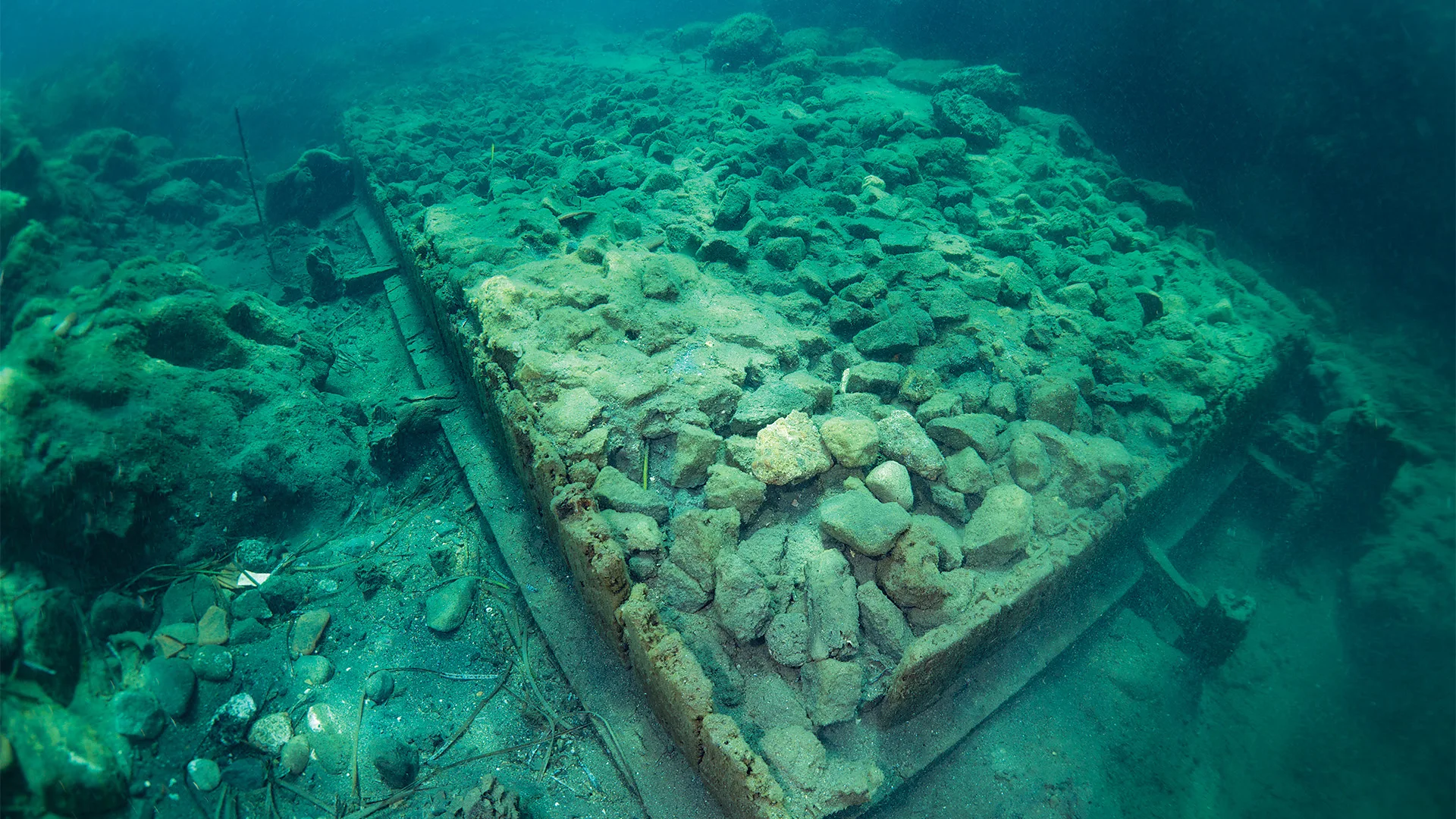
Photo: Alessandra Benini.
The ruins of Aenaria were buried in the sea for nearly 2,000 years, preserved underneath volcanic sediments.
Today’s story is about finding Aenaria, a Roman port that disappeared under the sea after a volcano erupted. Eva Sandoval at the BBC begins by describing a tour you can take there if you are interested in archaeology.
“As our tour sets sail, the vast Bay of Cartaromana opens up before us. Jagged cliffs shoot up from the waves; sunbathers sprawl on the inlet bridge leading to the 2,500-year-old Aragonese Castle. … After just 10 minutes at sea, we reach a network of buoys marking the ruins below. I press my hands against the vessel’s transparent bottom. Through the turquoise-blue water, between waving fields of seagrass and small striped fish, I glimpse a pile of rocks. Then the seagrass parts and I see that the rocks are arranged into a long rectangular form, its sides encased in wooden planks. This is an ancient city’s quay; buried in the cool dark for centuries and perfectly preserved. …
“I am on the Italian island of Ischia, where sometime around AD180, the Cretaio volcano erupted, and the ensuing shockwaves sank the Roman port city of Aenaria beneath the sea.
“At least, that’s what archaeologists think happened. … There are no records of the explosion, and very little written about the settlement itself. For nearly 2,000 years, there was no physical trace of it either. …
“The first hints of its existence were in 1972, when two scuba divers found Roman-era pottery shards and two lead ingots off Ischia’s eastern shore. The find intrigued archaeologists, but the ensuing investigation, helmed by local priest Don Pietro Monti and archaeologist Giorgio Buchner, yielded nothing. … The case went cold for nearly 40 years.
“Then, in 2011, passionate local sailors reopened the excavation, this time digging into the sea floor. Soon, they were able to confirm that 2meters beneath the bay’s volcanic seabed lay the ruins of a massive Roman-era quay. …
“As far as anyone had ever known, Ischia’s DNA was Greek. The island was renowned as the site of the first Greek colony in the Italian peninsula, established around 750BC in the north of the island. …
“When the Romans seized Pithecusae sometime around 322BC, they renamed the island Aenaria – a name that appears in ancient texts from Pliny the Elder to Strabo, often in relation to military events. But unlike the Greeks, who left behind a necropolis, kilns and troves of pottery, the Romans left only a few modest tombs, engravings and scattered opus reticulatum. …
” ‘The name was documented,’ echoes local resident Giulio Lauro. ‘But no one could find the place.’ Archaeologists had been looking for Roman Ischia on dry land, but it was buried below the sea.
“Lauro is the founder of the Marina di Sant’Anna; the cultural branch of the Ischia Barche sea-tourism cooperative. Along with various affiliated cultural groups – comprised of Ischian seafarers, history enthusiasts and archaeologists – they have self-funded the excavations for the past 15 years.
“Lauro is quick to tell me that he’s no scientist. ‘But I love the sea,’ he said. ‘In 2010, I got the idea to look again.’ …
“There were challenges, recalls Lauro: ‘Getting authorizations, training people, sourcing funds. We started from zero. We were lucky to believe in it. And then to actually find it.’ …
” ‘It was believed that the Romans never built a city on Ischia,’ says [Dr Alessandra Benini, the project’s lead archaeologist]. ‘It was the opposite.’ …
“Each summer, Benini and her team excavate the sea floor. Progress is painstaking due to a perennial shortage of funds. … During the site’s active months, curious visitors can take glass-bottomed boat tours, as well as snorkelling and scuba excursions to get even closer to the ruins. ‘You can see the underwater archaeologists at work, the equipment they use and everything involved,’ says Benini. …
“I ask Benini what she hopes to find this summer.
” ‘My dream is to find the foundations of the residential city,’ she says. ‘If we’ve found the port, then we know there was a city.’
“The team hopes to introduce Lidar, Georadar and sub-bottom profiler instruments into the digs, but Benini points out, ‘That’s expensive. We need more investors.’ “
Lots more at the BBC, here. No paywall.


 Suzanne's Mom's Blog