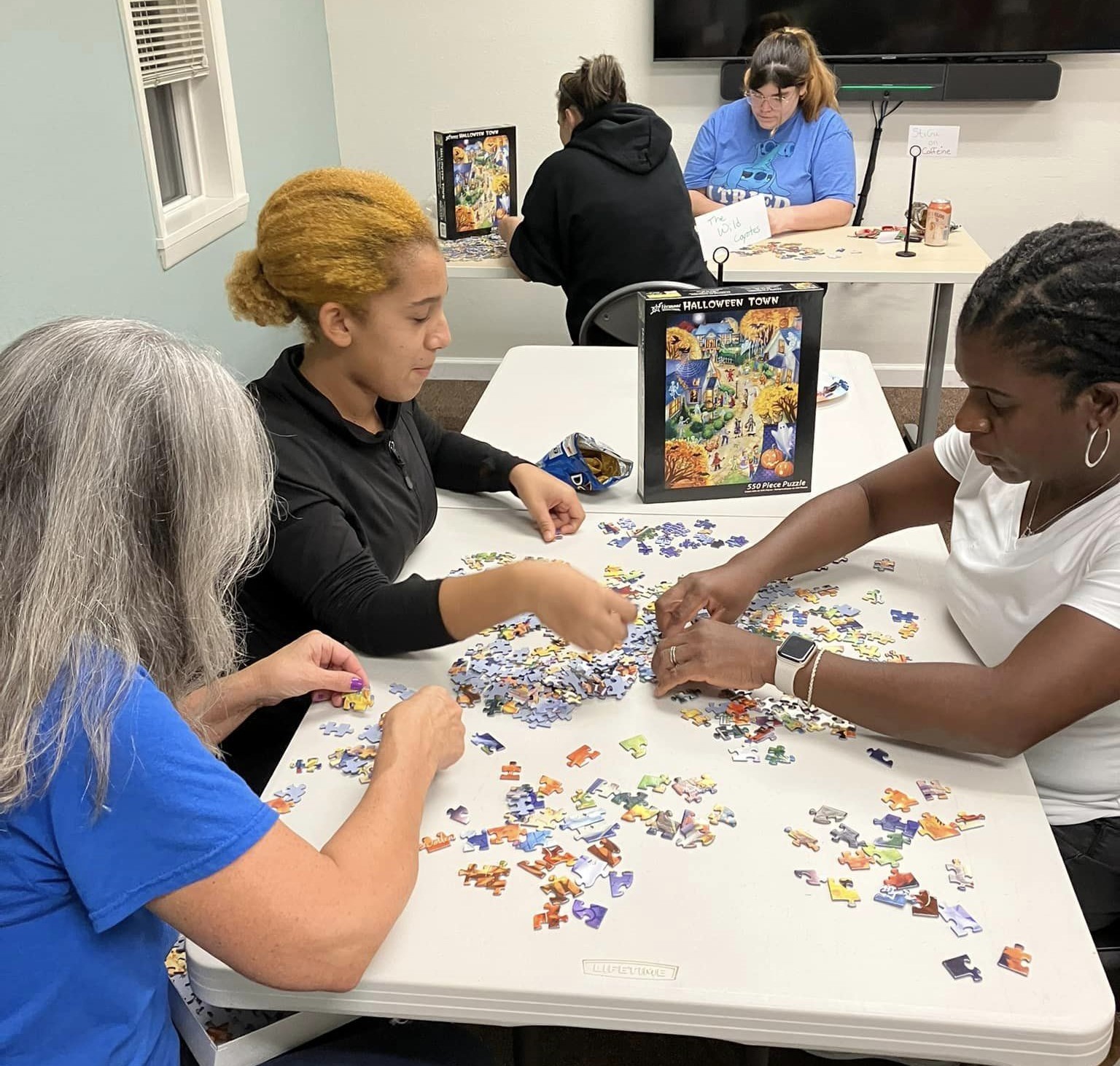
Photo: Clatskanie Library District via Oregon ArtsWatch.
The Clatskanie Library hosted a Halloween puzzle race last fall. “We want to be the community hub,” says library director Maryanne Hirning. “I want everyone to find something at the library.”
It would be hard to overstate the value of a library to a community, a refuge in so many ways. Remember the safe haven in Ferguson, Missouri, during the riots that erupted after the police killing of black teen Michael Brown? I have been following that library on Twitter since 2014 and am impressed with their services in calmer times, too.
At Oregon ArtsWatch, Amanda Waldroupe writes that libraries are often the heart and soul of rural communities.
“During the celebration of [the town of] Maupin’s centennial anniversary last year, its public library – the Southern Wasco County Library – printed a second edition of Chaff in the Wind: Gleanings of the Maupin Community.
“Chaff in the Wind is a history of Maupin and Wasco County that the library’s Friends’ group originally published in 1986. The library commissioned new chapters covering Maupin’s history since then.
“Another era also needed to be added: There was nothing about the region’s history before white people settled there, even though Native Americans had lived in the region for hundreds of years. So, Valerie Stephenson, the library’s director, reached out to the Confederated Tribes of Warm Springs.
“Delson Suppah, the Warm Springs’ cultural program coordinator, agreed to contribute – but not through writing a book chapter. Like many Indigenous cultures, the Warm Springs tribe conveys its history through oral storytelling. In two events, Suppah gave an oral history of the Warm Springs tribe’s history and presence in the area.
“Grant funding – in this case, $4,000 from Oregon Humanities – paid for the events and republishing the book. Without the grant, Stephenson said, none of it would have happened. …
“Oregon’s public libraries are well loved and well used, with one of the highest per capita circulation rates in the country. Public libraries are among the last institutions that are free and open to the general public, making them a natural gathering space for adults and children. …
“Libraries have always played a critical role in early literacy: teaching kids how to read, hosting summer reading programs, and reading and story time events for different age groups. Libraries were also early adopters in providing free access to computers and fast, broadband internet.
“Even before the COVID-19 pandemic prompted libraries to begin offering virtual and online services, libraries’ services were expanding to take on roles that blend information literacy, social, and community services. Library staff are increasingly being trained in basic mental health crisis response and how to administer Narcan or naloxone to people experiencing an opiate overdose. To serve growing numbers of immigrant communities, libraries are acquiring books in languages other than English, bilingual books, and hiring staff who speak languages in addition to English, especially Spanish.
“In many communities, libraries are a place where people experiencing homelessness can spend the day, where senior citizens find social interaction, and where kids can go after school.
“ ‘Libraries are places where people from all different backgrounds can interact,’ Buzzy Nielsen, a program manager for the State Library of Oregon, said. …
“That is especially the case in rural Oregon, where libraries are often the only places that host arts and cultural events.
“[Southern Wasco County Library] has a conference room large enough to host governmental, board, and other community meetings. The library hosts social workers from the Wasco County Health Department, who come to meet with residents and process applications for the Oregon Health Plan, SNAP benefits, disability, and other services. …
“Clatskanie’s library has started a young adult book club and hosted classes on flower arranging and cookie decorating, both taught by local business owners. …
“Libraries have also created Libraries of Things, where patrons can check out items ranging from e-readers with pre-downloaded e-books; ukuleles and other musical instruments; pots, pans, and other cooking equipment; fishing poles; and for kids, telescopes and science kits. …
“Libraries of Things reflect their community. Harney County’s library checks out canners, dehydrators, and other items necessary to preserve food.
“Wi-Fi hotspots are another common offering. Stephenson, Hancock, and others said the availability of fast, broadband internet in rural Oregon can be nonexistent. …
“Hancock said, ‘We have a lot of spots that aren’t served by internet companies.’ The library’s ten Wi-Fi hotspots are always checked out with holds placed on them. ‘They are hugely popular, she said. …
“With the expansion of library services, circulation has dramatically increased for a library’s most fundamental offering – books. [Maryanne Hirning, director of the Clatskanie Library District] said book circulation has increased by 400 percent. Other librarians say that once someone attends an event at a library, they are more likely to consider other services the library offers, become a member, and check out books.”
Lots more at Oregon ArtsWatch, here.
Blogger Laurie Graves has long understood that librarians are superheroes. And through her Great Library fantasy series, she shows that threats to libraries can be a matter of life and death.

 Suzanne's Mom's Blog