Feeds:
Posts
Comments

Posts Tagged ‘scent’

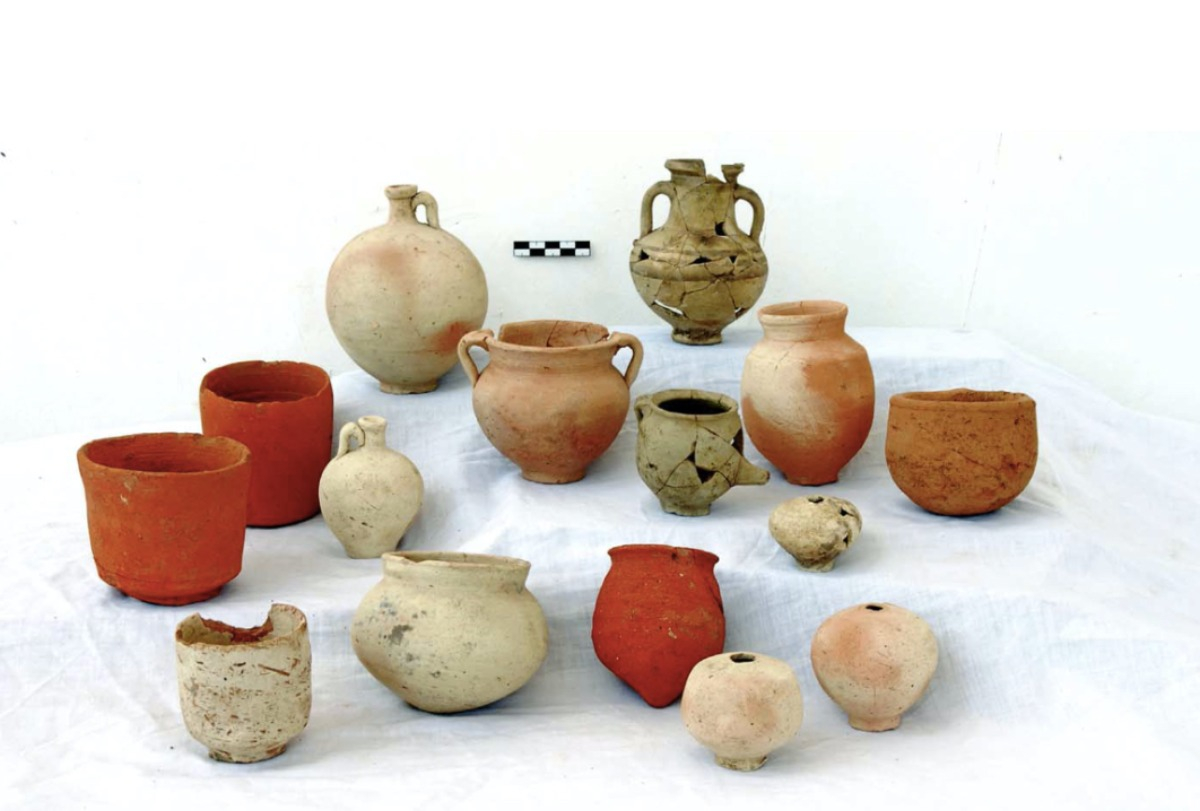
Photo: Jay Silverstein/University of Hawaiʻi.
Egyptian-era ceramic perfume bottles. Scientists are trying to reconstruct the fragrances of Cleopatra’s time.

As a longtime reader of mystery novels, I know that aroma can play a role in detectives solving a puzzling case. Today we learn about archaeologists who might be able to detect that Cleopatra had passed through the room where the body was found. Or her ghost. Or another archaeologist.

Elaine Velie reports at Hyperallergic, “A team who used ancient recipes to recreate an ancient Egyptian perfume perhaps worn by Cleopatra is back at it again. This time, they’re turning to chemical analysis to decipher the perfume’s exact ingredients and proportions.

“In 2012, University of Hawaiʻi (UH) professors Robert Littman and Jay Silverstein uncovered a perfume manufacturing site in Mendes, Egypt, a city that flourished from around 500 BCE to 600 CE. In the neighboring UH Tell Timai excavation site, the archeologists found a complex of kilns that was once abandoned in the second century BCE before being revived centuries later by the Romans; there, they discovered perfume bottles and amphoras containing perfume residue.

“The team partnered with Berlin-based Egyptologist Dora Goldsmith and Sean Coughlin, a professor of Greek and Roman philosophy in Prague, and used ‘experimental archaeology’ to test ancient perfume recipes. They tried different ingredients and cooked the perfumes in a variety of ways, eventually landing on one version that not only smelled good, but remained potent for two years. Littman and Silverstein exhibited their work at the National Geographic Museum in Washington, DC in 2019 and published their findings in the journal Near Eastern Archaeology as part of a paper titled ‘Eau de Cleopatra.’

“In the fourth century BCE, Egyptian perfume recipes were written in Greek, and in the first century BCE, they appeared in Latin texts. In reading these accounts, one fragrance emerges as immensely popular — the Mendesian perfume from the city of Mendes. It was mentioned by many Greek and Roman writers, including Pliny the Elder, and similarly to many scents today, the connotation was one of expense and luxury. Littman calls it the ‘Chanel no. 5’ of ancient Egypt and says it was popular during the reign of Cleopatra.

“It’s been difficult to determine whether the Greek and Roman recipes describe the real Egyptian Mendesian fragrance or Greek and Latin versions of the perfume, since Egyptian records of the scent are less widespread than the Greek and Roman ones. Even when studying Egyptian recipes, scholars do not always know the meaning of some words. … These sorts of uncertainties altered the accuracy of the recipe testing. And the onset of the COVID-19 pandemic delayed their efforts to test the compounds of the residue found in the UH Tell Timai amphora.

“Through a new chemical analysis, the team aims to resolve these questions and finally succeed in perfectly recreating the ancient Mendesian perfume. Littman, Silverstein, and their team plan to return to the Mendes site this summer, where they’ll bring a sample of the residue to Abdelrahman Medhat, a conservator of organic materials at the Cairo Museum.

“Littman told Hyperallergic that discoveries of ancient perfumes are incredibly rare. In 2005, perfumologist Mandy Aftel recreated a perfume worn by an ancient Egyptian mummy. In 2009, scientists at Bonn University in Germany analyzed what they thought was perfume from the tomb of Hatshepsut, but turned out to be a medicated skin lotion. …

“He also thinks perfume can tell us more about ancient societies than just their preferred scents. Littman, who has been excavating at the Mendes site since 2007, has developed a keen interest in the history of perfume. He views it as a lens through which to examine pubic health trends through time. When public health standards were lower, he says, people tended to wear more perfume. Deodorants and antiperspirants did not emerge until the early 20th century; instead, perfume was used to mask body odor. For example, perfume was incredibly popular in 17th-century France, when hygiene standards were relatively low. …

“ ‘One of the things that archaeology really developed in the mid-19th century, and some of the questions we look at are, “What was life like? What was civilization like?” ‘ Littman told Hyperallergic. ‘So when you look at perfume, perfume is an aspect of civilization.’ ”

The part about using perfume to cover up bad odors reminds of a biography I read about Elizabeth I in England. Believe me, you would not want to spend a winter in her palace, where there was no plumbing and everyone walked around holding some kind of fragrance to their noses to blot out the overflowing chamber pots!

More at Hyperallergic, here. No firewall.

Read Full Post »

Museum of Aromas

Don’t you love how many vocations and avocations there are in the world? Endless. People seem to keep thinking up new ones. They get interested in some obscure subject, and before you know it, they’re off to the races!

For example, as Nicola Davis writes at the Guardian, there are scientists trying to recreate the scents of Old Europe, from plague repellents to early tobacco.

“Smells can transport us to days gone by,” she notes. “Now researchers are hoping to harness the [smells] of the past to do just that.

“Scientists, historians and experts in artificial intelligence across the UK and Europe have announced they are teaming up for a €2.8m project labelled ‘Odeuropa’ to identify and even recreate the aromas that would have assailed noses between the 16th and early 20th centuries.

“ ‘Once you start looking at printed texts published in Europe since 1500 you will find loads of references to smell, from religious scents – like the smell of incense – through to things like tobacco,’ said Dr William Tullett of Anglia Ruskin University in Cambridge, a member of the Odeuropa team and the author of Smell in Eighteenth-Century England.

“The first step in the three-year project, which is due to begin in January, will be to develop artificial intelligence to screen historical texts in seven languages for descriptions of odours – and their context – as well as to spot aromatic items within images, such as paintings.

“That information will be used to develop an online encyclopaedia of European smells, including potted biographies of particular odours, together with insights into the emotions and places associated with certain scents.

“ ‘It will [also] include discussions of particular types of noses from the past – the kinds of people for whom smell was significant and what smell meant to them,’ said Tullett, adding that one example would be physicians.

“ ‘That could take us into all kinds of different scents, whether that is the use of herbs like rosemary to protect against plague, [or] the use of smelling salts in the 18th and 19th centuries as an antidote to fits and fainting,’ he said.

“Tullett added that a key part of the project is to highlight how the meanings and uses of different smells have changed over time, something that shows in the history of tobacco. …

“The team say they plan to use their findings to work with chemists and perfumers to recreate the smells of the past, and explore how the odours can be delivered – alongside insights into their significance – to enhance the experience of visitors to museums and other heritage sites.

“The team is not the first to engage the nostrils in the name of heritage – the Jorvik Viking Centre in York is famous for recreating the stench of the 10th century, a feature some have suggested makes a visit particularly memorable.

“ ‘One of the things that the Jorvik Viking Centre demonstrates is that smell can have a real impact on the way people engage with museums,’ said Tullett. But, he said, such engagement does not have to rely on unpleasant pongs.

“ ‘Where smell does get mentioned in museums, it is often the smells of toilets or wood burning,’ said Tullett. ‘We are trying to encourage people to consider both the foul and the fragrant elements of Europe’s olfactory past.’ ” More at the Guardian, here.

I guess there’ll always be an England.

Read Full Post »

There are no limits to human ingenuity. Jordan Todorov writes at Atlas Obscura, for example, about an “olfactory artist” who has been working to recreate the scents of cities for more than a decade. And why not?

” ‘Berlin smells of cigars and boiled cabbage.’ This observation comes from the 1963 travelogue Thrilling Cities by the British author Ian Fleming … But for Berlin-based olfactory artist Sissel Tolaas, who creates ‘smellscapes’ of major cities, it smells like so much more.

“ ‘Every city has an identity like we humans do. And every city is unique smell-wise,’ explains Tolaas, a half-Norwegian, half-Icelandic expatriate artist with background in chemistry, linguistics, mathematics, and visual arts. ‘The odor depends on things like climate, geography, demography etc. Inside the city, smells differs from neighborhood to neighborhood.’ …

“Tolaas is traveling around the world and mapping its cities, one smell at a time. The project, called SmellScapes, has taken her to 35 cities so far, from London and Paris to Cape Town to Kansas City (both of them).

“Tolaas started working on her SmellScapes more than a decade ago. Most of them are commissioned by either creative platforms, city councils, or universities and private foundations, and they serve an amazingly wide variety of purposes. For example, her SmellScape of Mexico City, developed in 2001 in collaboration with the Harvard graduate student teacher program, was a creative way to understand pollution. …

” ‘I walked around and [caught] in a playful manner the smells in different neighborhoods. The goal was reproducing the smell of pollution—the car exhaust, the refrigerator, the air conditioner … Then I gave the smells to people and asked them to articulate them which made them understand better what’s causing the pollution.’ …

“Tolaas collects the smell samples in a small glass tube called tennex. Then the container is sent to her research partners from International Flavors & Fragrances, an American perfumery corporation headquartered in New York City, which according to Tolaas is ‘one of a small number of companies which controls how the world smells and tastes.’…

“After analyzing the sample with a gas chromatograph, IFF sends Tolaas a formula that contains the fingerprint of the smell captured, describing all the subtle nuances in great detail. Using this data chart, Tolaas replicates the smell in her lab, combining some of the nearly 4,000 individual molecules she has at her disposal. The result, Tolaas explains, is as close as possible to the original smell.” More at Atlas Obscura, here.

I am going to start paying more attention to neighborhood scents. I know, for sure, we have pizza aroma and dry cleaning chemicals and the smell of trains grinding to a halt on metal tracks. But in spring, we also have lots of flower smells.

I may come back to this.

Photo: Atlas Obscura
Sissel Tolaas uses a nano-scale to measure the smell molecules.

Read Full Post »