
Photo: David L Ryan/ Boston Globe Staff.
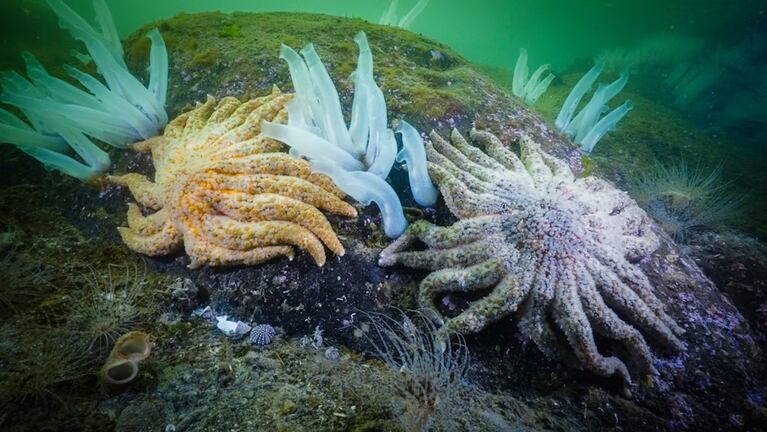
A view of a Forbes sea star at Northeastern University’s Ocean Genome Legacy Center.
As I was reading today’s story, an image kept coming to mind: an image of someone in a burning house running out with a few precious items.
You’ll see why when you read Kate Selig’s article at the Boston Globe on a genome bank.
“On a rocky outcropping a few miles northeast of Boston Harbor,” she writes, “scientists are racing to build a library of tissue and DNA from ocean creatures — before it is too late. It’s a last-ditch effort. As global warming drives ocean temperatures ever higher, some species have vanished and the populations of others have plummeted. If climate change continues unchecked, many marine species could face a mass extinction, rivaling the worst in earth’s history.
“To preserve the oceans’ historical record, researchers in Nahant, a peninsular town jutting into the Atlantic, are collecting samples from marine organisms around the world and distributing them to scientists.
“ It’s not difficult to do,’ said Dan Distel, a marine biologist who serves as the director of Northeastern University’s Ocean Genome Legacy Center. ‘It’s not expensive to do. And of course, if we miss the opportunity, it’s too late.’ …
“The Nahant collection has informed hundreds of studies, providing a baseline understanding of how species are doing while also tracking global trends. The repository houses common local species, such as spiky sea urchins and flatfish with their eyes trained skyward. But there are also some ‘real weirdos,’ as Distel described them. A prized specimen from the Philippines is a preserved giant shipworm, a glistening, tubular creature that lives in a tusk-like shell. A petite marine mussel the size and shape of a plump grain of rice rests in a small jar.
“A whiteboard at its entrance decorated with drawings of fish, sea stars, and a crab displays the current count: over 31,000 DNA samples and 28,000 tissue samples.
“Distel is the ringmaster behind the menagerie. … In addition to his work at the center, he has dedicated much of his career to studying shipworms, a type of worm-like clam notorious for gnawing through submerged wood. Distel was part of an international team that discovered a live specimen of the giant shipworm, a find that drew international attention. …
“ ‘These guys are a great example of a nearly extinct species,’ he said, with a touch of reverence. ‘There’s only one place in the world where we know they can still be found.’
“As humanity continues to burn fossil fuels, the world’s oceans have stood as a bulwark to the most extreme impacts of climate change by swallowing much of the excess heat trapped by greenhouses gases. But that has come at a staggering cost.
“The surface layer of the ocean has warmed by about 1.5 degrees Fahrenheit over the past century. In the Gulf of Maine, which is warming much faster than most ocean surfaces on the planet, the higher temperatures are forcing out lobsters, altering the migration patterns of whales, and fueling a population boom of invasive green crabs.
“The center was founded in 2004 by Donald Comb, a Massachusetts biotechnology pioneer. … Comb, who loved the oceans, decided to put up the funds to build a biorepository focused on marine species. The center became the first ocean-focused public DNA bank in the United States. …
“Large samples preserved in jars are stored in shelving units and a repurposed tool chest. They infuse the center with what students call ‘the low tide smell.’
“The real action takes place in the freezer room. Four mechanical freezers, rigged with alarms and known as ‘minus 80s’ for their low temperatures, store small tubes that contain the complete genome of an organism. A single freezer can fit thousands of samples. The center also has a liquid nitrogen freezer that chills samples so quickly that living bacteria can be revived. …
“Angela Jones, a Northeastern PhD candidate in marine and environmental sciences, has supplied the center with samples from her doctoral research on sea stars, studying two species in New England that have undergone steep population declines. …
” ‘It’s important to understand what the species are like now so that we can understand how they change under worsening conditions,’ she said.”
More at the Globe, here.

 Suzanne's Mom's Blog