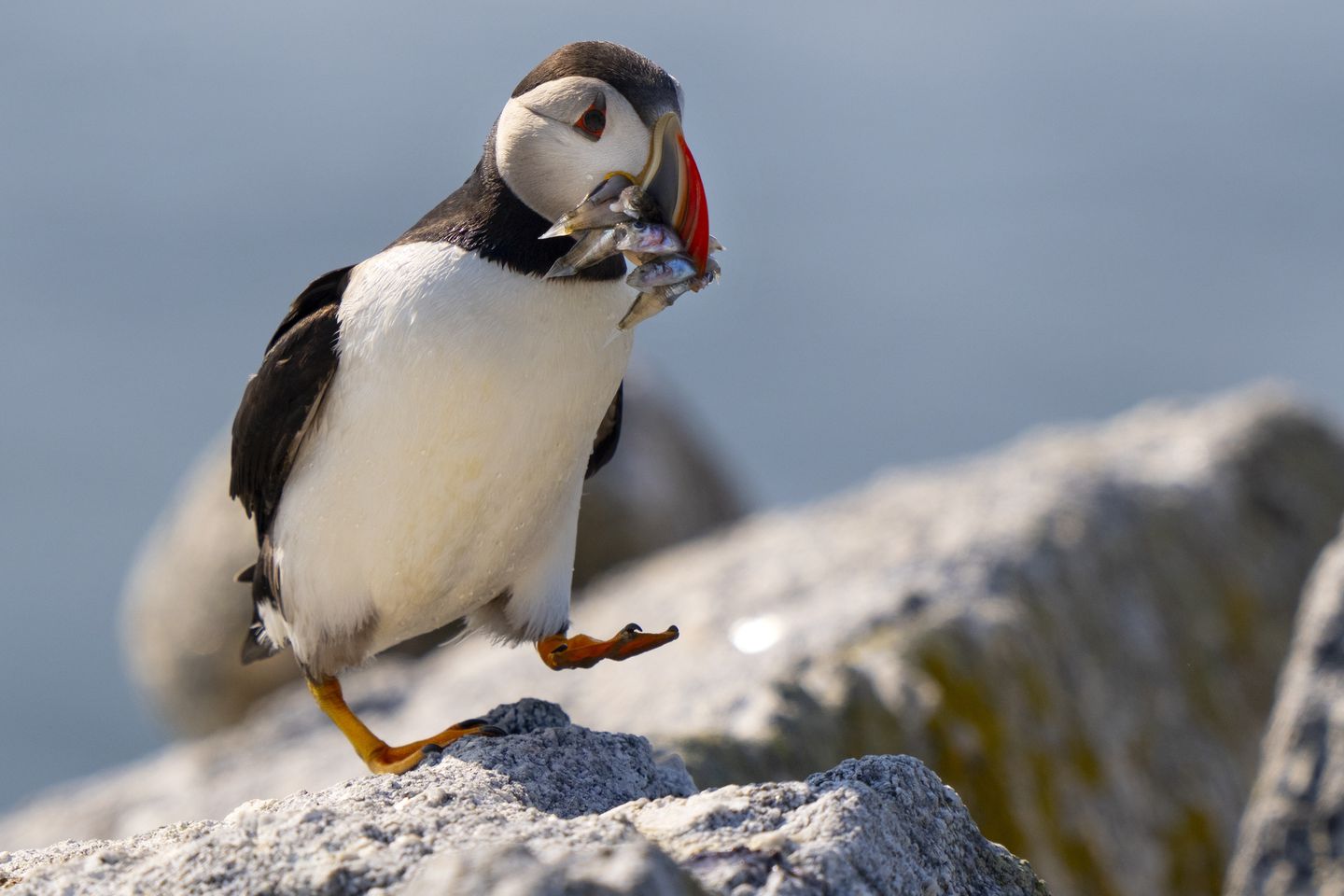
Photo: Robert F. Bukaty/ Associated Press.
An Atlantic puffin feeding its chick in a burrow under rocks on Eastern Egg Rock, a small island off mid-coast Maine on Aug. 5.
I learned a few years ago that that adorable seabird called the puffin might be in trouble. Because warming oceans were killing off their food, puffins were producing fewer successful offspring. This year, scientists who monitor the puffins say 2023 was the second consecutive rebound year for fledgling chicks. But it sounds like only a brief reprieve.
Patrick Whittle reports for the Associated Press (AP), “On remote islands off the Maine coast, a unique bird held its own this year in the face of climate change.
“Atlantic puffins — clownish seabirds with colorful bills and waddling gaits — had their second consecutive rebound year for fledgling chicks after suffering a catastrophic 2021, said scientists who monitor the birds. The news flies in the face of environmental trends, as scientists have said warming waters off New England jeopardize the birds because that reduces the kind of fish they need to feed their chicks.
“One fish, though — the sand lance — has remained in abundance this year, allowing puffins to thrive, said Don Lyons, director of conservation science at National Audubon Society’s Seabird Institute in Bremen, Maine. He said it’s a sign the impact of climate change on ecosystems is not always as tidy as we think.
“The encouraging news comes as the Audubon Society is celebrating its 50th anniversary of tending to Maine’s puffin colonies, which it restored from just a few dozen pairs. There are now as many as 3,000 birds, and the population is stable, Lyons said. …
“The puffins — also known as ‘clowns of the sea’ or ‘sea parrots’ — nest in burrows and feed their chicks small fish such as herring. Two years ago, the colonies suffered one of their worst years for reproduction in decades due to a lack of those fish. Only about a quarter of the birds were able to raise chicks that summer.
“Audubon and other conservation groups have tied the fish shortage to warming ocean temperatures.
The Gulf of Maine, which has puffin colonies on its islands, is warming faster than most of the world’s oceans. …
“The puffins’ ability to reproduce despite environmental changes speaks to the resiliency of seabirds, said Bill Sydeman, president and chief scientist of the Farallon Institute, a marine preservation organization based in California. However, the long-term dangers posed by climate change — such as fatal heat waves, loss of food, loss of islands to sea level rise, and inability to breed — remain existential threats. …
“ ‘The problem with climate change is these breeding failures and low breeding productivity years are now becoming chronic,’ Sydeman said. ‘There will be fewer young birds in the population that are able to recruit into the breeding population.’
“Maine’s puffins are the only breeding Atlantic puffins in the US Worldwide. The species lives in the North Atlantic from Maine and Canada to Europe. …
“The Maine puffin population once dwindled to only about 70 pairs on tiny Matinicus Rock. Hunters who pursued the birds for their meat and feathers had nearly wiped them out by the early 1900s. Stephen Kress, an Audubon ornithologist, sought to grow puffin colonies starting in the 1970s by relocating chicks from Canada to Eastern Egg Rock, another tiny island. …
“The effects of climate change on seabirds have been a focus of scientific inquiry in recent years. Interest in the subject has accelerated because of die-offs of some of the puffin’s auk family relatives, such as common murres and Cassin’s auklets off the West Coast.
“The challenges faced by seabirds make successful breeding seasons especially important, said P. Dee Boersma, a University of Washington professor of biology and director of the university’s Center for Ecosystem Sentinels.”
My husband saw puffins in Iceland. Have you ever seen them? I think I may have encountered them in a zoo, but unfortunately, that’s it.
More at the Globe, here.

 Suzanne's Mom's Blog