Feeds:
Posts
Comments

Posts Tagged ‘seahorse’

Photo: Valkyrie Pierce/Unsplash.
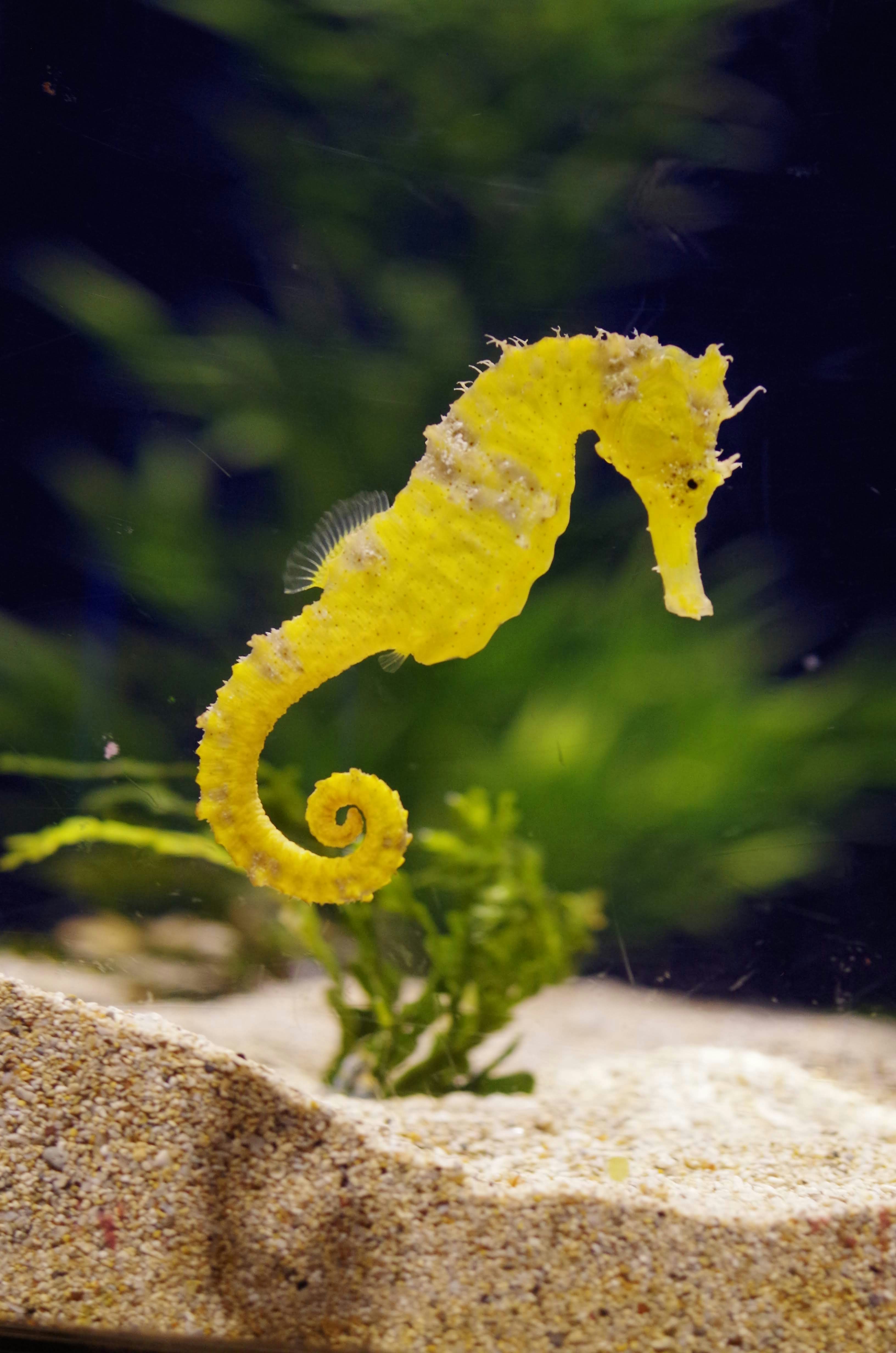
Citizen scientists are helping us learn more about seahorses.

For all its shortcomings, social media has enabled us to work together on meaningful projects if we so choose. Consider the citizen scientists who are expanding our knowledge of the natural world.

Erin Blakemore has a story at the Washington Post about the latest research on seahorses — and how you can help study them.

“Members of the public are helping to advance research on sea horses, the tiny fish that can be found in coral reefs, shallow waters and estuaries around the world, according to a study.

“When researchers looked at the results of public contributions to the iSeahorse science project between 2013 and 2022, they found the community effort enabled scientific advances in the field.

“Citizen contributions provided new information on 10 of 17 sea horse species with data once considered deficient and helped update knowledge about the geographic distribution of nine species, researchers wrote in the Journal of Fish Biology. Some of the observations even helped scientists better understand when and how sea horses breed. … According to the project website, iSeahorse has amassed about 11,000 observations from more than 1,900 contributors to date.

“Overall, the researchers were able to validate 7,794 of the observations from 96 countries and 35 sea horse species. The volunteer observers even noted rare species that traditional monitoring probably would not detect, they write.

“ ‘Seahorses are very much the sort of fascinating species that benefit from community science, as they are cryptic enough to make even formal research challenging,’ Heather Koldewey, the project’s co-founder and the lead on the Bertarelli Foundation’s marine science program, said in a news release. …

“Want to get involved? Visit https://projectseahorse.org/iseahorse/ to learn more. More at the Post, here.

And check out this page from the Journal of Ethnobiology and Ethnomedicine, here. It reads, in part, “Seahorses are endangered teleost fishes under increasing human pressures worldwide. In Brazil, marine conservationists and policy-makers are thus often skeptical about the viability of sustainable human-seahorse interactions.

“This study focuses on local ecological knowledge on seahorses and the implications of their non-lethal touristic use by a coastal community in northeastern Brazil. Community-based seahorse-watching activities have been carried out in Maracaípe village since 1999, but remained uninvestigated until the present study. …

“We interviewed 32 informants through semi-structured questionnaires to assess their socioeconomic profile, their knowledge on seahorse natural history traits, human uses, threats and abundance trends.

“Seahorse-watching has high socioeconomic relevance, being the primary income source for all respondents. Interviewees elicited a body of knowledge on seahorse biology largely consistent with up-to-date research literature. Most informants (65.5 %) perceived no change in seahorse abundance. Their empirical knowledge often surpassed scientific reports, i.e. through remarks on trophic ecology; reproductive aspects, such as, behavior and breeding season; spatial and temporal distribution, suggesting seahorse migration related to environmental parameters.

“Seahorse-watching operators were aware of seahorse biological and ecological aspects. Despite the gaps remaining on biological data about certain seahorse traits, the respondents provided reliable information on all questions, adding ethnoecological remarks not yet assessed by conventional scientific surveys. We provide novel ethnobiological insight on non-extractive modes of human-seahorse interaction, eliciting environmental policies to integrate seahorse conservation with local ecological knowledge and innovative ideas for seahorse sustainable use. Our study resonates with calls for more active engagement with communities and their local ecologies if marine conservation and development are to be reconciled.”
Read Full Post »

Photo: Seacoast Science Center.
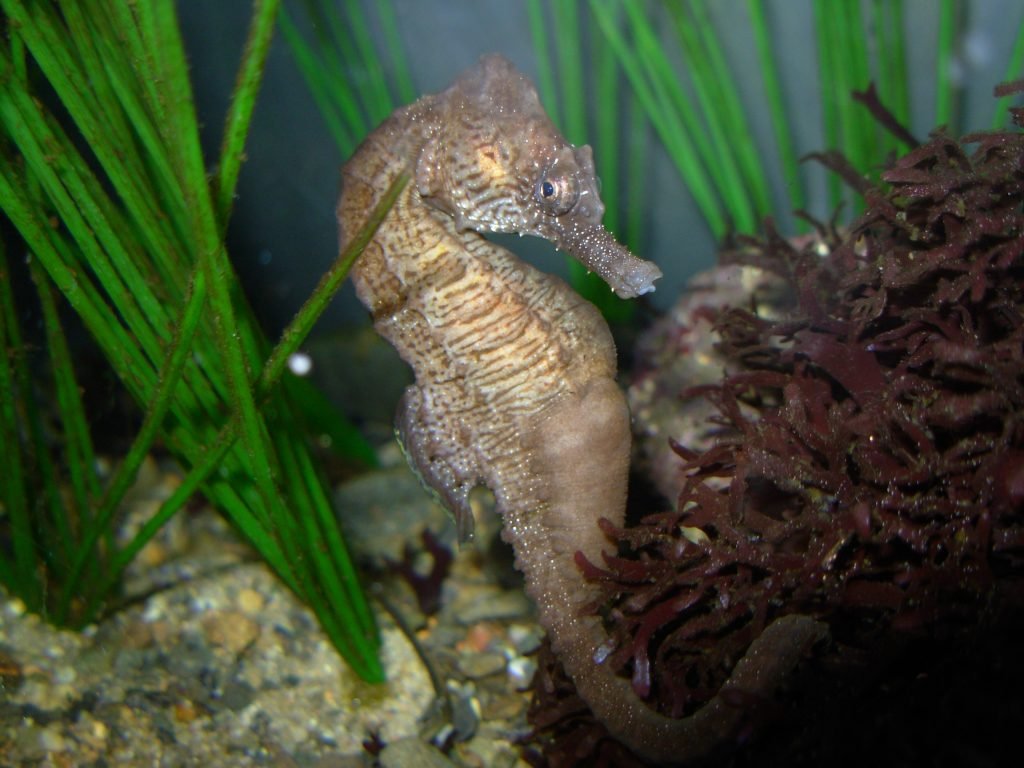
The male seahorse carries from 5 to 2,000 babies in his pouch, depending on the species.

More and more dads take on nurturing roles these days, a great benefit to kids — and moms, too. That got me thinking about perhaps the top nurturing dad of the animal kingdom, the seahorse. So I was pleased to find a blog post about papa seahorses at the Seacoast Science Center at Odiorne Point State Park in Rye, New Hampshire.

Intern Ashley Breault, who in 2016 was an Ocean Studies and Communications student at the University of New England, wrote, “Father’s Day is a great time to thank all the dads out there who step up their game for life’s most important job! Inarguably, the most notable dad in the animal kingdom, the seahorse has some pretty unique traits that qualify them for the #1 dad in-the-sea award!

“There are more than 50 different seahorse species … all of which do something that gives them the title of best dad: they are one of the only species in which the male carries and delivers its babies. …

“After hours of a courtship ‘dance’ that includes synchronized tail movements and twirling, a male and female seahorse will mate. The female seahorse makes the eggs, and during this mating process, transfers the unfertilized eggs to the male seahorse. The male seahorse fertilizes the eggs and is now a proud father, carrying anywhere from 5-2,000 babies in his pouch, depending on the species.

“In here, these offspring will get all the food and oxygen they need to develop. Anywhere from 14 days to 4 weeks later, all these little seahorses will be born.

“Baby seahorses are called fry and once they are born, they are completely independent. Mom and dad leave them to find food and shelter all on their own. Unfortunately, only a few of the thousands born will make it to adulthood. …

“Here at the Seacoast Science Center, you can find seahorses in our Eelgrass exhibit tank. The seahorses at the Center are called White’s seahorses, Hippocampus whitei, and are actually native to Australia, where they are a very common along the coast. These seahorses are typically very small, growing no longer than 20 cm. Our seahorses are fed mysid shrimp 4 times a day and get all the love and care they need. Because they are so small, they can only eat small amounts of food at a time, which is why they get fed so often.

“One seahorse species that you might be able to find in our local waters are Lined seahorses, Hippocampus erectus, which can live as far north as Nova Scotia and as far south as Venezuela.” More here.

You might want to check out Seacoast Science Center’s other blog entries, here, especially the post called “One Ocean,” which has a holistic take on the interconnectedness of all the oceans on planet Earth. “The idea of One World Ocean is a relatively new way of thinking about the saltwater basins we all learned about in elementary school. … Over 70% of Earth’s surface is ocean, and understanding its enormous influence on our planet and our lives on land is the first step to understanding the urgency to preserve and protect this life-giving resource.”

The Seacoast Science Center is open Wednesdays to Sundays, 10 am to 4 pm. They encourage people to buy advance tickets and, if unvaccinated and over age 3, to wear a mask.

Read Full Post »

I  noticed the Eric Carle picture book Mister Seahorse at Suzanne and Erik’s house today, and it got me thinking about seahorses as fathers.

Did you know seahorse fathers carry the babies from conception to birth, not the mothers?

According to Wikipedia, “The male seahorse is equipped with a pouch on the ventral, or front-facing, side of the tail. When mating, the female seahorse deposits up to 1,500 eggs in the male’s pouch. The male carries the eggs for 9 to 45 days until the seahorses emerge fully developed, but very small. Once the young are released into the water, the male’s role is done and he offers no further care.”

It’s kind of the reverse of today’s devoted fathers. With no direct role in giving birth to babies, they sure do get involved in the daily care and feeding. Grandfathers, too. My husband babysits regularly, and can handle most anything, including diapers.

For more on seahorses, and how to protect them, check out the Sea Horse Trust, here. And if you’re up for a refresher on how increased carbon dioxide in the atmosphere is endangering sea creatures with spines, including the pygmy seahorse, reread my review of the climate-change movie Revolution, here.

Art: Eric Carle

Read Full Post »