Photo: Caitlin Kelly.
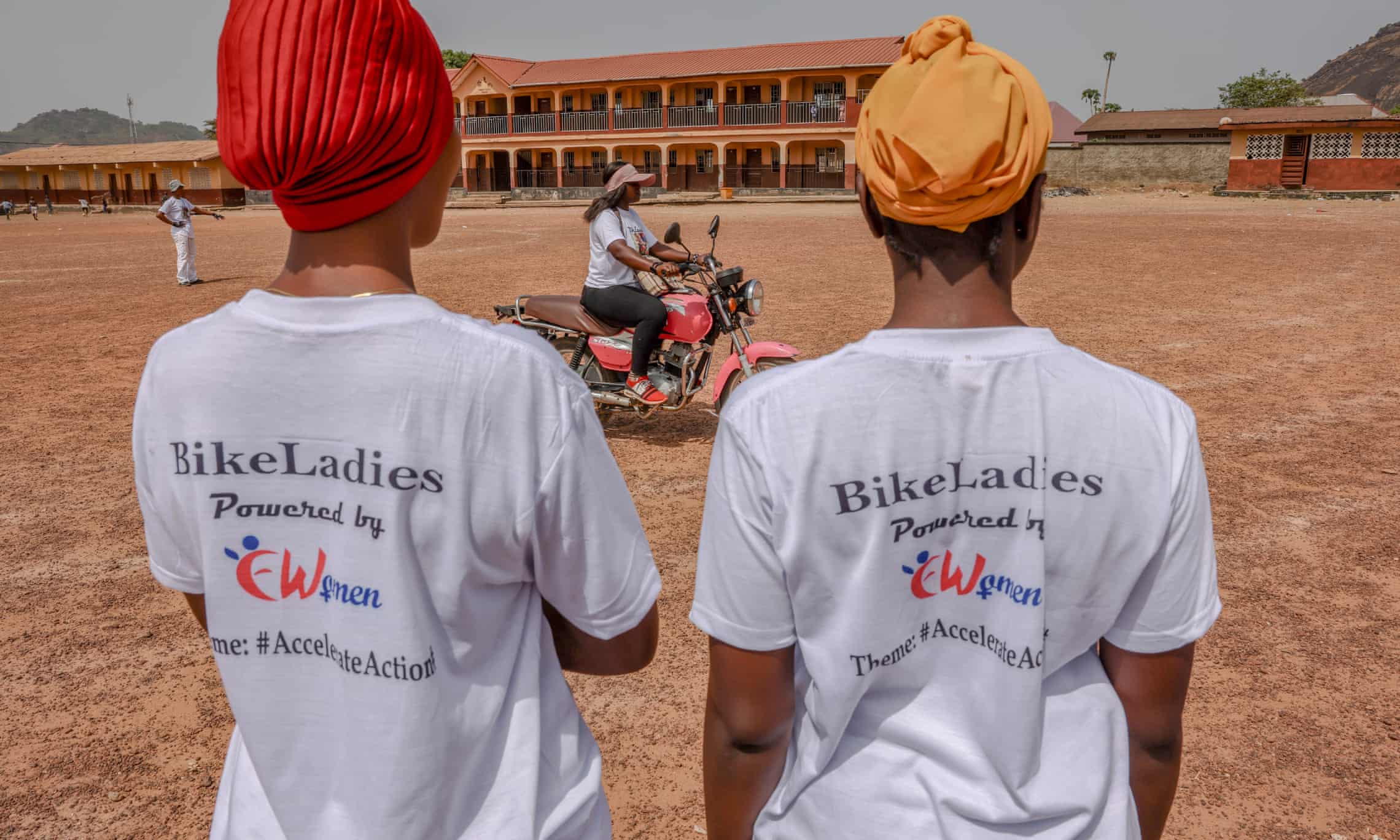
The Bombali Bike Ladies of Sierra Leone hope that by learning to ride a motorbike and take up package delivery services it will be possible to improve their lives.
I’ve been reading a mystery about some Minnesota Indigenous women who, fed up with a spate of kidnappings, unite to fight back. Whenever I read stories about women uniting to improve their lives and the lives of other women, I rejoice. After all, the individual women who eventually get to run their countries do not always operate differently from their male predecessors, but women in mutual-support initiatives definitively behave differently.
In today’s Guardian article, Caitlin Kelly writes about Mariama Timbo, the sole female biker in her Sierra Leone province ferrying people and goods to town and “training a new generation of women to follow her lead.”
“Streaming through the green fields of Sierra Leone’s Bombali district, Mariama Timbo sits tall on her pink motorbike. Women selling nuts on the side of the road wave as she glides by; policemen give an approving nod as she passes through checkpoints. ‘They don’t give me any trouble,’ she says – a badge of honor in the rural district. Taking her time on the rocky roads, she brakes, slowly approaching the bumps. …
“The 26-year-old is the sole female motorcyclist in the northern province ferrying people and goods to Makeni, one of Sierra Leone’s fastest growing cities. …
“At a petrol station en route, male drivers greet Timbo with fist-bumps and high fives. ‘At first when I started, people were mocking me,’ she says. ‘Now they see how my life has changed since I started riding the bike.’
“In Sierra Leone, motorcycles are a lifeline. The locally known okadas are often the only accessible and affordable way to reach markets, hospitals and cities. With nearly 60% of the country’s rural population living in poverty, commercial riding offers income to hundreds of thousands – nearly all of them men.
“In her early teens, Timbo left her village, Kagbere, to ‘join society’ and attend school in Makeni, but the opportunity turned into a nightmare when she was sexually abused by a male relative who was helping her financially. ‘I didn’t feel safe,’ she recalls.
“She managed to move out and pay for the last years of school by doing odd jobs in Makeni but couldn’t afford further education. In 2022, she turned to Kisimi Kamara at eWomen Sierra Leone, a local NGO that supports business initiatives for women. One thing she had learned during her time away was how to ride a motorbike. The NGO helped Timbo get funding for a motorbike via a World Bank grant.
“ ‘I decided to ride because I knew I could survive,’ says Timbo.
“Defying stereotypes, Timbo has since started transporting goods and people – earning about 50NLE [$2.42] a day.
“Since the civil war in the early 2000s, okadas have become a popular mode of transport after the fighting destroyed public infrastructure. A recent survey by the Institution of Civil Engineers found that women make up almost half of motorcycle taxi passengers in rural Sierra Leone – but the drivers are almost always men.
“Timbo makes the 45-minute journey between Makeni and Kagbere twice a day, mostly to the market. Like many rural villages in Sierra Leone, Kagbere is isolated, agriculture-dependent, and cut off from mains electricity and water. As she arrives, women flock to greet her.
“ ‘We are exchanging things – we are constantly giving to each other because we are family,’ says ‘aunty Marie,’ one of the women in the village.
“Marie hops on the back of Timbo’s bike to sell pepper and groundnuts at the market, but she also helps tend the land Timbo has recently been able to invest in.
“ ‘Mariama has changed over the past few months … because of that motorbike,’ says Kamara. According to him, more than 60 local women – including sex workers in search of alternative work – have shown interest in learning to ride after seeing Timbo on her bike in Makeni.
“On International Women’s Day in March, a group of young women gathers in a dusty school playground, watching as Timbo skids around confidently. One by one, they jump on the bike, nervously revving the engine. They are the newly formed Bombali Bike Ladies – under Timbo’s leadership. Timbo recently won a grant from the UNFPA and the government to teach others how to ride.
“ ‘It’s good for women to ride bikes, because they are very patient and caring,’ says Aysha Kamara, a 21-year-old student who hopes the motorbike could help her secure work with an NGO.
“ ‘Job opportunities for young people in Sierra Leone are so difficult … unless you create one for yourself,’ says Adama Makaloko, 24, who is hoping to master the bike to ’empower herself’ and sell produce.
“Sibeso Mululuma at the UNFPA says: ‘The challenge presented by the group was that young women in Bombali district faced economic hardship, making them vulnerable to exploitation and gender-based violence due to a lack of skills and financial independence.
“ ‘It sends a strong message … that there’s nothing wrong with taking up space or doing things differently. That’s powerful.’ ”
More at the Guardian, here. Great photos and no paywall.

 Suzanne's Mom's Blog