Photos: Mahmud Hossain Opu for NPR
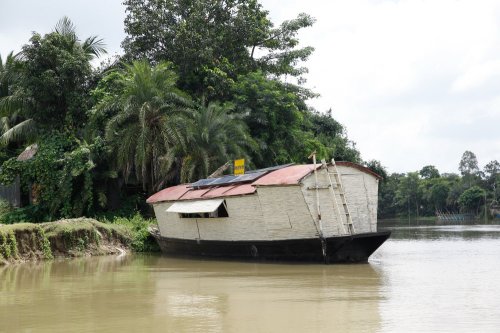
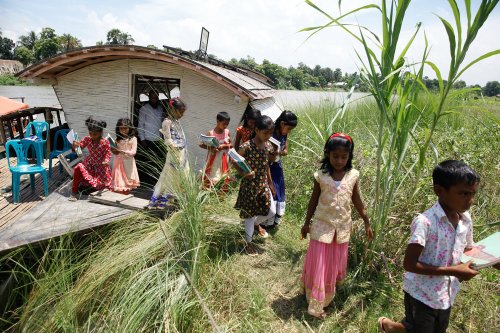
The nonprofit group Shidhulai Swanirvar Sangstha has a fleet of 23 school boats in Bangladesh. The boats pick up kids along the river, then pull over into the marshy riverbank to hold class.
Kids complain about school when school is a given, but what about when it is hard to access? I have been reading about a fire-ravaged county in California that has no schools right now (story here). California is sure to get it together before long, but what about poor countries with drastic education challenges?
Jason Beaubien reports about Bangladesh at National Public Radio (NPR). “On the Atrai River in the northwest of Bangladesh, a small beige boat is tied up in tall grass that lines the riverbank. The interior of the boat is packed with narrow benches which in turn are jammed with children.
“There are 29 students in this third-grade class and it would be hard to fit any more into the narrow vessel. The kids sit shoulder-to-shoulder facing a blackboard at the back of the boat.
“When the teacher asks for a volunteer to recite a multiplication table, 8-year-old Nila Khatun’s hand shoots straight toward the unpainted ceiling.
“She leads the class in a chant that begins with ‘6 times 1 equals 6’ in Bengali. They end with ‘6 times 9 equals 54.’
“Educators in Bangladesh have a problem. Not only do they face many of the same challenges as teachers in other resource-poor countries — funding constraints, outdated textbooks, overcrowded classrooms — they also have to worry about monsoon rains. Flooding is so common in Bangladesh that students often can’t get to the classroom.
“So one local charity has decided to take the classrooms to the students in the form of schools on boats.
“This boat is one of 23 floating year-round schools in this part of Bangladesh run by Shidhulai Swanirvar Sangstha, a local nonprofit group. …
“Mohammed Rezwan, the founder of Shidhulai Swanirvar Sangstha, grew up in this part of Bangladesh.
” ‘If you visit these areas you’ll find that during the monsoon season they get isolated,’ he says. ‘It becomes very difficult to have the normal life.’ …
” ‘In the rural areas. the parents are mostly concerned with the safety of the girls,’ he says. ‘If they [girls] have to travel a long way to go to school, then the parents would not let them go to school.’ …
“That’s true for the family of third-grader Nila. Her mother Musa Khatun says that if it wasn’t for the floating school, Nila probably wouldn’t be in school at all. …
“Khatun says that during the monsoons the village is only accessible by boat. Their family primarily survives by raising jute in the nearby plains. The long, fibrous plant is used to make burlap bags. Nila’s mother, however, sees a different future for Nila. She says Nila is the smart one of the family. No one in their family has ever gone to college, yet Khatun insists her daughter is going to be a doctor.
“And Nila nods her head enthusiastically.”
More here, including eleven wonderful pictures.
When class is done for the day, the boat putters along the river to drop off its students.


 Suzanne's Mom's Blog