Feeds:
Posts
Comments

Posts Tagged ‘shipping’

Photo: Seabound.
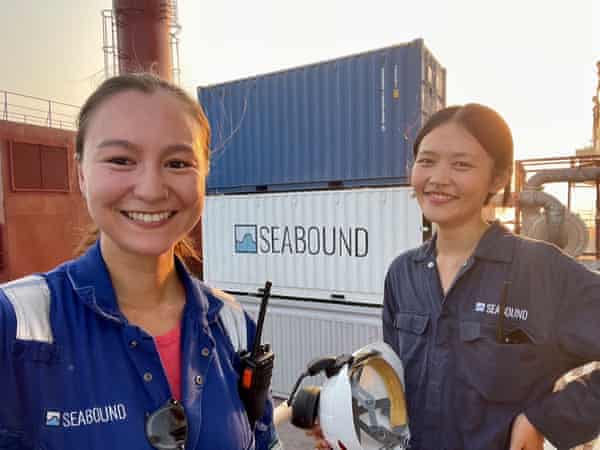
Seabound co-founders are chief executive Alisha Fredriksson (left) and chief technology officer Rojia Wen. Seabound’s carbon-capture prototype sailed for two months on a midsize container ship. 

Today’s story is about two women in the male-dominated shipping industry and their work on what might be a stepping stone to sustainability. The challenge is that the process to create their carbon-absorbing pellets also involves carbon release.

Emma Bryce writes at the Guardian, “An industrial park alongside the River Lea in the London suburb of Chingford might not be the most obvious place for a quiet revolution to be taking place. But there, a team of entrepreneurs is tinkering with a modest looking steel container that could hold a solution to one of the world’s dirtiest industries.

“Inside it are thousands of cherry-sized pellets made from quicklime. At one end, a diesel generator pipes fumes through the lime, which soaks up the carbon, triggering a chemical reaction that transforms it into limestone.

“With this invention, Seabound, the company behind it, hopes to capture large amounts of carbon directly from the decks of cargo ships, and help clean up this strikingly polluting industry. …

“Behind all this is Alisha Fredriksson, a young entrepreneur who once dreamed of being a doctor but reached a turning point in her career after reading a report from the Intergovernmental Panel on Climate Change that detailed the global implications of 2.7 F degrees versus 3.6 F degrees of warming.

“ ‘That’s when I realized that everyone around the world will be affected by the climate crisis, and so if I cared about large-scale social impact, the best thing I could do would be to help tackle it,’ says 30-year-old Fredriksson, chief executive of Seabound. …

“Trials have shown that her invention can scrub most of the carbon from the ship exhaust, filtered through its lime-pebbled interior. Ultimately, the goal is to have this device strapped to ships across the world’s oceans, she says. …

“She and her co-founder, Roujia Wen, hit on the idea of scaling down the existing quicklime-based carbon-capture technology typically employed at industrial plants. They then made a prototype, and attracted about $4m in funding from investors. Some of this came from shipping companies. ‘It all happened really quickly. Suddenly we had money, and we had to go build it,’ says Fredriksson. …

“Since then, successive prototypes of the Seabound container have taken her from the company’s test-bed in east London, to … a three-week voyage to test its efficiency. This showed that a Seabound unit can capture 78% of all the carbon from the exhaust that is pumped through it, and 90% of the sulphur, a toxic air pollutant.

“The latest prototype is being built to the dimensions of a standard 20ft shipping container, so that it can seamlessly slot in with cargoes on deck, Fredriksson says. … Once in port, the limestone-filled units can be substituted for containers of fresh quicklime. This product is made by heating limestone to high temperatures in kilns, an energy-intensive process that also releases CO2 from the limestone, making production extremely carbon-intensive.

“Companies are trying to make quicklime using kilns heated with renewable energy, or developing methods to capture the released CO2 so that it doesn’t enter the atmosphere. Seabound is working to source this ‘green’ quicklime, Fredriksson says. …

“Some critics are concerned that decarbonizing technologies could distract from solutions, such as zero-emission ammonia fuel or wind-powered innovations, that are essential to push the shipping industry to net zero.

“ ‘The potential for short-term use of carbon-capture retrofits on existing vessels should not become a justification to extend the lifespan of fossil fuels or delay the shift to truly sustainable alternatives,’ says Blánaid Sheeran, climate diplomacy policy officer at Opportunity Green, a nonprofit organization focused on gaps in global climate policy.

“But Fredriksson believes Seabound’s technology could support this transition. In April, at a meeting of the International Maritime Organization, UN member states agreed to a landmark deal that will start charging ships for every ton of emissions above a threshold. That threshold will gradually decrease to push the industry towards green fuels.

“Seabound slots into this new regulatory landscape, according to Fredriksson, by enabling ships to decarbonize their fuels, thereby lowering their emissions, and gradually adjust to the rules by adding more containers over time. …

“Fredriksson says [Seabound’s] offering is cost-effective and she has already had a commitment from one company to fit the first full-scale containers on to its ships this year.”

More at the Guardian, here. No firewall. Donations sought.
Read Full Post »

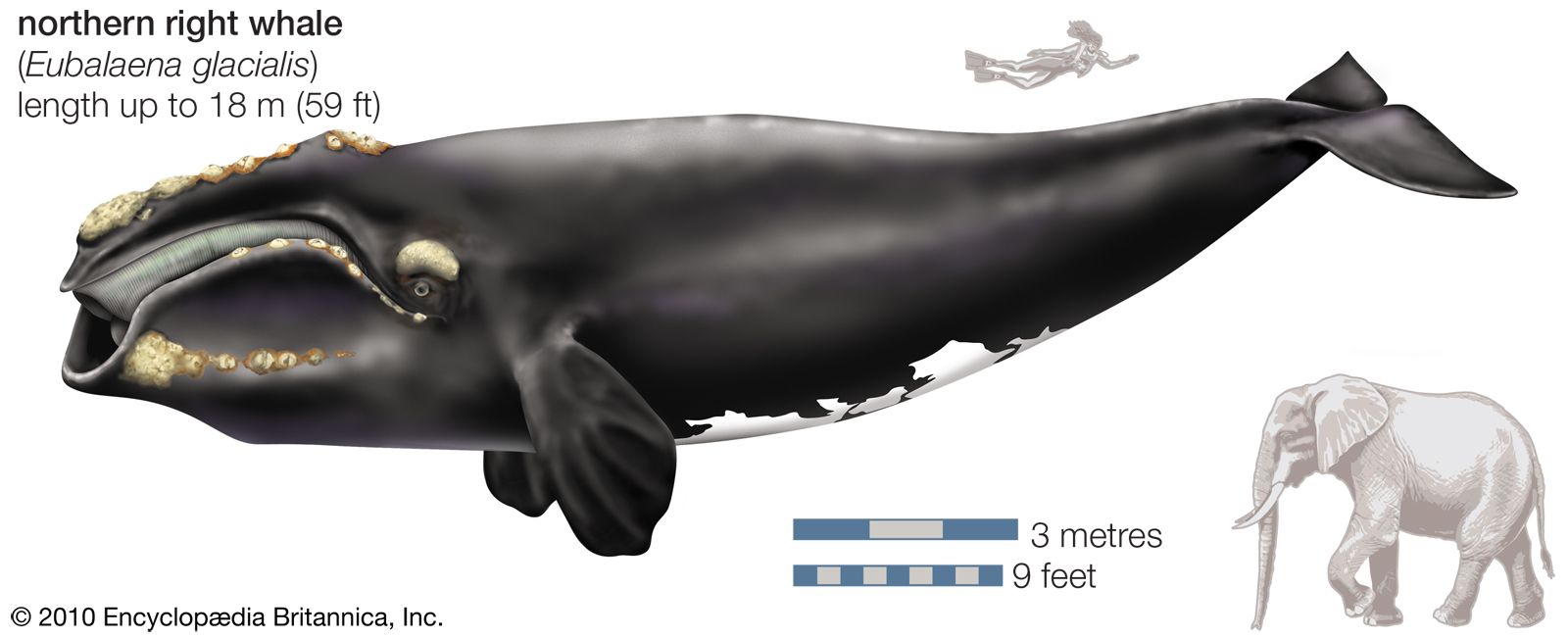
As the website Right Whale Festival notes, “The North Atlantic right whale (Eubalaena glacialis) is a federally protected ​endangered species.” Fewer than 350 exist today. Recovery is hampered by a slow reproduction rate and threats from entanglement in fishing nets and collisions with vessels.

Last week, I was talking to my younger grandson about elephants, and the conversation morphed into the topic of endangered species. He told me that the most endangered marine animal is the vaquita. I mentioned the right whale.

Today’s story is about an ocean scientist who is using drones and satellites to protect whales. Tatiana Schlossberg wrote about him for the Washington Post.

“Just yards from the Fish 1, a 22-foot research vessel, a humpback whale about twice the size of the boat hurled itself out of the water, sending shimmering droplets in a broken necklace of splash. In the other direction, a hulking cargo ship, stacked high with containers, crept closer.

“Aboard the Fish 1 … ocean scientist Douglas McCauley wanted to see whether the near real-time detection system he and his colleagues had developed, Whale Safe, could avert collisions between whales and ships in the Santa Barbara Channel.

“The tool represents one of the ways McCauley, who heads the Benioff Ocean Science Laboratory at the University of California Santa Barbara, is working to protect the ocean even as it becomes more industrialized. By collecting data from several sources — an acoustic monitoring buoy that listens for whale songs, identifies them according to species with an algorithm and sends that information to satellites; a predictive habitat model for blue whales; and sightings logged in an app — Whale Safe forecasts to ships the chances of meeting a whale. Then, it grades shipping companies on whether they actually slow down to 10 knots or less during whale migrations, from May 1 to Dec. 15.

‘We can literally watch all of the ships in California and across the whole ocean; we are better positioned than ever before to try to track damage as it occurs, or before it occurs,’ McCauley said. …

“Humans have worked in the seas for centuries: fishing, seafaring and more recently, drilling for oil and gas and the development of offshore wind farms. Shipping lanes cross almost every surface of the sea, except for shrinking swaths of the Southern and Arctic Ocean. …

“In meetings with corporate executives and political leaders, McCauley has made a consistent argument: Protecting the sea is in our interest, since it already does a lot of the work for us.

“In 2020 McCauley led a report that provided a framework for marine protected areas on the high seas, finding that such refuges could be powerful tools for biodiversity conservation, carbon sequestration and climate resilience. Even port and fishing communities, he argued, depend on an ocean that is still wild and alive. …

“The encounter in late September, amid one of the world’s busiest shipping channels and a vibrant ecosystem, offered a glimpse of how to do just that. Minutes after the container ship had passed McCauley’s boat, the whale — possibly the same one, but it is hard to tell — had found another [whale], and the two sent up exhales of spray.

“It was as if a bulldozer operator had plowed through a herd of elephants without stopping, not too far from a major city’s downtown, hoping to avoid a crash. And it happens many times a day here in the Santa Barbara Channel, even though barely anyone sees it. …

“The ocean is, by far, the world’s largest carbon sink, having absorbed about 40 percent of the excess greenhouse gasses from burning fossil fuels. But it comes at a cost: more acidic and warmer waters, which may not soak up as much carbon going forward. The fact that ocean animals evolved to a narrow range of conditions, McCauley and others found, makes them more vulnerable to climate change. …

“He learned through experience: What is good for the ocean is also good for people, and possibly business too. Slowing down ships means fewer ship strikes, which means more whales. That is good for biodiversity and climate change: Whales themselves are carbon sinks and fertilize plant growth (another carbon sink). …

“Three shipping companies contacted for this article, as well as an industry association, said that they supported such programs. CMA CGM, among the world’s largest shipping container companies, is sending alerts above medium directly to their captains, and Hyundai Heavy Industries is working with Whale Safe to incorporate its data directly onboard new ships.

“But some of the firms tracked by the tool, which has recently expanded its use to include San Francisco, have received F grades. Matson Navigation, for example, only slowed down roughly 18 percent of the time.

“Lee Kindberg, the head of environment and sustainability for Maersk, which received a B for slowing down in about 79 percent of cases, said the company supports Whale Safe. But she added that shippers must balance safety and speed restrictions against weather and demands from companies — and their customers — who want everything faster.”

More at the Post, here.

Read Full Post »

gettyimages-510594876-19f88f4c460b1a2c1af5df525f58bc94a9eb24d1-s600-c85

Photo: John Greim/LightRocket via Getty Images
The world’s largest container-shipping company, Maersk, has promised to make its operations zero carbon by 2050. Doing so will require using new fuels, such as hydrogen.

Would you pay more for goods delivered on ships that don’t use fossil fuels? Many people can’t afford to pay more, so sometimes the idea of cutting our dependency on oil and coal seems impossible. Fortunately — because they don’t know what’s impossible — young people are leading the charge.

But even corporations are starting to think it would be to their advantage to go carbon free. Maersk, the world’s largest container-shipping company, based in Denmark, is one such corporation. And there are others.

As Rebecca Hersher reported at National Public Radio (NPR), “The global shipping industry is enormous — thousands of ships carry billions of dollars of goods each year across nearly every ocean on the planet.

“Those ships run mostly on a particularly dirty type of fuel known as heavy fuel oil, or bunker fuel. It’s thick and sooty, and when it burns, it emits sulfur and particulate matter that can cause respiratory illness. It also emits greenhouse gases, including carbon dioxide and methane, which trap heat in the atmosphere and cause global warming.

” ‘If shipping was a country, it would be the sixth-largest polluter in the world,’ says Nerijus Poskus of the shipping technology company Flexport. ‘About 3% of global emissions are released by ocean freight shipping.’

“The industry is growing so steadily, he says, that it’s projected to produce more than 15% of global greenhouse gas emissions by midcentury if ships continue to burn the same fuel, which is a real possibility considering that most cargo ships are designed to last at least 30 years.

“Yet there are signs that the status quo is changing and that a new fuel could make cargo ships among the cleanest transportation methods on Earth. …

“The international body that helps create global shipping regulations has clamped down on emissions of some air-polluting substances when ships are in or near ports. The new regulations, which started going into effect in 2012 and which decrease limits dramatically in January 2020, require ships to significantly cut the amount of sulfur pollution they emit when they’re near land. For the U.S., the regulations apply anywhere within 200 miles of its coastline. …

“Additional increasingly stringent emissions standards are planned for the next two decades. The largest container-shipping company in the world, Maersk, announced in 2018 that it intends to make its operations carbon free by 2050, though it’s still unclear how the company would achieve that goal.

“What is clear is that success will require new ships, new engines and — above all else — a new fuel. … Research at the U.S. Energy Department’s Sandia National Laboratories suggests that of [liquefied natural gas and hydrogen], hydrogen is the most promising.

“Using hydrogen to generate electricity is very clean. Hydrogen fuel cells combine hydrogen with oxygen and create electricity and water. The electricity can be used to turn a propeller, for example. The exhaust from fuel cells is moist air — with no greenhouse gases. …

“Leonard Klebanoff, a researcher at Sandia … and his then-research partner, Joe Pratt, started systematically analyzing whether current ships could be retrofitted to run using hydrogen fuel cells instead of fossil fuels.

“Pratt says the project started when a San Francisco Bay ferry operator asked the Energy Department whether it was possible to switch his fleet over to hydrogen power. … The answer, they found, was yes.

“The main issue was about size. For each unit of energy, liquid hydrogen is about four times larger by volume than conventional diesel … but ‘the efficiency of a fuel cell is about twice as much as a diesel engine,’ Klebanoff says. …

“When they analyzed the entire system, Klebanoff and Pratt found that it would be possible to retrofit most types of existing vessels to run on hydrogen and even easier to construct a new ship powered by fuel cells.”

Read more at NPR, here.

Read Full Post »

Image: Wallenius Wilhelmsen Logistics
Wallenius Wilhelmsen Logistics scooped two Singapore Environmental Achievement Awards for sustainability.

In The Sea Around Us, Rachel Carson suggested that Earth’s oceans might be too vast for humans to completely ruin. At least that’s what I remember, but I was only 14 when I tried to tackle the grown-up books on my new school’s summer reading list.

I wonder what Carson would say now, given that increased carbon dioxide is damaging reefs and many sea creatures.

She might also be concerned about shipping, but as Hannah Koh reports at Eco-Business, sustainable practices are starting to appear.

“Despite being in an industry that is predisposed towards environmental degradation, Swedish-Norwegian shipping company Wallenius Wilhelmsen Logistics (WWL) has not let the circumstances define it.

“The company has been proactively putting in place measures to reduce sea and airborne pollutant emissions and set up an international coalition to champion the enforcement of sulphur emission regulations – critical to minimising the impact of the shipping industry.

“Its initiatives impressed the judges of the Singapore Environmental Achievement Awards – which aims to increase the level of awareness and adoption of good environmental approaches within organisations, held by the non-profit Singapore Environment Council – that WWL won the SEC-CDL Outstanding Singapore Environmental Achievement Award and the SEC-MPA Singapore Environmental Achievement Award (Maritime).

“Speaking to Future Ready Singapore in a phone interview, WWL’s head of sustainability Anna Larsson shares that the company’s award-winning approach to sustainability is guided by a combination of its long-term vision as well as immediate-term targets.

“Having and acting on a sustainable vision for the future has reaped rewards for WWL, from saving costs to staff retention, and prepares WWL for the future of the shipping industry today, which challenges companies to balance their bottom lines against their environmental impacts. …

“Ship operators today are under pressure to clean up their act, especially after the United Nations shipping agency ruled in October 2016 to implement a global sulphur cap of 0.5 per cent by 2020. …

“Experts have estimated that this will cost the industry some US$35 to $40 billion alone for the container shipping industry, at a time when the shipping industry is suffering its worst downturn ever.” More here.

Gotta love those Swedes for biting the bullet!

Read Full Post »

In a recent post, we described homes being made out of shipping containers. But an architect friend cautioned that it’s not easy to get all the permits for something like that, asking, “How many how many people do you know who would welcome a container home in their neighborhood?”

Well, here’s a story about shipping containers recycled for something that might be more manageable.

Yvonne Abraham writes at the Boston Globe, “On a blah gravel lot in East Boston sits an especially cool example of the human ability to invent and adapt. Spend enough time here, and even the most dedicated pessimist might feel hopeful about the future.

“It’s not much to look at from the outside: four recycled freight containers, painted a friendly shade of green, sharing a patch of land with some trucks at the base of Eagle Hill.

“But inside those containers, it’s spectacular. Disco-lit by thin ribbons of red and blue LED lights, all manner of leafy greens grow in long PVC planters that hang from the ceiling in tight rows. The hydroponic plants are watered and fed by an ingenious, and remarkably efficient, irrigation system. Lush and bursting with flavor, they’re neatly harvested in seconds and then it’s on to restaurants all over the city.

“These containers — which make up an operation owners Connie and Shawn Cooney have named Corner Stalk — hold the equivalent of a four-acre farm. The Marblehead couple came to farming just a couple of years ago. Connie, 63, taught in public schools for 35 years, and Shawn, 61, was a tech entrepreneur. …

“They both wanted to try something new, and they believed in what the guys who make the containers — Boston-based Freight Farms — are doing: creating computer-controlled environments that can grow produce year round, anywhere where there’s electricity and a water supply.” Read how the business grew — and where it’s headed — at the Boston Globe.

Photo: http://www.CornerStalk.com

Read Full Post »