Feeds:
Posts
Comments

Posts Tagged ‘shipwreck’

Photo: Ilan Ben Zion.
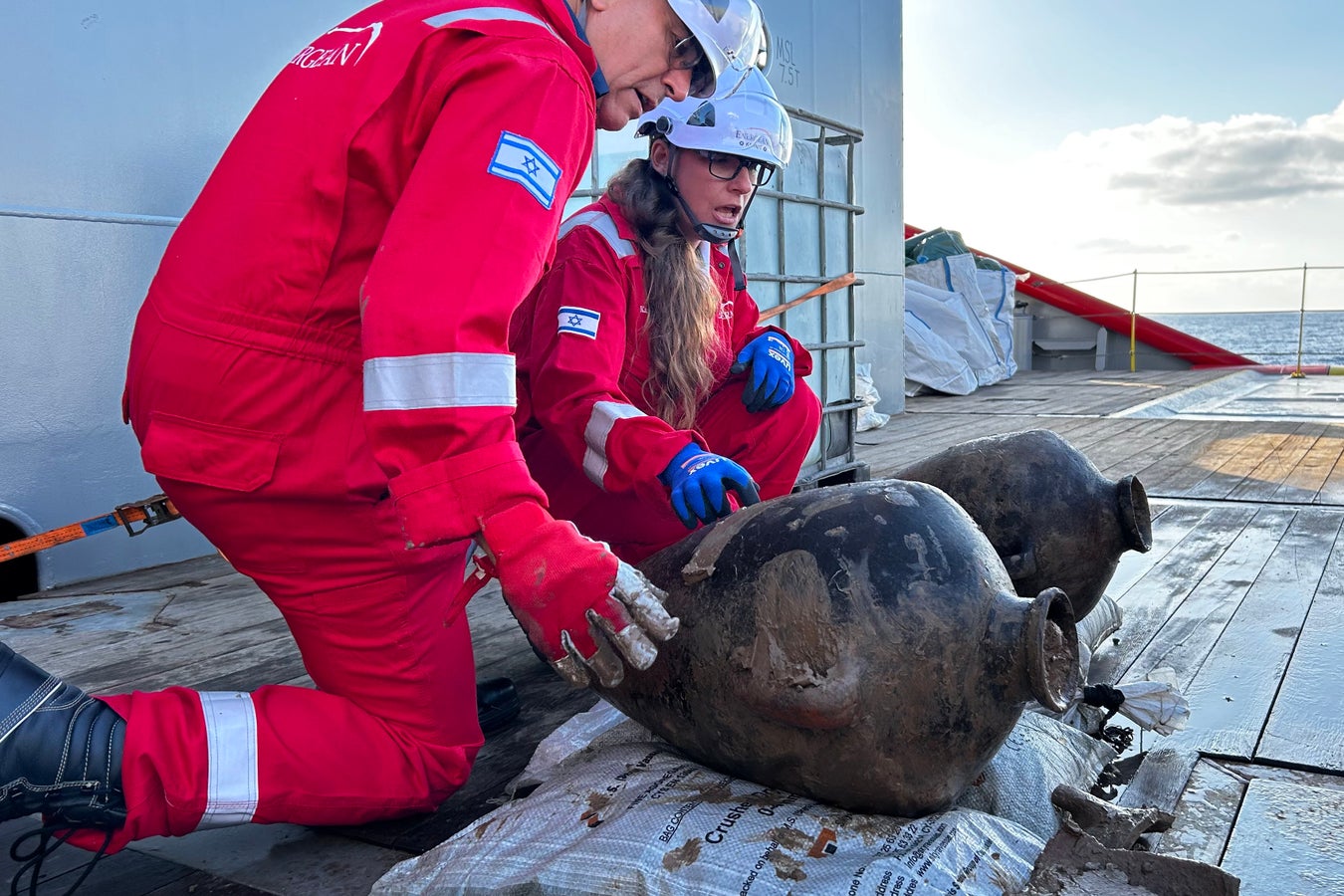
IAA archaeologist Jacob Sharvit (left) and Energean environmental lead Karnit Bahartan examine Canaanite storage jars retrieved from the seafloor of the Mediterranean on May 30, 2024. They are from the Bronze Age (which ran about 3300 to 1200 BC, according to Wikipedia). 

Judging from past comments here, we all like archaeology stories, especially those that explore the mysteries of shipwrecks. It must be something about realizing that nothing is ever completely lost.

At Scientific American, Ilan Ben Zion reports on the recent discovery of a Bronze Age shipwreck in the Mediterranean.

“Golden sunlight fell on the two amphorae, still caked in brown ooze, as they breached the Mediterranean’s waves. Their ascent from the seafloor, more than a mile down and 60 miles from land, had taken three hours. It was the first daylight they had seen in at least 3,200 years, and they came from the only Bronze Age shipwreck discovered in deep waters.

“Archaeologists retrieved these Canaanite storage jars, just two from a cargo of dozens located far off northern Israel’s coast in May.

” ‘It’s the only ship from this period that was found in the deep sea,’ one of the final frontiers of archaeology, says Jacob Sharvit, director of marine archaeology at the Israel Antiquities Authority. Only a handful of other Late Bronze Age ships have been discovered — all of them in shallow coastal waters of the Mediterranean Sea, including in the Aegean Sea.

“Sharvit helped spearhead a complex archaeological operation far offshore, along with the Israel Antiquities Authority (IAA) and offshore gas firm Energean to retrieve the jars from the seafloor.

“In the Bronze Age people shipped these storage jars across the Levant starting around 2000 B.C.E., when maritime trade in the Mediterranean exploded.

“ ‘They’re always either pointy or rounded at the bottom,’ so they rock with ship’s motion but don’t tip over and break, says Shelley Wachsmann, a nautical archaeology expert at Texas A&M University, who was not involved in the research.

“These workaday ceramics evolved so consistently over the centuries that they can be reliably dated with an examination of their shape and design. Based on the recently discovered jars’ neck, the pronounced angle of their shoulders and their pointed base, these amphorae are estimated to date to between 1400 and 1200 B.C.E., the IAA said in a recent press release.

“At that time, the ship and its crew sailed a world of prolific international trade, diplomacy and relative stability in the eastern Mediterranean, which was dominated by the Egyptian and Hittite empires. Merchant ships carrying olive oil, wine, ores, timber, precious stones and numerous other goods plied the seas between Greece, Cyprus, Anatolia, the Levant and Egypt.

” ‘This is the time that the Mediterranean is globalized,’ says Eric Cline, a professor of archaeology at George Washington University. ‘You’ve got lots of commerce, lots of diplomacy and lots of interconnections’ between the Egyptian, Hittite, and Assyrian empires and the lands between them, says Cline, whose newly published book, After 1177 B.C.: The Survival of Civilizations, explores the aftermath of the collapse of this Late Bronze Age international order.

In our own era of globalization, this disintegration draws particular interest among scholars looking for clues into how stable civilizations foundered in the past.

“The first signs of the shipwreck surfaced in 2023, during an environmental survey that Energean conducted ahead of its development of a new undersea natural gas field. The survey’s sonar scans were meant to locate and protect deep-sea ecological hotspots from undersea construction, says Karnit Bahartan, Energean’s environmental lead.

“Subsea surveys of the nearby Leviathan gas field conducted in 2016 by Noble Energy (now part of Chevron) reportedly turned up at least nine deep-sea archaeological sites, including a Late Bronze Age shipwreck. But details of the finds were never disclosed, and the sites were never excavated, according to a Haaretz report in 2020.

“ ‘What we were doing is looking for sensitive areas, sensitive habitats, anything that can be worth saving,’ Bahartan recalls.

“Closer examination of the sonar hits revealed that most were modern trash, Bahartan says as she flips through photographs taken by a remotely operated vehicle (ROV). The images show plastic bags, deck chairs, oil drums and a porcelain toilet, seat included. Occasionally, she says, she and her colleagues might find a solitary amphora or ceramic fragments.

“But one sonar blip turned out to be a large assemblage of jars jutting out of the seabed. ‘I didn’t know if it was something dramatic or not. I just sent it to the [Israel] Antiquities Authority,’ Bahartan says.

“Energean offered the IAA a ride onboard the Energean Star, an offshore supply and construction vessel. … Six hours out of Haifa’s port, the Energean Star hovered over the wreck’s coordinates, and a crane lowered a truck-sized, canary-yellow-and-black ROV into the sea. It took an hour to descend to the bottom. Nearing the seabed, operators released the ROV toward the site. …

“Dozens of jars, nearly identical and about half a meter long, clustered in an oblong patch roughly 46 feet long and 19 feet across. … The ROV circumnavigated the wreck, taking a high-resolution video that would be stitched into a photomosaic of the site. Sharvit picked out a couple jars from the fringes that could be extracted with minimal disturbance.

“Sharvit had hoped to find the ancient crew’s personal effects to help nail down the ship’s origin but spotted none. The IAA is running a so-called petrographic analysis of the ceramics to try to pinpoint where they came from; analyses of residue and trace elements could help identify their contents.

“Cline, who was not involved in the IAA mission or its preliminary study, says the proposed date ‘would place the wreck right in the middle of the most interconnected period of the Late Bronze Age in the Aegean and eastern Mediterranean, which is exciting.’ ”

More at Scientific American, here.
Read Full Post »

Photo: Rob Schoenbaum/The Guardian.
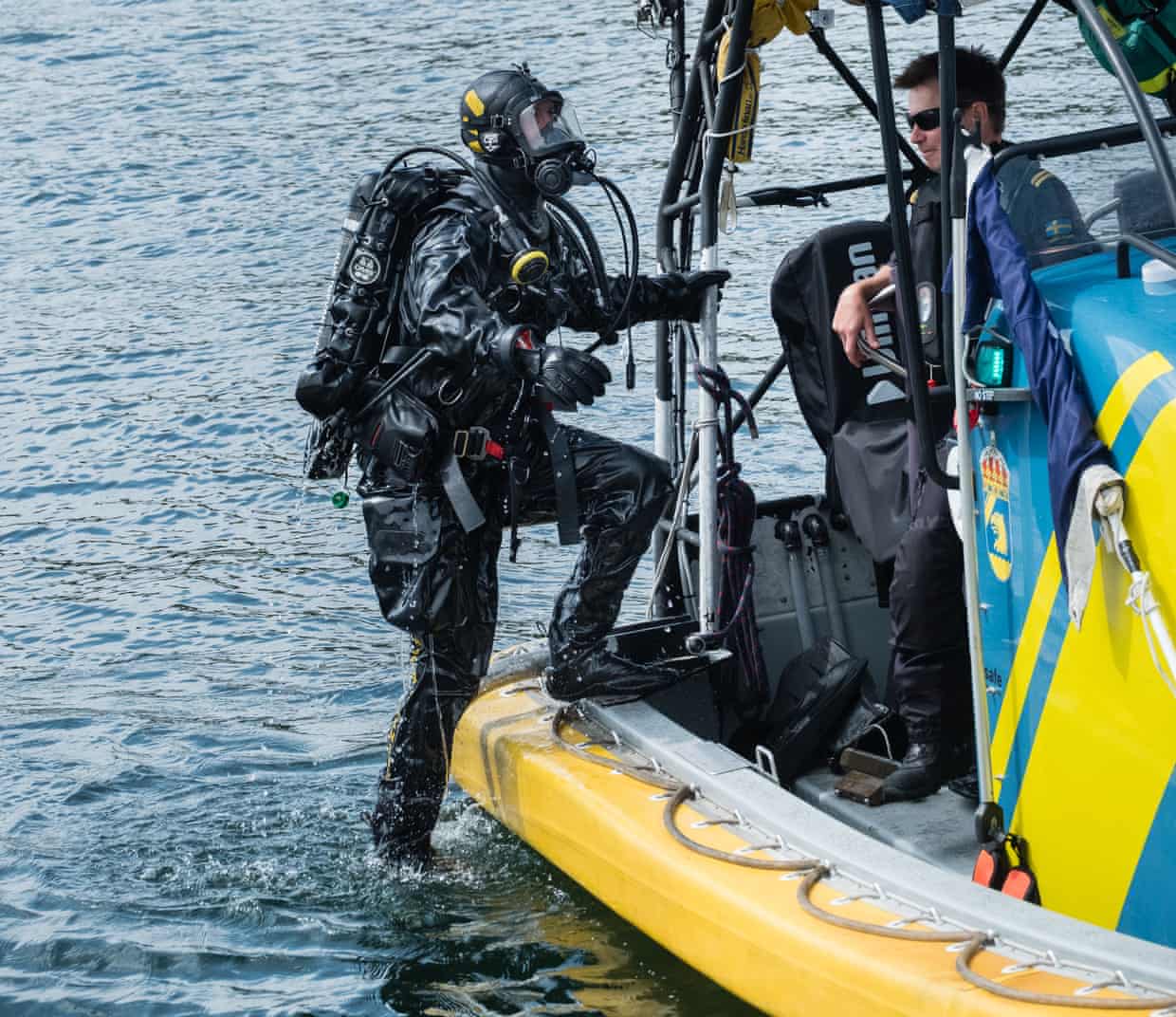
A Swedish coastguard diver exits the water after inspecting a wreck.

So many different kinds of work in the world! Today’s article, from the Guardian, describes an unusual job in Sweden. It involves going underwater to protect old shipwrecks from looters.

Miranda Bryant writes, “Among the rocky shores and wooden summerhouses of Dalarö, an exclusive Swedish summer retreat, there was little to indicate anything other than a typical summertime scene on the Stockholm archipelago.

“It was only as the coastguard boat reached a discreet yellow buoy that there was any suggestion of the 17th-century shipwreck lying, preserved, 30 metres beneath it. ‘STOP,’ read a sign. ‘Marine cultural reserve.’

“Bodekull, built by the English shipbuilder Thomas Day, is believed to have run aground in 1678 and sunk while transporting flour to the Swedish naval fleet in Kalmar, down the coast in south-east Sweden.

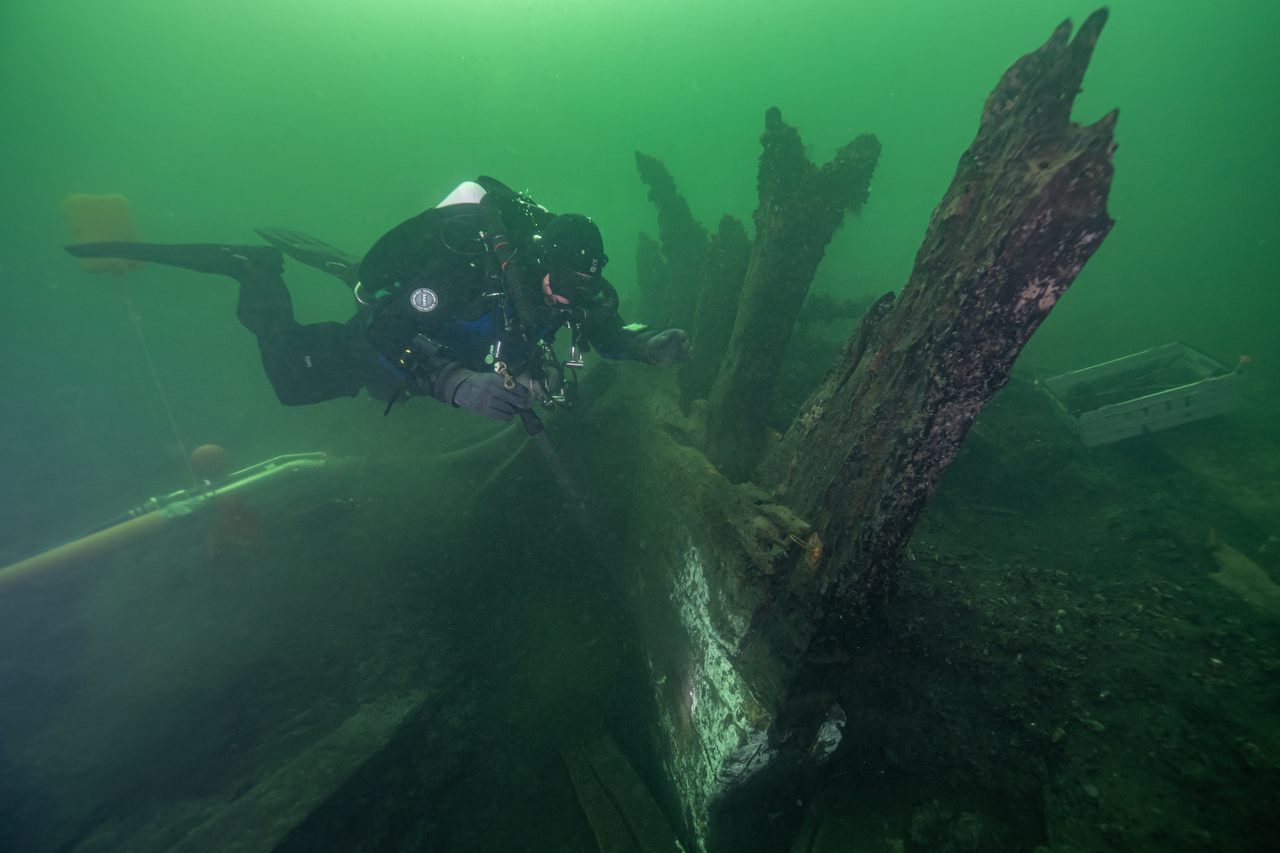
“Thanks to the Baltic’s brackish water protecting the wreck from shipworms, the 20-metre-long ship remains on the seabed, upright and largely intact, full of relics that are still being discovered. Two of its three masts poke up towards the sky in their original position.

“But now Bodekull faces a human threat to its existence. Authorities say that it is among thousands of historic wrecks across the Nordics that are at risk from plundering.

“On a monitoring operation last week, experts shared photographs with the Guardian that show that objects are vanishing from shipwrecks.

“Those responsible are believed to be a diverse array of offenders, from light-fingered sport divers in search of souvenirs to criminal gangs looking for high-value objects to sell. Such is the scale of the problem that the coastguard is now regularly sending divers down to monitor at-risk sites.

“ ‘The plundering problem isn’t just a Swedish problem, it’s a Baltic Sea problem,’ said Jim Hansson, a marine archaeologist at Vrak, the museum of wrecks, citing the sea’s low salinity and comparatively shallow average depth of 55 metres.

“These unique conditions, as well as the existence of an estimated 100,000 shipwrecks, make the Baltic a ‘mecca for marine archaeologists,’ he said. But it’s also increasingly attracting looters. Around Stockholm alone, Hansson knows of six wrecks that have been looted by international and Swedish divers. …

“ ‘Sweden has one of Europe’s longest coasts so it’s a lot of water to guard and it isn’t easy,’ said Hansson. …

” Coastguard divers normally work on environmental disasters, inspect ships for drugs and weapons and help police looking for murder weapons. ‘It is very unique for us to be part of this,’ [Patrick Dahlberg, a coastguard commander] said. …

“[On August 1] Coastguard diver Patrik Ågren said he didn’t see any evidence of tampering as he emerged from recording the contents of a tool drawer on the ship containing planes, sledgehammers, a basket and carpentry equipment. … Video footage he recorded during the dive will be compared with previous footage to check for changes.

“But on a later dive they discovered that a wheel on a cannon had been removed, a deck beam collapsed and a wine bottle moved since they last visited in January. While some of the changes may have been caused by nature, Hansson said it was difficult to see how the wheel and wine bottle could have been moved without human intervention. …

“Hansson said removing relics from wrecks prevented them from building a full picture of the type of ship, where it was going and what it was doing.

“ ‘We collect all the puzzle pieces just like a police or coastguard investigation,’ he said. ‘That’s why it is super important that objects are not moved because it is like ripping the pages from a book. In the end all you will have left is an empty shell.’

“Amid heightened tensions with Russia after its invasion of Ukraine, allegations of spying and Sweden’s hopes of imminently joining Nato, it is a critical time for the Baltic.

“But Hansson said that cultural monuments could also be used in war. ‘What happened with Nord Stream [gas pipeline bombings] could similarly happen with national cultural heritage monuments like shipwrecks. The first thing that happens with big conflicts is that you erase a nation’s integrity and history.’ ”

More at the Guardian, here.

Read Full Post »

Photo: Brett Seymour.
A trove of spices was found in the stern of the ship by Brendan Foley and a team of archaeologists. It had been there for centuries.

For those of us who hope that one day the lost island of Atlantis will be found, any story about underwater discoveries of ancient artifacts is thrilling.

Line Sidonie Talla Mafotsing writes at Atlas Obscura, “Built 1485, the Danish warship Gribshunden served as the flagship and mobile seat of government for King Hans of Denmark and Norway. In the summer of 1495, Hans set sail for Kalmar, Sweden, where he was set to negotiate with Swedish leader Sten Sture the Elder. The goal of the mission was to convince Sten Sture and the Swedish council to give up their sovereignty and rejoin the Kalmar Union, which had unified much of Scandinavia under a single ruler (and which Sweden had left a few decades before, despite the union being named for a Swedish town).

“The ship itself had a role to play: to show Hans’s authority to the Swedish council. It was also laden with goods — from gunpowder weapons to artwork to delicacies — to demonstrate his power.

“However, while anchored in the Baltic Sea near the port of Ronneby, Sweden, Gribshunden mysteriously caught fire. Though the king wasn’t on board at the time, many crewmen were, in addition to all those pricey goods. Although the exact number of deaths is unknown, many of the crew of 150 were on board when the ship sank to the bottom of the Baltic with its precious cargo. …

“In the 1970s, a local diving club came across a mysterious wooden wreck there, in 33 feet of water. It wasn’t until 2001 that the first archaeological excavations of the ship began, after one of the divers told local archaeologists about what they had found. It was another decade before the remains were identified as those of Gribshunden. All through the excavation of the wreck, remarkably preserved by the cold waters of the Baltic, amazing and sometimes odd artifacts have emerged and attracted media attention. In 2015, there was a nearly perfectly preserved wooden ‘sea monster’ figurehead. In 2019, archaeologists discovered a well-preserved rare Atlantic sturgeon. Further excavations in 2021 revealed something even more remarkable: a treasure trove of spices, plant material, fruits, nuts, and cereals, that somehow survived underwater for more than 500 years.

“In a study published in the journal PLoS ONE, Brendan Foley and Mikael Larsson, archaeologists at Lund University in Sweden, examined the finds for new insights into how nobility lived and ate during the Middle Ages, and shed light on how these organic materials survived so long underwater.

“Foley and a team had been excavating the stern when they made the finds. ‘We think, but we’re not sure, that the back part of the ship is probably where the highest ranking individuals were situated,’ says Foley. They sifted through the sand and silt and revealed almond shells and peppercorns. They recovered thin strands of saffron by hand. ‘We took four samples of botanical assemblage that included both local and exotic spices, fruits, and vegetables,’ says Larsson, including black mustard, dill, clove, ginger, cucumber, grape, and berries such as blackberry and raspberry. ‘The botanical remains that really stand out are the exotic spices,’ he says. Clove, ginger, and saffron had never been found before in the medieval Baltic.

Larsson says that their work is the first anywhere in the world to find saffron in such a setting. …

“Though the geographical origins of saffron are not completely understood, it is thought to have originated in the eastern Mediterranean, and been grown in Southwest Asia and the Mediterranean basin. Ginger is believed to have originated in Southeast Asia, and cloves are native to Indonesia. Black pepper comes from South India. Despite this time being known as the ‘Dark Ages’ in Europe, the finds show that Scandinavia wasn’t just a backwater of the world economy. …

“[One] question focuses on how these delicate organic remains were able to survive in the Baltic. ‘It’s a mystery,’ says Foley. ‘We don’t know, we didn’t find any containers.’ When they found the saffron, it was just in a lump in the sediment. ‘No glass jar around it, no ceramic jar, no wooden box, no silver box,’ he says. It may have been stored in some sort of fine textile bag that disintegrated over the years—but somehow the spice remained.

“ ‘The Baltic Sea is really weird,’ Foley says. For one, it has the lowest salinity found in the global oceans. This, combined with low temperatures and low dissolved oxygen to feed microbes, have given the Baltic a reputation for remarkable preservation of archaeological material, specifically wooden shipwrecks.”

More at Atlas Obscura, here. No firewall.

Read Full Post »

Our 5-year-old grandson’s friend had been planning to attend an American Repertory Theater musical with her grandmother today at 10 a.m. We decided to go, too.

The show was The Pirate Princess and was loosely (very loosely) based on Shakespeare’s Twelfth Night. It was a hoot for me, and the young man in the photo seemed riveted. But whether he could make head or tail of the  convoluted plot, I have my doubts. It will be interesting to see down the road what he remembers — and whether he wants to see more plays.

The plot involves a brother and sister who get separated in a shipwreck (in this case, it’s thanks to a monster called the Kraken) and have separate adventures with characters who later mistake the sister dressed as a boy for the boy and vice versa. (I kept whispering in my grandson’s ear, “The pirate thinks he’s the girl that he thinks is a boy”; “The Queen thinks he’s his sister but doesn’t know his sister is a girl.” My grandson didn’t respond.)

There were songs, musical instruments, fancy costumes, pirates storming up lighted platforms in the middle of the audience, sword fights, and imaginative special effects. I especially like the jellyfish created by glowing umbrellas with streamers, carried along the aisles in the dark. The Kraken with his many legs was pretty great, too.

After the show, we had hot chocolate and cookies at the Darwin on Mt. Auburn Street. I’m not sure what our grandson will be able to tell his parents about the madcap entertainment he witnessed, but bits and pieces will likely emerge over time. I myself saw Peter Pan and Alice in Wonderland when I was four, but I didn’t become a theater nut until I was 10.

010216-hot-chocolater-after-theater

Read Full Post »