Feeds:
Posts
Comments

Posts Tagged ‘shortage’

Photo: Jacob Posner/Christian Science Monitor.
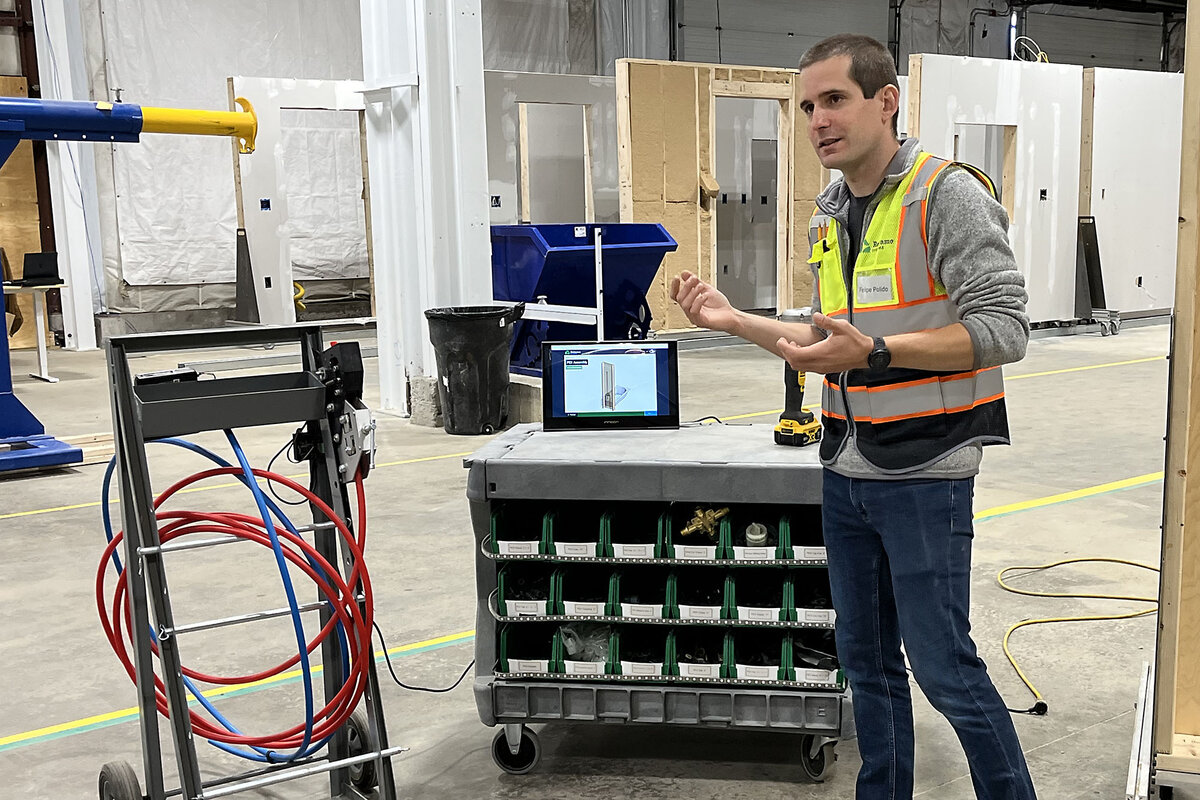
Felipe Polido, co-founder and head of technology at Reframe Systems, explains how the company uses robots and simplified processes in construction.

Innovations of the kind we continue to need in areas such as medicine, housing, and carbon reduction will probably rely more on entrepreneurs and businesses than on government for years to come.

I won’t be the one to begrudge any visionary a reasonable profit. In fact, the only thing that worries me about today’s story is the reduced need for human workers. See what you think.

Jacob Posner writes at the Christian Science Monitor about one company aiming to do so by benefiting others.

“A growing number of startups are trying to reinvent the U.S. homebuilding industry, with big goals of making it both more efficient and more climate-friendly. It is a disruption that many say is past due. The construction industry is not only struggling to meet housing needs but also is one of the country’s largest emitters of greenhouse gases. …

“Massachusetts-based Reframe Systems is among the new companies hoping to change one of the nation’s largest industries. Reframe is developing a ‘next generation’ modular construction method to build high-efficiency housing. Employees follow instructions on iPads to install plumbing and electrical components into robot-made walls, then transport these modules to construction sites, where they are stacked into multifloor units.

“But the challenges are myriad. Despite a huge influx of investor funding, the share of housing stock built through high-tech modular construction remains small. …

“[Recently a crowd] gathered to see a robot build a house. In a concrete-and-steel factory in Andover, Massachusetts, yellow-vested consultants, sustainable builders, and possible investors strain to see past a clear fence. Behind the barrier, a giant blue arm jutting from the floor comes to life.

“Its sensor-covered hand analyzes a pile of wood before emitting a loud hiss, then carefully suctions a two-by-four. Rotating at the shoulder and extending its elbow, the robot methodically delivers the plank to a partially completed wall.

“On the other side of the factory – about the size of a hangar for small planes – a few human workers are on their lunch break. They are employees of a three-year-old company called Reframe Systems, which is one of a growing number of startups across the United States scrambling to reinvent the homebuilding industry. …

“More than 100 startups have entered the industry in the past two decades, according to estimates by Tyler Pullen, a senior technical adviser at the Terner Center for Housing Innovation at the University of California Berkeley. He says there are likely more than 200 construction innovation companies currently doing business in the U.S.

“Like many of these, Reframe is focused on a new form of modular construction to upend one of the county’s largest industries. The company aims to create affordable, net-zero houses, which generate the same or more energy than they consume. Reframe CEO Vikas Enti says he can deliver a hefty return to investors – all while making a significant dent in the housing and climate crises. The next step, he says, is to build a factory that can produce 500 apartment units per year using lessons learned from his small, pilot factory in Andover. Then, he hopes to build a network of facilities across the country, varying their sizes to meet the demands and needs of their region. …

“So far, Reframe has completed one two-bedroom house. …

“The current model for modular construction – using assembly-line technologies to build homes – has its origin in the period after World War II. … But federal support for the movement dwindled, and in recent years, modular construction companies have mostly focused on the luxury housing market and sustainability-focused buyers. …

“The need for companies like Reframe is clear, modular boosters say.

“Energy consumed by residential buildings is responsible for around 15% of all U.S. emissions. Fossil fuels warm most of the country’s roughly 145 million apartment units and houses, in addition to keeping their stoves running and heating water. …

“Reframe was founded by roboticists who used to work at Amazon. Following instructions on iPads, its human employees insert plumbing and electrical wiring into the robot-made walls, turn them into ‘modules,’ and bring them to construction sites, where they are stacked into multifloor, highly energy-efficient homes. Because the iPad instructions are akin to a Lego or Ikea manual, Reframe can employ fewer high-cost, high-skill laborers.

“Having most of the needed professionals – electricians, plumbers, architects, engineers – under the same roof solves a problem of communication Mr. Pullen sees as endemic to the traditional construction industry. Every different professional involved must work together, but they are all ‘masters of their own kingdom,’ he says.

“While not all companies offer net-zero buildings like Reframe, Mr. Pullen says building in a factory setting lends itself to tighter structures that hold their temperature better. Plus, factory construction results in less waste. Companies know what they need to order for hundreds of projects at once; in traditional building, ad hoc orders require far more trucks and often leave behind excess material like piping and drywall.”

More at the Monitor, here. No paywall.

Read Full Post »

Photo: Serious Shea.
Community members stand by a tree planted in Senegal during the launch of the Great Green Wall Corporate Alliance, an initiative that is part of larger efforts to prevent desertification in Africa’s Sahel region. “Serious Shea,” says the Christian Science Monitor, “is transforming a previously firewood-dependent shea industry in Burkina Faso.”

When it comes to human rights and climate justice, corporations can get into the act. It can even boost their brand. Blogger Rebecca told me about a clothing company, Fair Indigo, where she buys clothes because the cotton is organic and she knows the workers are paid a fair wage. I myself have bought cotton towels at Patagonia, which has protected the environment for decades and now promises not to use cotton from Chinese forced labor.

At the Christian Science Monitor, Taylor Luck, Whitney Eulich, Ahmed Ellali, and Sandra Cuffe write about how various countries are working on water conservation — and how certain companies are helping.

“In Guatemala, farmers are setting up ‘living fences’ around fields, creating a buffer of roots to protect their soil during increasingly strong rainy seasons. In Jordan, local Bedouin communities and authorities are pioneering resilient desert agriculture in a region that has been hit by longer and more intense heat waves.

“And in Burkina Faso, William Kwende has been working to revolutionize shea butter production – by substituting renewable energy for traditional wood-burning methods that result in deforestation. He has introduced an approach with 100% renewable energy, self-sustaining biomass burners, and a closed water system, which is curbing emissions while also reducing crop losses. 

“At a time of global strain on food production, including an emerging famine in parts of East Africa, his story symbolizes the potential for using innovation to adapt to a changing climate.

The business Mr. Kwende co-founded, called Serious Shea, is designed to promote reforestation and to secure fairer wages and independence for the local women at the heart of the process. 

“A key part of the innovation: Serious Shea’s eco-processing centers transform shea tree biomass into natural biofertilizer and biochar, enriching soils that are at risk of desertification and reducing reliance on expensive imported chemical fertilizers. 

“ ‘People talk about water and food imports, but when you talk about food crises and adaptation, fertilizer is at the heart of it,’ Mr. Kwende tells the Monitor on the sidelines of COP 27 [Conference of Parties 27], this year’s global climate summit, at Sharm el-Sheikh. …

“Across the globe, innovative ideas like that are greatly needed. Extreme weather events are affecting the vital sector of food production – with the shifts especially hard for Indigenous communities and small-scale farmers. In Peru, rising temperatures have upended the livelihoods of alpaca farmers. In Pakistan, massive floods have sidelined several million acres from crop production. In Somalia and Kenya alone, drought threatens to push millions into food-poverty and starvation. …

“With its own farmers suffering losses amid intense heat waves and drop in Nile waters, atop the food-security crisis in the Horn of Africa, Egypt has placed agriculture front and center to an unprecedented degree at the current [COP]. …

“Agriculture experts say some of the solutions will involve mass-produced technologies such as battery-operated farm equipment. But it will also involve the rise and transfer of hundreds of local, homegrown solutions emerging across the world, many of which advocates say can cut carbon, improve resilience, and be replicated elsewhere. 

“In Mexico, where last summer eight of 32 states experienced moderate to extreme drought and where half of all municipalities in the country face water shortages, some farmers turn 2-liter soda bottles upside down over saplings to capture morning dew or dig holes and line them with organic materials like leaves, to retain rainfall around young trees.

“To the south in Peru, Alina Surquislla’s family has never seen anything like the current effects of rising temperatures in their three generations of alpaca herding. 

“There’s no water; the grass is turning yellow and disappearing for lack of rain,” says Ms. Surquislla. Alpacas are dying out at worrying rates. Speaking over a Wi-Fi satellite connection while walking at nearly 16,000 feet above sea level in the Apurimac region … for now, she says the answer for herders is to go to higher and higher elevations in search of water and grazing.

“Water is also scarce in Jordan. There, local Bedouin communities and authorities are scaling up pioneering desert agriculture in Al Mudawara, a border region near Saudi Arabia that has been hit by longer and more intense heat waves in the past few years. 

“Since 2019, under a directive by Jordan’s King Abdullah, each family in the area has been tending to 6-acre plots of yellow corn and green onions, watered from an underground aquifer. The crops have proved resilient to more frequent 120 degree F temperatures, sprouting up into green waves amid reddish desert sands that have not been utilized for agriculture in modern history. 

“Now over 4,000 acres of corn stalks stand 3 feet high and onions sprout in Al Mudawara. These provide alternative sources of income and living for Bedouin families, many of whom have been forced to abandon traditional camel shepherding due to the mounting costs of imported animal feed. …

“Says Abu Fahed al Huweiti, former director of the Al Mudawara Agricultural Cooperative that has steered the project. ‘It has given a new hope for people here.’

“In Tunisia, amid the lush fig and olive groves of Djebba, clinging to the tops of the Gorraa mountain, farmers continue a centuries-old terraced farming that has helped them cope with massive heat waves and drought that has hit much of Tunisia. 

“A series of cement-lined canals crisscross down the hill through the terraced farms, carrying water from natural springs fed by winter’s snow to groves of figs, pomegranates, quince, and olives on a rotating basis of collective water-sharing. 

“This ingenious method of traditional Berber farming provides timed irrigation of entire land plots, allowing local farmers to grow not only trees but also herbs and diverse flora and fauna, feeding livestock and chickens – all from the same measured water delivery. …

“ ‘We in Djebba keep using the same old techniques because it has shown success. It is an inherited model of coexistence and represents the ideal use of available water resources,’ says Fawzi Djebbi, Djebba farmer, activist, and head of the annual Djebba Fig Festival.  ‘Here we use the water as a collective resource from the mountains. This water belongs to all of us.’  

“Knowledge- and expertise-sharing has also been critical to speeding up farmers’ adaptation to the pummeling effects of severe weather events. 

“The CCDA, an Indigenous and small farmers movement for land rights and rural development in Guatemala, is working with many of their 1,300 affiliated communities around new techniques to help farmers adapt. This year’s rainy season has been one of the longest and heaviest this century, for example.

“One technique is planting trees and plants with deep roots around crop plots. The plants are a buffer against erosion, provide shade during the hot and dry season, and sometimes include edible plants as well. …

“Global organizations are seeking to spread helpful practices and information. The United Nations Food and Agriculture Organization (FAO) has been teaming up with Vodafone to get early warning systems and messages to rural farmers across Africa to better prepare for projected climate trends and to provide advice on mitigation measures.” 

More at the Monitor, here.

Read Full Post »

I love my vinyl records and can easily understand the renewed demand for them. They’re so popular, there isn’t enough vinyl or pressing equipment to create all the new ones wanted right now. I sympathize, but what should I do with my anti-plastic concerns? Buying vintage is always a good solution for getting products that don’t hurt the environment, but new bands can hardly use vintage vinyl.

Ben Sisario wrote recently at the New York Times about the challenges.

“Within the Indianapolis office of Joyful Noise Recordings, a specialty label that caters to vinyl-loving fans of underground rock, is a corner that employees call the ‘lathe cave.’ There sits a Presto 6N record lathe — a 1940s-vintage machine the size of a microwave that makes records by cutting a groove into a blank vinyl platter. Unlike most standard records, which are pressed by the hundreds or thousands, each lathe-cut disc must be created individually.

‘It’s incredibly laborious,’ said Karl Hofstetter, the label’s founder. ‘If a song is three minutes long, it takes three minutes to make every one.’

“This ancient technology — scuffed and dinged, the lathe looks like something from a World War II submarine — is a key part of Joyful Noise’s strategy to survive the very surge of vinyl popularity the label has helped fuel. Left for dead with the advent of CDs in the 1980s, vinyl records are now the music industry’s most popular and highest-grossing physical format, with fans choosing it for collectibility, sound quality or simply the tactile experience of music in an age of digital ephemerality. After growing steadily for more than a decade, LP sales exploded during the pandemic.

“In the first six months of this year, 17 million vinyl records were sold in the United States, generating $467 million in retail revenue, nearly double the amount from the same period in 2020, according to the Recording Industry Association of America. …

“Yet there are worrying signs that the vinyl bonanza has exceeded the industrial capacity needed to sustain it. Production logjams and a reliance on balky, decades-old pressing machines have led to what executives say are unprecedented delays. A couple of years ago, a new record could be turned around in a few months; now it can take up to a year, wreaking havoc on artists’ release plans.

“Kevin Morby, a singer-songwriter from Kansas City, Kan., said that his latest LP, ‘A Night at the Little Los Angeles,’ barely arrived in time to sell on his fall tour. And he is one of the lucky ones. Artists from the Beach Boys to Tyler, the Creator have seen their vinyl held up recently. …

“For Joyful Noise, the vinyl crunch has also presented a puzzling problem. Up to 500 V.I.P. customers pay the label $200 a year for special editions of every LP it makes. But the production holdups mean the label cannot predict which titles will be ready during 2022. …

“The label’s solution is to make lathe-cut singles for each of the eight albums it intends to release next year, as placeholder bonuses while its customers wait. Doing so will cost Joyful Noise money and time — Hofstetter groaned as we calculated that eight records with five minutes of music per side, cut 500 times each, would take 666 hours of lathe work — but the label sees it as a necessary investment. …

“The pandemic shut down many plants for a time, and problems in the global supply chain have slowed the movement of everything from cardboard and polyvinyl chloride — the ‘vinyl’ that records (and plumbing pipes) are made from — to finished albums. In early 2020, a fire destroyed one of only two plants in the world that made lacquer discs, an essential part of the record-making process.

“But the bigger issue may be simple supply and demand. Consumption of vinyl LPs has grown much faster than the industry’s ability to make records. …

“ ‘What worries me more than anything is that the major labels will dominate and take over all of the capacity, which I don’t think is a good idea,’ said Rick Hashimoto of Record Technology Inc., a midsize plant in Camarillo, Calif., that works with many indie labels. Others say the big labels are just a convenient target. The real problem, they believe, isn’t celebrities jumping on the vinyl bandwagon but that the industrial network simply has not expanded quickly enough to meet growing demand.

“ ‘Am I mad that Olivia Rodrigo sold 76,000 vinyl copies of her album?’ said Ben Blackwell of Third Man, the record label and vinyl empire that counts Jack White of the White Stripes as one of its founders. ‘Not at all! This is what I would have dreamed of when we started Third Man — that the biggest frontline artists are all pushing vinyl, and that young kids are into it. If someone is mad that that prevents some other title from being pressed,’ Blackwell continued, ‘it feels a little bit elitist and gatekeep-y.’ “

More at the Times, here.

Read Full Post »