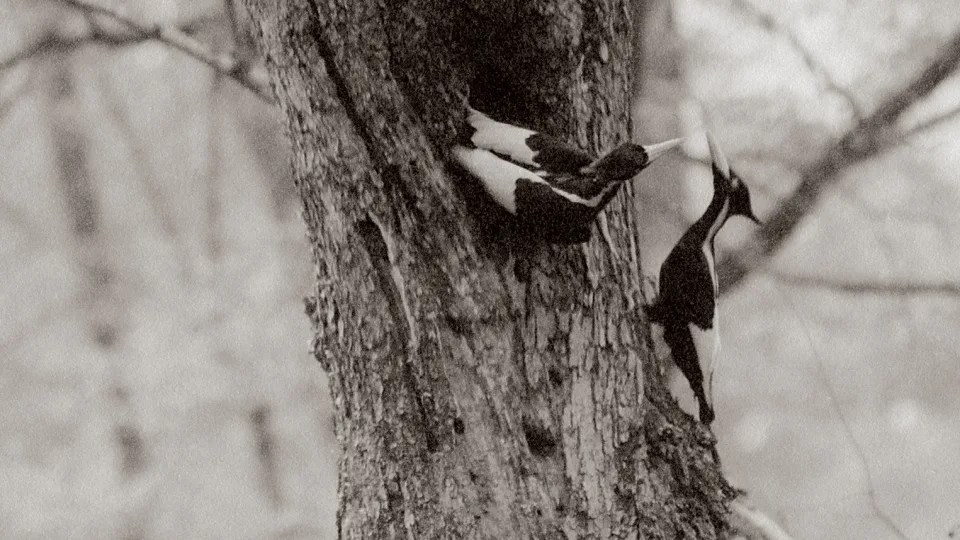
Photo: Arthur Allen/Cornell Lab of Ornithology.
Ivory-billed woodpeckers in Louisiana in 1935.
When our younger granddaughter was in pre-school and learned about dinosaurs, she latched on to the word “extinct.” The idea of something being completely gone was powerful to her, and when she was angry at her brother she turned the word a verb: “I’m going to extinct you.”
Today I learned about the variety of reasons we keep some things off the extinct list even when they seem gone forever. As Rachel Ramirez reported at CNN, Federal wildlife officials “are delaying a long-awaited decision to declare the ivory-billed woodpecker extinct, months after grainy photos and videos emerged that purported to show the bird flying through a Louisiana forest.
“In 2021, the agency seemed ready to declare the so-called Lord God Bird extinct: The US Fish and Wildlife Service announced plans to remove 23 species, including the ivory-billed woodpecker, from the endangered species list due to extinction. Thorough scrutiny of ‘the best scientific and commercial data available’ had led to the conclusion the bird no longer exists, the agency told CNN.
“[But in October] Fish and Wildlife declared 21 of those species extinct — and the ivory-billed woodpecker is not among them. …
“The government’s last accepted sighting of the red-crowned bird species was in April 1944 by artist and birder Don Eckelberry.
“But expert biologists and birdwatchers have been adamant the nation’s largest woodpecker is still out there. Just after the feds announced the proposal to remove the bird, public comments poured in from ornithologists, amateur birders and even communities like the Cherokee Nation, whose leaders asserted the creature is a symbol whose ‘influence on our cultural activities remains to this day.’
“Amid the wave of testimony, the wildlife service invited more public comment and announced extensions to its decision that effectively postponed its ivory bill verdict into 2023. Now, that critical decision to delist the bird is once again delayed. …
“ ‘John Fitzpatrick, a renowned ornithologist and retired director emeritus of the Cornell Lab of Ornithology, told CNN, ‘Evidence of its persistence continues to emerge, albeit none of it 100% convincing to everyone.’
“Since the 1944 sighting, the only other ‘compelling evidence,’ according to the federal wildlife service, was 2005 research from Fitzpatrick and his associates that claimed ivory bill sightings in eastern Arkansas’ Cache River National Wildlife Refuge. …
“In 2022, CNN joined avid birdwatchers to search the Tensas River National Wildlife Refuge in Louisiana, where the ivory-billed woodpecker was last officially seen. Around the same time, a group known as Project Principalis — a nod to the ivory bill’s scientific name, Campephilus principalis — was gathering evidence observed over the prior decade by Steve Latta of the National Aviary and other colleagues.
“Using unmanned trail cameras and drones, they’d captured grainy pictures of what they claimed was the ivory bill.
“ ‘We have some of the best images, if not the best images, that have been produced in 80 years,’ Latta, who claimed he has seen the bird in 2019, told CNN at the time.
“This May, Project Principalis published peer-reviewed research that unveiled such recordings, which they submitted to the feds, including a drone video from October 2022 of two ivory bills quickly flying onto a tree branch.
“ ‘Our ultimate goal is the conservation of the species, its habitat, and the many other species relying on that habitat,’ Latta told CNN Monday. ‘Keeping the Ivory-billed Woodpecker on the Endangered Species list brings us one step closer to that goal.’ ”
More at CNN, here.

 Suzanne's Mom's Blog