Feeds:
Posts
Comments

Posts Tagged ‘skill’

Photo: Robin Lubbock/WBUR.
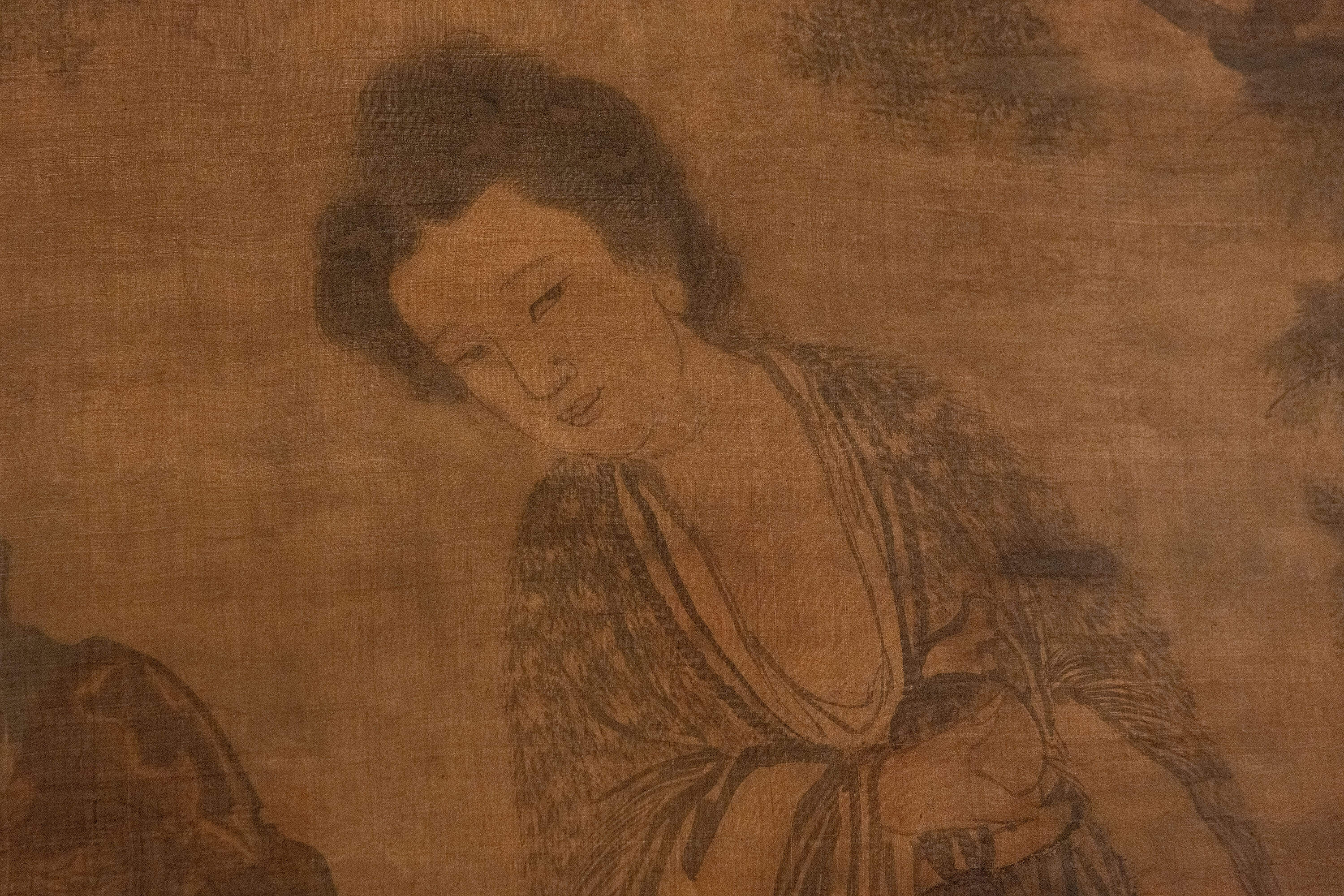
Detail of “The Immortal Magu with Wine Vessels” ink on silk scroll.

My mother had some silk scrolls from her 1930s travels in China. When my husband and I were downsizing, we were unable to interest John or Suzanne — or an auction house — in taking them. Fortunately, Niece Kate was up for it. I was so glad we could keep them in the family.

Today’s story is about the unique skills it takes to restore old scrolls — in this case, one that was donated to Wellesley College by a former student.

Artemisia Luk at WBUR’s “The Artery” reports, “In 2022, Yuhua Ding discovered a damaged Chinese scroll sitting in storage at Wellesley College’s Davis Museum. Underneath its many stains and cracks, she recognized a familiar figure: the Magu deity from the 16th-century Ming Dynasty.

“Ding is an assistant curator of collections and academic affairs at the Davis. Her research focuses on ancient Chinese art and antiques. Seeing ‘The Immortal Magu’ in poor condition, she was determined to preserve the piece.

“The artwork was donated to Wellesley by Lois Levin in 1983.  She had graduated from the college in 1942 and wanted to make the work available to students. …

“To repair the hanging scroll, Ding sought the help of conservator Jing Gao and Studio TKM Associates, a conservation studio in Somerville [Massachusetts] that restores artistic and historic works on paper. Gao trained at the Palace Museum in Beijing, and he is a world-renowned conservator of Asian paintings.

“ ‘Scrolls look so simple. You think to yourself, “Oh, it just rolls up,’ you know?” ‘ said Deborah LaCamera, partner and senior conservator at Studio TKM Associates. ‘But the structure of a scroll is so intricate and so precise that you really can’t make a functioning scroll if you’re not an expert.’ …

“In 1988, Gao became the first and only conservator for Chinese paintings in the United States upon joining the University of Michigan’s Museum of Art. He became a conservator at the Museum of Fine Arts, Boston, in 1995. …

” ‘He cannot really retire,’ joked Ding. ‘There are only several Chinese conservators in the United States, and they’re all in high demand. Especially in painting. People will wait for the right hands to touch it.’

“Gao lent his spare Fridays for the year-long process of restoring “The Immortal Magu.” First, Gao dismantled the original scroll, removing the old backing paper and replacing it with several layers of new backing and a custom-made silk mount. …

“When examining the ink painting of Magu, LaCamera and Gao used raking light and microscopic photography to identify creases, cracks, and stains. Upon close examination, they found several inconsistencies in the silk density and weaving patterns, clear signs that the painting had been restored twice before.

” ‘Art conservation is essential to understanding the process of art making and to reveal hidden stories of art,’ explained Ding.

“Juxtaposed against a large black frame, the cream-colored silk scroll stands out in the small exhibition room. … A woman with long fingernails sways with her feather cape. She is enveloped by the branches of a tree and three wine jars that rest by her feet. …

” ‘The number of Magu paintings in the Ming Dynasty are very rare,’ explained Ding.

“For the final stage of ‘The Immortal Magu’ restoration process, Ding and curatorial intern Berit Raines visited the Somerville studio to watch Gao in action. Gao used a traditional pressing stone to flatten the fibers of the backing paper, a process that took nearly eight hours. …

” ‘This project really, firmly established that this is the field that I want to go into,’ said Raines, a junior at Wellesley College. …

“On April 8, Ding will moderate a conversation with Gao, LaCamera, and Raines at Wellesley College. They’ll share insights and reflections from the year-long conservation project on ‘The Immortal Magu.’ “

More at the Artery, here.
Read Full Post »

Photo: North Carolina office of state archaeology.
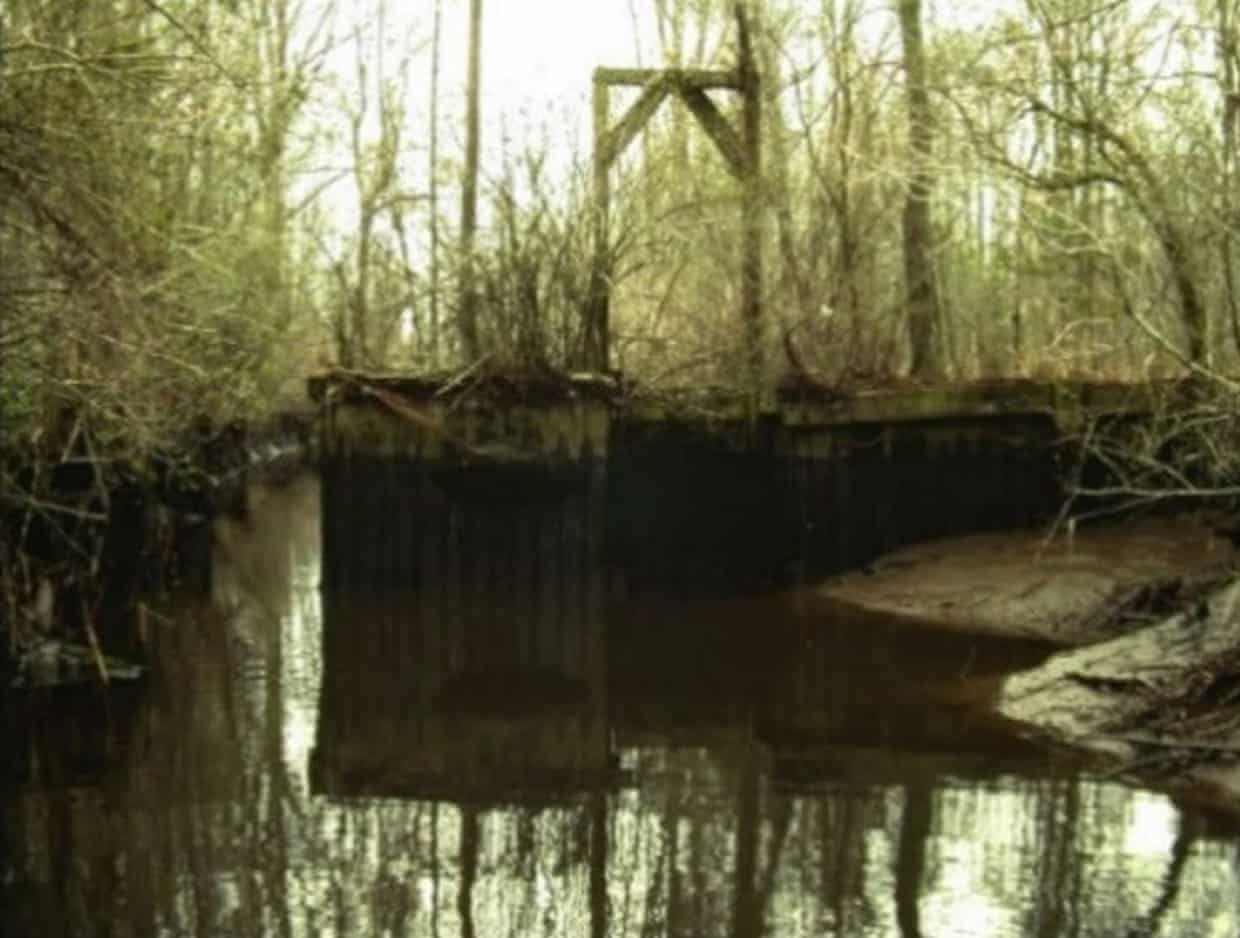
A rice gate, seen here in 1986. At Eagles Island, North Carolina, in the late 1700s, the enslaved Gullah Geechee people began creating ingenious rice fields. 

If the people described in this archaeological report used brilliant rice-growing techniques while enslaved, imagine what they might have done if they had been free! But, alas, slavery destroys lives of the enslaved and their descendants for generations, as Pat Conroy documented in The Water is Wide, his memoir about teaching.

In an in-depth article at the Guardian, Adria R Walker writes about recent archaeological discoveries concerning the Gullah Geechee people of the American South.

“As a former deputy state underwater archaeologist, Mark Wilde-Ramsing can’t help but look down. While rowing around North Carolina’s Eagles Island, at the tip of the Gullah Geechee corridor, he noticed signs of human-made structures, visible at low tide. Though he’d retired, he was still active in the field and knew his former agency hadn’t recorded the structures – which meant he had come across something previously undocumented. …

“Wilde-Ramsing knew the area had once been full of rice fields. His neighbor, Joni ‘Osku’ Backstrom, was an assistant professor in the department of environmental sciences at the University of North Carolina-Wilmington whose specialty was shallow-water sonar, and he had the skills and technology to explore the area. Using a sonar device, the duo detected 45 wooden structures in the river, and the remote sensing tool allowed Backstrom and Wilde-Ramsing to acoustically map the canal beds. …

“Spanning 2,000 acres (809 hectares) of the northern end of Eagles Island, the 45 irrigation devices were developed by enslaved people, who would later come to be known as the Gullah Geechee. The devices were used to control water flow for the rice fields in conjunction with earthen dams and levees, Wilde-Ramsing said.

Their existence provides further evidence of the engineering and technological skills that Gullah Geechee people used for rice cultivation, beginning in the late 1700s at the latest.

“Backstrom and Wilde-Ramsing documented their findings in a study published earlier [in 2024]. ‘The use of the island for this endeavor prior to the Civil War, in large part rested on the shoulders of transplanted and enslaved Africans and their descendant Gullah Geechee tradition,’ the study reads.

“The team’s discoveries, which came after two years of research in and around Eagles Island, have helped further shed light on the ingenious, skilled work of the Gullah Geechee people. Though Gullah Geechee people have been studied for centuries, Backstrom and Wilde-Ramsing’s research is the first to focus on their irrigation systems. The research couldn’t come soon enough: Eagles Island is environmentally vulnerable, both because of climate change and ongoing development. The duo registered their sites with the state, making development more difficult as a means to ensure the protection of cultural artifacts.

“ ‘The whole area was originally swamp. It was cleared mostly in the post-colonial, early 1800s period for tidal rice cultivation because that area was freshwater,’ Wilde-Ramsing said. ‘They were able to actually use, regulate, introduce the water and drain it with the tides.’ …

“The work the Gullah Geechee people did would have been exhaustive. Wilde-Ramsing says it required removing the cypress forests, then building dams and levees. Growing rice necessitated the use of water, so they created long wooden boxes, or ‘trunks,’ with gates on either side, that allowed them to let the water in by opening the gates. …

“The enslaved populations throughout the Gullah Geechee corridor – which spans the coasts of North Carolina to upper Florida – were isolated in such a way that they developed and maintained a culture different from that of most plantations.

“ ‘[They were] from coastal regions of west Africa, an area that had similar environs to those along the southern Atlantic seaboard centering on Georgia and the Carolinas, where rice agriculture was a mainstay of the economy,’ the study reads. …

” ‘I didn’t quite realize the role that rice played. It rivaled cotton during the 1840s and 50s,’ Backstrom said. ‘It was all over Europe and the US and it was all run by African Americans. A lot of it was developed based on their skills. I’m just happy that it’s coming to light and they’re getting their – I won’t say new – but recognition that this was an amazing thing, amazing work.’

“Even though Wilde-Ramsing and Backstrom’s discovery likely won’t permanently stop either development or climate change, not least because the island is owned by multiple private entities, the existence of historic, cultural artifacts can ensure that the Gullah Geechee structures are at least documented instead of simply being razed and forgotten.

“The researchers have been in communication with East Carolina University’s maritime program, and the school plans to send a contingent to the site to study some of the characteristic types. People from the school will be able to work on noting the various structures, trying to figure out how they operated and taking samples. Backstrom said that they’ve also been in contact with researchers at George Mason University in Fairfax county, Virginia, including a professor who had ancestors [from the area].

“In terms of further discovery, a mix of approaches best suits the complicated terrain. ‘We’re thinking about using drone imagery,’ Backstrom said. ‘We have some preliminary drone footage, which gives us access to these areas at dead low tide, areas that we had a lot of difficulty with, even with a very small vessel.’ The area is remote, full of tight nooks and crannies. It’s ‘particularly challenging because of the tides and the timing,’ he said. The different combinations of drone imagery and sonar mean the researchers aren’t limited by turbidity in the water.

“Backstrom hopes to go to west Africa, specifically to Senegal or the Senegambia region, where many Gullah Geechee people were from, to learn about the history of rice farming, including the roles women and children played. Children, for instance, tasted the water to ensure too much saltwater wasn’t being let in, and women helped in the actual cultivation of the rice, using skills from their home countries that were passed down throughout generations.”

More at the Guardian, here. No firewall. Donations help save reliable news.

Read Full Post »

Do you believe that kids are overprogrammed with structured activities — not enough time for daydreaming, not enough time for experimenting?

Well, here’s a site that might encourage parent-and-child experimenting on do-it-yourself projects. Sounds like it could be rewarding in a variety of ways (collaborating with parents, nurturing creativity, building confidence and independence).

The NY Times writes that a couple who do home improvement got an idea for projects that might interest children.

They “developed Built by Kids (builtbykids.com), a Web site devoted to do-it-yourself projects that parents and children can collaborate on, like herb gardens planted in a wheelbarrow, refurbished tatami tables and handmade wagons. The tasks were tested and refined during a series of daylong workshops with friends at the couple’s Los Angeles bungalow.

“Their intention is to revive some of the backyard know-how that children had before the distractions of television, video games and other off-the-shelf entertainment, [founder Timothy] Dahl said. The do-it-yourself movement is enjoying a long, fashionable run as an alternative to consumer culture, he added, but when children are involved, the results are ‘too often dismissed as disposable “crafts.” ‘ “ Read more. Try a project.

Photograph: BuiltByKids.com

Read Full Post »