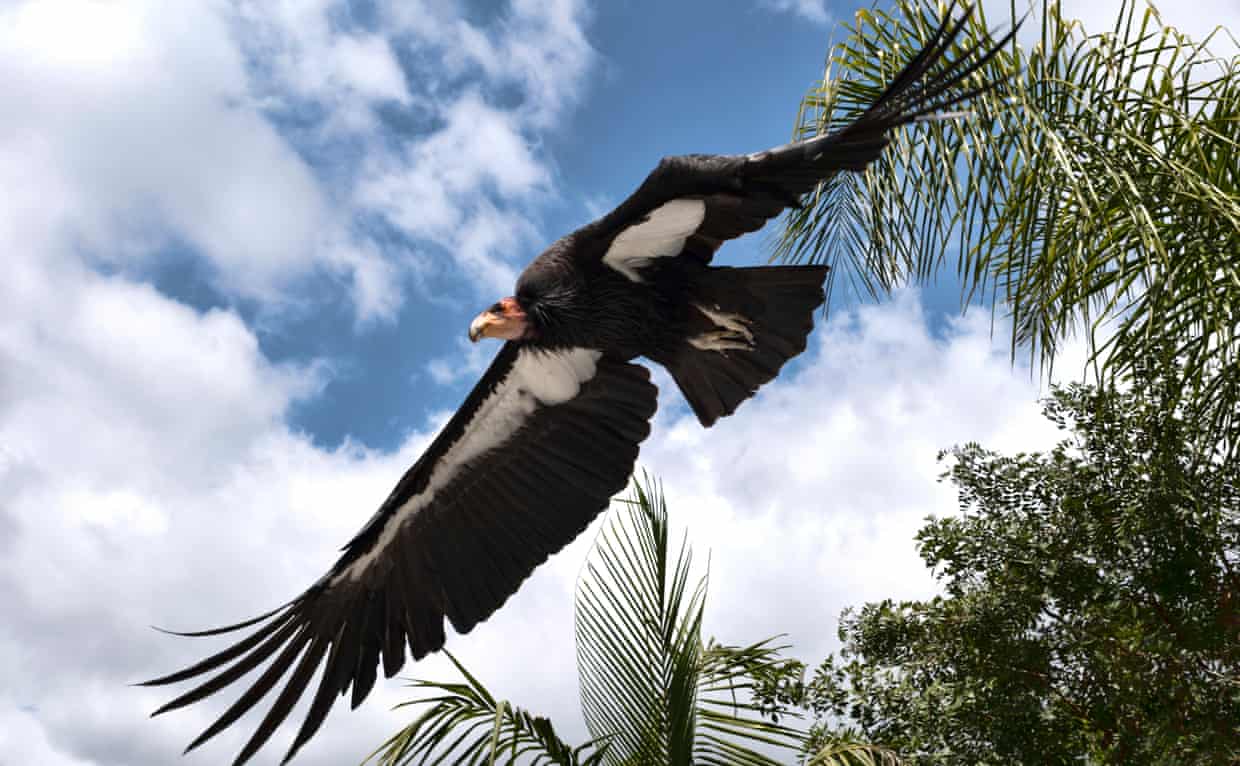
Photo: Richard Vogel/AP.
A California condor takes flight at the Los Angeles Zoo, on 2 May 2023.
Few of us warm up to scavengers like condors and vultures, but I recall a kid I knew back in the day who was obsessed with endangered California condors. Now their numbers are creeping back, thanks to protection efforts, and more people are learning why scavengers are essential.
Coral Murphy Marcos reports at the Guardian, “Nearly 20 new California condors will fly across the western sky after a record-setting hatching of baby birds this summer at the Los Angeles Zoo.
“The zoo marked a record of 17 California condor chicks hatched during this year’s breeding season, with staff members preparing to set the birds into the harsh wild as they are currently protected as an endangered species.
“ ‘Our condor team has raised the bar once again in the collaborative effort to save America’s largest flying bird from extinction,’ said Rose Legato, curator of birds at the LA Zoo.
“Legato said the record number of birds was thanks, in part, to new breeding and rearing techniques developed and implemented by the team. The process places two or three condor chicks together with a single adult surrogate condor to be raised. Usually, the four-inch-long eggs are laid in late winter or spring, and take two months to hatch. …
“The condors will be released as part of the recovery program for the California condor, led by the US Fish and Wildlife Service. In 1967, the California condor was listed as endangered by the federal government. …
“Twelve years later, the wildlife service started the California Condor recovery program. The species ranged from California to Florida and western Canada to northern Mexico, but, by 1982, only 22 condors survived in the wild. Those birds remained in captivity and were placed in the agency’s program. As of December 2023, there were 561 California condors in the world, of which 344 are living in the wild, according to the zoo.
“Ashleigh Blackford, the California Condor recovery program coordinator, said that the birds play an important role in the ecosystem because they help eliminate disease and recycle nutrients by feeding on animal carcasses that would otherwise decompose and spread disease. …
“This year, for the first time, the zoo’s condor team implemented a technique allowing three chicks to be raised at the same time by a female to increase the ability to raise condors without human interaction. … This process helps breeding pairs produce more than one viable egg in a season. It also makes the birds adjust better to the wild after they are released.
“The number of birds in the wild fluctuates due to habitat loss, pesticide contamination, consumption of micro trash in their environment, and lead poisoning from eating lead bullet fragments or shot pellets found in animal carcasses.
“Lead poisoning is the main hurdle to recovery of the California condors. Avian influenza is also an increasing threat to the condors. In response to a recent outbreak of highly pathogenic avian influenza in the western coast of the US, the US Fish and Wildlife Service has been vaccinating condors before releasing them into the wild.” More at the Guardian, here.
And while we’re on the topic of scavengers, read how cattle medicine that accidentally poisoned vultures in India led to thousands of human deaths.
Catrin Einhorn wrote at the New York Times, “To say that vultures are underappreciated would be putting it mildly. With their diet of carrion and their featherless heads, the birds are often viewed with disgust. But they have long provided a critical cleaning service by devouring the dead.
“Now, economists have put an excruciating figure on just how vital they can be: The sudden near-disappearance of vultures in India about two decades ago led to more than half a million excess human deaths over five years, according to a [study] in the American Economic Review.
“Rotting livestock carcasses, no longer picked to the bones by vultures, polluted waterways and fed an increase in feral dogs, which can carry rabies. It was ‘a really huge negative sanitation shock,’ said Anant Sudarshan, one of the study’s authors and an economics professor at the University of Warwick in England.
“The findings reveal the unintended consequences that can occur from the collapse of wildlife, especially animals known as keystone species for the outsize roles they play in their ecosystems.” The Times story is here.
My last word on this topic is for people who enjoy reading mysteries set in foreign countries. One of my all-time favorite mysteries is The Skull Mantra, which is the beginning of a series about Tibet. Somewhere in that series, I learned about the role of a class of people who traditionally prepared bodies to be exposed to vultures on high plateaux for “sky burials,” a way of life that other Tibetans seemed to find both distasteful and holy.

 Suzanne's Mom's Blog