Feeds:
Posts
Comments

Posts Tagged ‘sleuth’

Photo: Steven Wright/Unsplash.

Anyone can post on Wikipedia. I even tried it once myself. But volunteer editors are always checking that you obey the rules. My post on the neglected artist Lucille Corcos was removed because at that time, citations from online links were not allowed.

Today’s story shows what can happen if your Wikipedia entries are mainly another no-no: self-promotion. There’s a lot of self-promotion on Wikipedia, but this guy was especially sneaky.

Nate Anderson writes at Ars Technica, “Quick — what are the top entries in the category ‘Wikipedia articles written in the greatest number of languages‘?

“The answer is countries. Turkey tops the list with Wikipedia entries in 332 different languages, while the US is second with 327 and Japan is third with 324. Other common words make their appearance as one looks down the list. ‘Dog’ (275 languages) tops ‘cat’ (273). Jesus (274) beats ‘Adolf Hitler’ (242). …

“A couple months back, something would have been different. Turkey, the US, and Japan were still in the same order near the top of the leaderboard, but the number one slot was occupied by an unlikely contender: David Woodard, who had Wikipedia entries in 335 different languages. …

“Woodard is a composer who infamously wrote a ‘prequiem’ — that is, a ‘pre requiem’ — in 2001 for Oklahoma City bomber Timothy McVeigh, who had murdered 168 people with a truck bomb. The piece was to be performed at a church near McVeigh’s execution site in Terre Haute, Indiana, then recorded and played on the radio so that McVeigh would have a chance to hear it.

“According to the LA Times, which spoke to the composer, ‘Woodard’s hope in performing the 12-minute piece, he said, is to “cause the soul of Timothy McVeigh to go to heaven.” ‘ …

“Woodard also had a scheme to help save Nueva Germania, an 1880s colony in Paraguay that was designed to let German culture flourish away from the influence of European Jews. … ‘As an artist who is fed up with much of the pretentious nonsense that has come to define Western culture,’ Woodard told SF Gate, ‘I am drawn to the idea of an Aryan vacuum in the middle of the jungle.’

“So what was a guy like this doing with articles in 335 different languages? Inquiring minds want to know, which is why people have posted questions to sites like Reddit over the last year asking about the Woodard situation. …

“A Wikipedia editor who goes by ‘Grnrchst’ recently decided to find out, diving deep into the articles about Woodard and into any edits that placed his name in other articles. The results of this lengthy and tedious investigation were written up in the August 9 edition of the Signpost, a volunteer-run online newspaper about Wikipedia.

“Grnrchst’s conclusion was direct: ‘I discovered what I think might have been the single largest self-promotion operation in Wikipedia’s history, spanning over a decade and covering as many as 200 accounts and even more proxy IP addresses.’

“A network of accounts with an unusual interest in Woodard was identified, and its activities over the last decade were mapped. Starting in 2015, these accounts inserted Woodard’s name ‘into no fewer than 93 articles (including “Pliers,” “Brown pelican,” and “Bundesautobahn”), often referencing self-published sources by Woodard himself.’ And that was just in the English version of Wikipedia.

“From 2017 to 2019, the accounts ‘created articles about David Woodard in at least 92 different languages, creating a new article every six days on average .… They started off with Latin-script European languages, but quickly branched out into other families and scripts from all corners of the globe, even writing articles in constructed languages; they also went from writing full-length article translations, to low-effort stub articles, which would go on to make up the vast majority of all translations (easily 90 percent or more).’ …

“After a reduction in activity, things ramped up again in 2021, as IP addresses from around the world started creating Woodard references and articles once more. For instance, ‘addresses from Canada, Germany, Indonesia, the UK and other places added some trivia about Woodard to all 15 Wikipedia articles about the calea ternifolia.’

“Then things got ‘more sophisticated.’ From December 2021 through June 2025, 183 articles were created about Woodard, each in a different language’s Wikipedia and each by a unique account. These accounts followed a pattern of behavior: They were ‘created, often with a fairly generic name, and made a user page with a single image on it. They then made dozens of minor edits to unrelated articles, before creating an article about David Woodard, then making a dozen or so more minor edits before disappearing off the platform.’

“Grnrchst believes that all the activity was meant to ‘create as many articles about Woodard as possible, and to spread photos of and information on Woodard to as many articles as possible, while hiding that activity as much as possible. … I came to believe that David Woodard himself, or someone close to him, had been operating this network of accounts and IP addresses for the purposes of cynical self-promotion.’

“After the Grnrchst report, Wikipedia’s global stewards removed 235 articles on Woodard from Wikipedia instances with few users or administrators. Larger Wikipedias were free to make their own community decisions, and they removed another 80 articles and banned numerous accounts. …

“In the end, just 20 articles about Woodard remain, such as this one in English, which does not mention the controversy.”

More here.
Read Full Post »

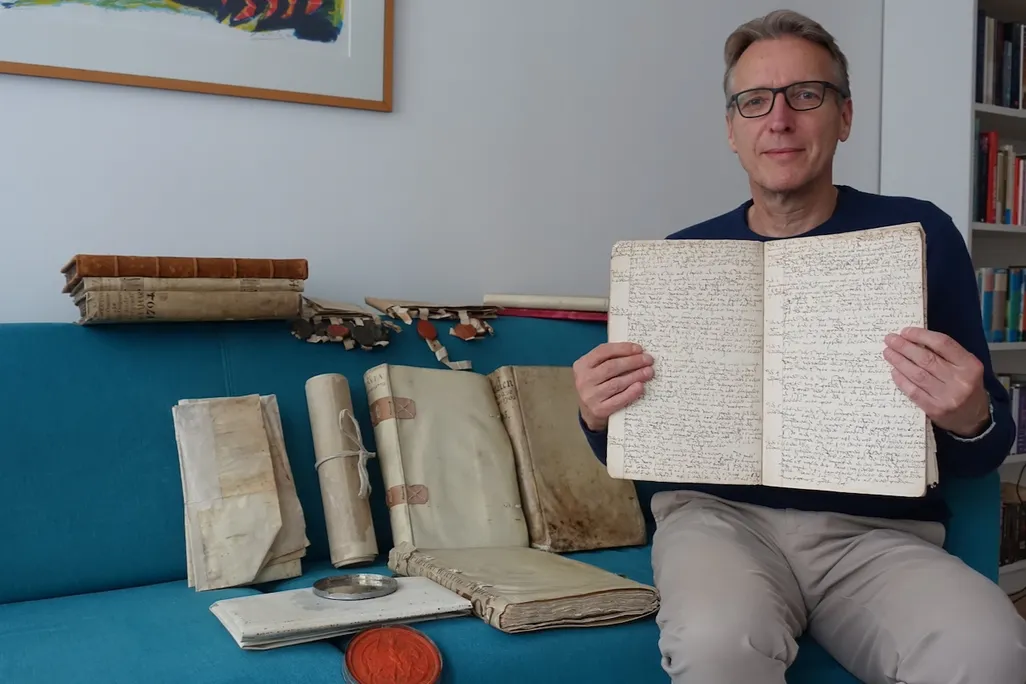
Photo: Arthur Brand.
A box given to art sleuth Arthur Brand contained records from the Dutch East India Company. They had been stolen a decade ago from the Hague in the Netherlands.

Everyone likes a mystery, especially one that gets solved in a satisfactory way. Of course, “satisfactory” is in the eye of the beholder. I myself like to have the perp brought to justice. Other people prefer something brutally realistic.

France 24 reported recently on a mystery solved by Arthur Brand, the “Indiana Jones of the Art World.” In this case, the perp is long gone.

“A Dutch art sleuth has recovered a priceless trove of stolen documents from the 15th to the 19th century, including several UNESCO-listed archives from the world’s first multinational corporation. Arthur Brand [ said] the latest discovery was among his most significant.

” ‘In my career, I have been able to return fantastic stolen art, from Picassos to a Van Gogh … yet this find is one of the highlights of my career,’ Brand told AFP.

“Many of the documents recount the early days of the Dutch East India Company (VOC), whose globetrotting trading and military operations contributed to the Dutch ‘Golden Age,’ when the Netherlands was a global superpower.

“VOC merchants criss-crossed the globe, catapulting the Netherlands to a world trading power but also exploiting and oppressing the colonies it conquered. The company was key to the slave trade during that period, with generations of enslaved people forced to work on Dutch plantations. …

“The company was also a leading diplomatic power and one document relates a visit in 1700 by top VOC officials to the court of the Mughal emperor in India.

” ‘Since the Netherlands was one of the most powerful players in the world at that time in terms of military, trade, shipping, and colonies, these documents are part of world history,’ said Brand.

UNESCO agrees, designating the VOC archives as part of its ‘Memory of the World’ documentary heritage collection.

” ‘The VOC archives make up the most complete and extensive source on early modern world history anywhere,’ says UNESCO on its website.

“The trove also featured early ships logs from one of the world’s most famous admirals, Michiel de Ruyter, whose exploits are studied in naval academies even today. …

“No less enthralling is the ‘who-dunnit’ of how Brand came by the documents.

“Brand received an email from someone who had stumbled across a box of seemingly ancient manuscripts while clearing out the attic of an incapacitated family member.

“This family member occasionally lent money to a friend, who would leave something as collateral – in this case the box of documents. …

“Brand investigated with Dutch police and concluded the documents had been stolen in 2015 from the vast National Archives in The Hague. The main suspect – an employee at the archives who had indeed left the box as collateral but never picked it up – has since died. …

“The art detective said he spent many an evening sifting through the documents, transported back in time.

” ‘Wars at sea, negotiations at imperial courts, distant journeys to barely explored regions, and knights,’ he told AFP.

” ‘I felt like I had stepped into Robert Louis Stevenson’s Treasure Island.’ ” More at France 24, here.

Don’t you love that UNESCO has a category of valuables called “Memory of the World”? Wow, what else belongs to the Memory of the World, and is it being protected for the very reason that we don’t remember it? Is Robert Louis Stevenson in Memory of the World?

Read Full Post »

Photo: Pat Greenhouse/Globe Staff.
Dutch artist Hendrick Avercamp’s winter scene, stolen in 1978, arrived in May at the Worcester Art Museum in Massachusetts. 

As an inveterate reader of mystery novels, I do love a yarn about art thieves, especially if there’s a clever sleuth who figures out what happened. It’s best if the perps end up in jail, but you can’t have it all. These things take time.

At the Boston Globe, Malcolm Gay has a good story about Clifford Schorer, a former president of the Worcester Art Museum’s board as well as “an international art dealer and sleuth who spends his days (and many nights) hunting ‘sleepers’ — lost masterpieces whose true identities have been obscured through the ages.

“Schorer had flown from Brussels [on a day last May] with the painting he now carried in his hands, a winter scene by the acclaimed Dutch Golden Age artist Hendrick Avercamp.

“The artwork was stolen nearly half a century earlier in a sensational 1978 heist from the baronial estate of Helen and Robert Stoddard, a Worcester industrialist. The Avercamp picture, along with numerous other paintings and other valuables taken from the home that night, had not been seen since. Local officials were stumped. So was the FBI. …

“[Schorer] and a conservator carefully unwrapped the package, revealing the aged but unscathed picture of Dutch figures skating in winter.

“ ‘It was nirvana,’ Warner Fletcher, a nephew of the Stoddards, said of the moment. …

“The Avercamp originally disappeared the night of June 22, 1978, when thieves broke into the 36-acre Stoddard estate, hacking open sofa cushions to cart away valuable works by Camille Pissarro, J.M.W. Turner, and Pierre-Auguste Renoir, among others. …

“That night, with Helen undergoing cancer treatment at a Boston hospital, Robert turned in just before midnight. [He] was sound asleep when thieves broke in through the sun porch.

“The burglars ransacked the home, rifling through drawers and closets. They drank the couple’s liquor and ate food from the fridge, according to later news reports. They made their way through each room, snatching paintings from the walls and pocketing collectibles including miniature carvings, silver tea sets, watches, and valuable music boxes.

“When Stoddard awoke the next morning, he realized the house had been robbed when he found his glasses on the floor. …

” ‘We never had a suspect,’ Ralph E. Doyle, a retired detective sergeant with the Worcester Police Department, told the Telegram & Gazette in 2000.

That‘s not to say there haven‘t been breakthroughs.

“The most valuable work in the Stoddard’s collection, Pissarro’s 1902 oil on canvas, ‘Bassins Duquesne et Berrigny à Dieppe, temps gris,’ surfaced at a Cleveland auction house in 1998. …

“The discovery of the Pissarro prompted authorities to look closely at a Springfield-area art dealer named Robert Cornell and his ex-wife, Jennifer Abella-Cornell, who had brought the painting to Ohio. But the estranged couple gave wildly conflicting accounts. [An FBI] spokesperson later told the Telegram & Gazette that reconciling their stories was ‘like beating a dead horse.’ …

“The trail of the Avercamp and other missing works then went cold. Frustrated by the lack of progress and still hoping they might be retrieved, Fletcher, the Stoddards’ nephew, finally turned to Schorer in 2021. He put information about the missing artworks in a manila envelope and sent it to the sleuth.

“Fletcher was by then familiar with Schorer. … He’s renowned in the trade, and he’d recently discovered a previously unknown drawing by Northern Renaissance master Albrecht Dürer that was purchased at a Concord estate sale for $30.

“Schorer was only vaguely aware of the Stoddard theft at the time, but as he looked through the envelope’s contents, he began to concentrate on the works he found most interesting: the Avercamp, the Turner, and an oil painting by 19th-century Dutch painter Johan Jongkind. …

“His search came up empty. But from his years of experience tracking down stolen art, Schorer knew that disreputable dealers will sometimes misrepresent works to evade detection.

“ ‘Finally, I said, “All right, if I had that painting, who would I fence it as?” ‘ Schorer recalled thinking.

“He knew that Avercamp, a mute painter who specialized in outdoor winter scenes, had a nephew, Barent Avercamp, who mimicked the style of his more gifted relative. Schorer turned again to his computer, this time searching for winter scenes by the famed painter’s nephew.

Bingo: Fifteen minutes later, he came across a throw pillow that was selling for $18.40 with a portion of the missing Avercamp scene — including a distinctive arch — printed on its case. …

“Schorer had made a breakthrough. The only known images of the Avercamp were grainy black and white photos from the ’70s. But this image was in color. It could mean only one thing: The photo was taken after the theft.

“ ‘I clicked on that, and it took me to a page trying to sell me a pillow,’ Schorer recalled. There, just above the asking price, he also found the logo of the image licensing company that held the source file.

“Schorer navigated to the site and paid $39 to download the photo. As he parsed its metadata, he discovered the copyright on the image: L.S.F.A.L., an acronym for Lawrence Steigrad Fine Arts Ltd., a dealer he’d known for years.

“Steigrad told Schorer he’d taken a photo of the painting for Newhouse Galleries, which had offered the artwork at a fine arts fair in the Netherlands in the mid-90s.

“Working another angle, Schorer discovered the name of the person who’d originally sold the work to Newhouse: Sheldon Fish. Fish told Schorer he’d purchased the painting at the Brimfield Antique Flea Market, a short drive from Worcester.”

Brimfield, Holy Cow! It’s a really famous flea market in our area, where Suzanne found most of the antique lockets she sold. I followed her around as she shopped one rainy weekend before Covid.

I love reading this stuff. The rest of the story is at the Globe, here.

Read Full Post »

Photo: IPP [India Pride Project].
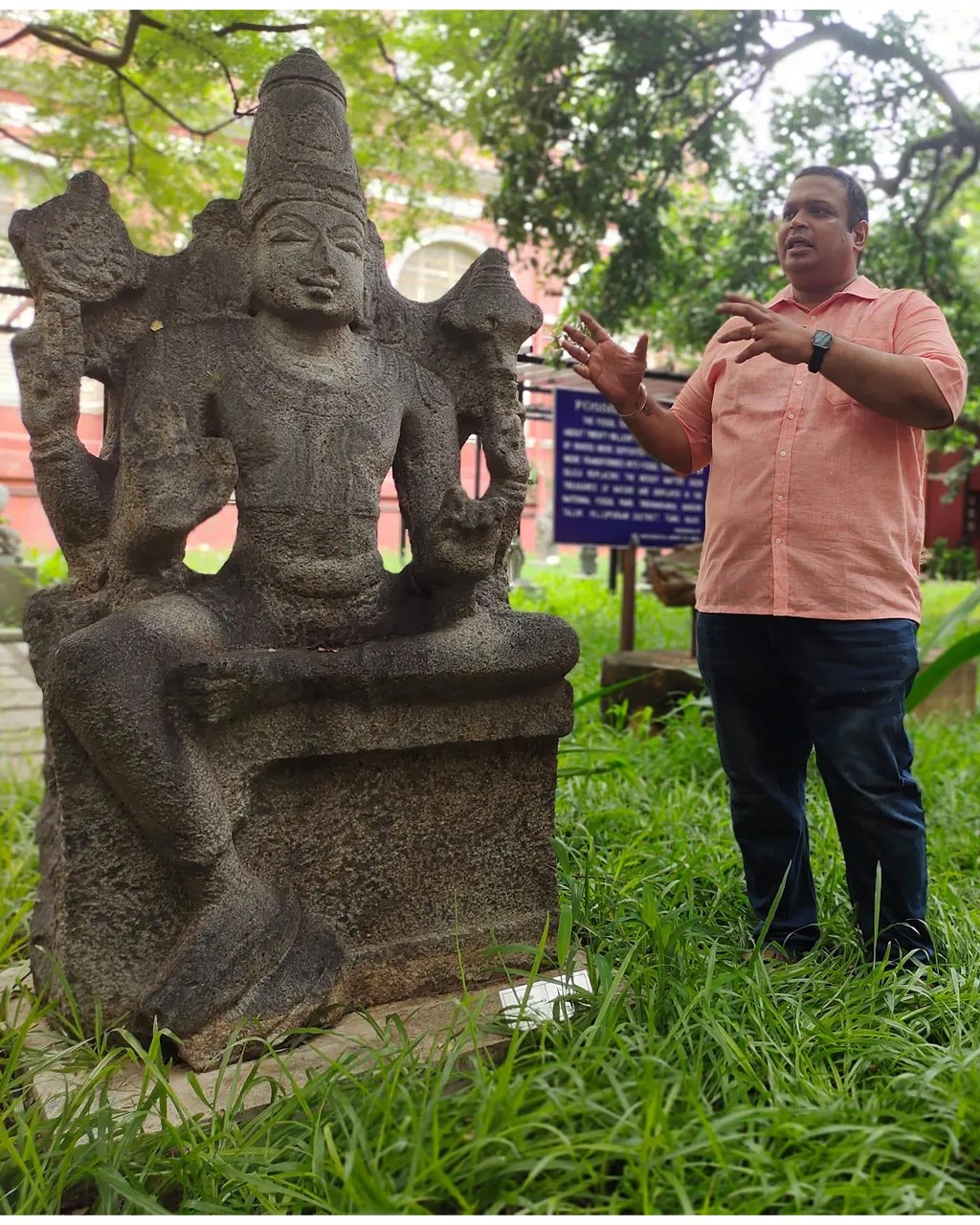
S Vijay Kumar, above, “travels through India, documenting artifacts and investigating the trail of missing objects online,” says the BBC.

For how many millenia have travelers thought it was perfectly fine to pick up local art objects and take them home, perhaps eventually donating them to museums? Today the looted countries are saying, “Wait a minute–that’s mine.”

Charukesi Ramadurai writes at BBC “Culture” that volunteers in India have started doing something about these thefts.

The story starts with recent speculation concerning the coronation of King Charles III, when many eyes in India were turned toward the Queen Consort and the “the contentious Koh-i-Noor diamond.” Would she wear it? She did not.

“While the palace has not made any official statement about the reason,” Ramadurai reports, “there were worries about it causing diplomatic issues with India, if it had been used, given the country’s claims to be its rightful owner. …

“The Koh-i-Noor, first found in written records in 1628, has long been the subject of acrimony between India and its former colonizer, with a persistent demand by the Indian government and its citizens for its return. As this piece in India’s Mint newspaper explains bluntly, ‘The main controversy around the diamond is that the British give an impression to its younger generation that the Koh-i-Noor was a gift from India and make no official mention of the violent history behind acquiring it.’

“The renewed uproar about the Koh-i-Noor has also led to intensifying questioning of all the other resources – not just the sparkly stones –  taken away from the Global South by western powers over centuries of trading and ruling. ‘Wear the diamond, give back the rest,’ suggests this op-ed piece in The Indian Express.

“Among the ‘rest’ are priceless cultural artifacts – and this is what the India Pride Project concerns itself with. This citizen movement for the restitution of stolen and smuggled antiques (particularly statues) from public museums and private collectors across the world was started in 2013 by shipping executive S Vijay Kumar and public policy expert Anuraag Saxena from Singapore. …

“These sleuths, with the help of a small, anonymous global team of volunteers from various fields – who communicate mostly online – have brought back to India several millions worth of antiquities from countries like Australia, Singapore, Germany, UK and the US.

“Most recently, they made the news when their efforts aided the investigation that prompted the National Gallery of Australia to return antiques worth $2.2 million – stolen by art smuggler Subash Kapoor – to the Indian government. Their targets include both artifacts taken forcibly out of India during the British colonial era, and those more recently stolen and smuggled from temples and public collections.

“Kumar, who is now based in Chennai in south India, and Saxena, who remains in Singapore, talk with ease about field trips to document missing idols and sting operations with auction houses. … This is not to suggest they are some kind of gung-ho art vigilante group, given the amount of plodding through paperwork and complex negotiation work they do. Their work involves advocacy, activism and coordinating between governments and law enforcement agencies such as Customs, Europol and Homeland Security within India and outside. Kumar says, ‘In the past when they reached out to India, nobody replied, so now we are doing that job.’

India Pride project is more of a network than an organization – we have no money, no employees and no authority,’ admits Saxena candidly, even a tad proudly.

“Art expert and former Egyptologist at the British Museum, Lewis McNaught, who now runs Returning Heritage, an online resource about cultural restitution, thinks the IPP model of citizen activism is intriguing. ‘They go out and actively source information using a social network of supporters. And only when they are able to confirm that the object has been stolen, do they approach the government, which in turn applies pressure on the museum or other governments where the object is being held.’

“There has been an established pattern of theft and trafficking of valuable art and artifacts from poorer countries in Asia and Africa to richer nations in the West – either directly by colonizing forces or in more recent times, through a sophisticated network of smugglers.

“In his book The Anarchy: The East India Company, Corporate Violence, and the Pillage of an Empire (and in various other places), writer and historian William Dalrymple has called out the looting of thousands of priceless objects from India to Britain by the employees of the trading East India Company. …

“Long after the colonizers have retired, there still remains a flourishing multi-billion-dollar black market in stolen antiquities. Serendipitous discovery is rare, such as this story from the 2018 Met Gala when Kim Kardashian took a photo in her sparkling gold gown twinning with a resplendent golden mummy. The photo drew attention to, well, the mummy, which was then detected to have been smuggled out of Egypt unnoticed in the chaos of the 2011 Arab Spring, making its way into New York’s august Metropolitan Museum of Art. The ensuing media outcry forced the Met – which had paid $4 million for fake documents – to return said mummy to Egypt.

“And before anyone feels too sorry for this museum’s loss, it is important to know that despite the 1970 Unesco Convention aimed at ending the illicit trade of antiquities, museums including big ones like the Met and The British Museum (the largest receiver of stolen goods, some say) have continued to buy from art thieves such as the now-convicted Subhash Kapoor. Kumar, who has written about his long pursuit of Kapoor in his book The Idol Thief, says this is simply because of the standard market economics of supply and demand. In a 2020 piece for the New Indian Express entitled: ‘When the buying by museums stops, the looting stops,’ Kumar called out museums for turning a blind eye to the origins of coveted antiquities.”

More at the BBC, here. No firewall.

Read Full Post »