Feeds:
Posts
Comments

Posts Tagged ‘snail’

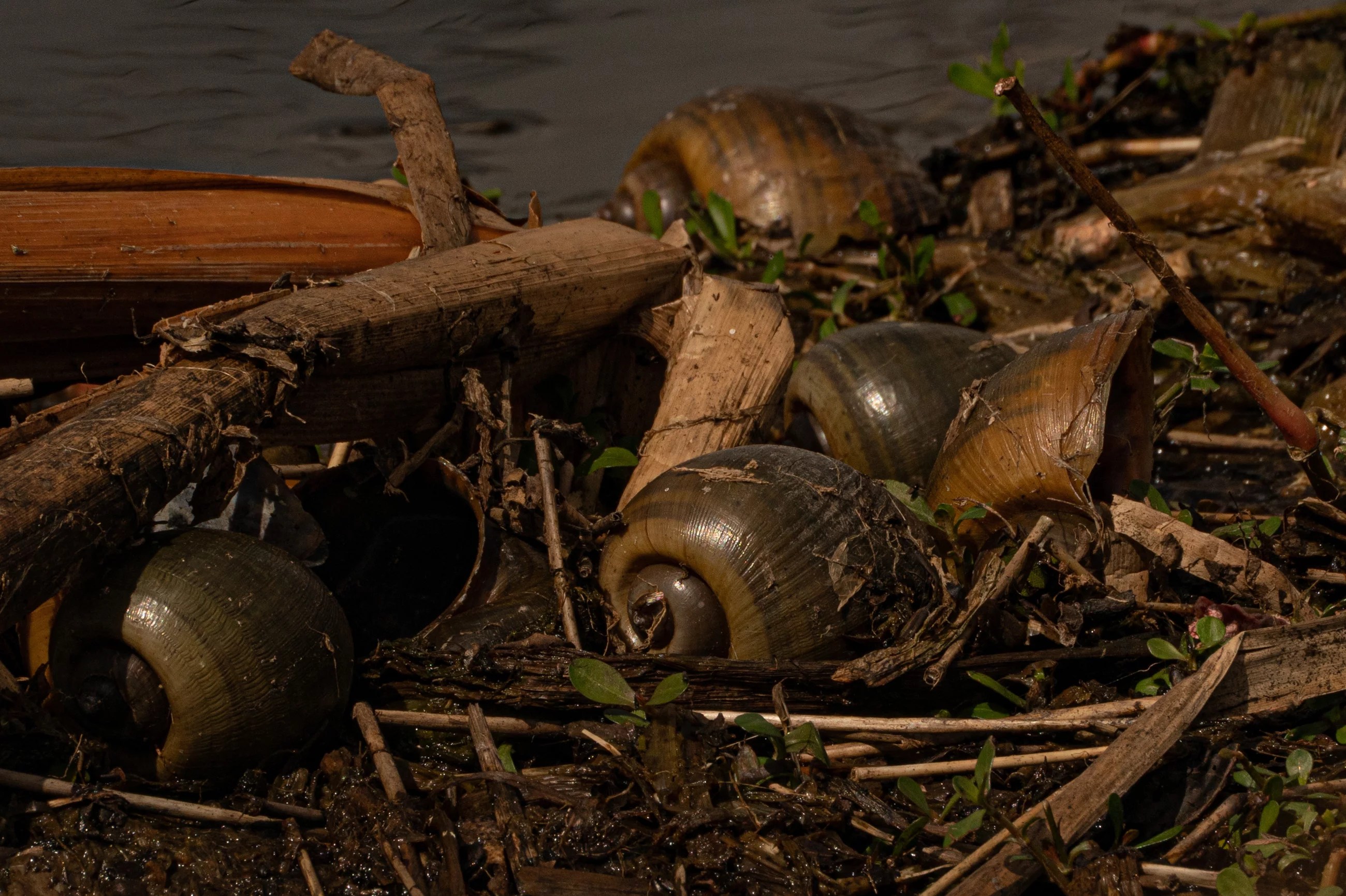
Photo: Sydney Walsh for NPR.
Apple Snail shells along the banks of Lake Okeechobee in Moore Haven, Fla. The snails are an invasive species, but they are helping an endangered bird stage a comeback.

“It’s an ill wind that blows nobody good.” We don’t like invasive species as a rule, but in today’s story, one kind is saving an endangered bird. Proving once again that life is complicated.

Greg Allen reports at NPR (National Public Radio), “In Florida’s Everglades, few species are more closely tied to the habitat’s health than an endangered bird, the snail kite. The Everglade snail kite is a raptor, similar to a hawk, that eats just one thing: snails.

“Over the last century, as much of the Everglades was drained, the bird’s population declined precipitously. But the kite has bounced back recently thanks to an exotic snail. It’s a rare case of an invasive species having a positive impact.

Robert Fletcher, a University of Florida professor who directs a snail kite monitoring program, says the invasive species was first spotted in 2004. Within a few years, it had expanded through much of the Everglades. ‘And it was around that time,’ he says, ‘that we started to see snail kite number increase.’

“Few people pay closer attention to the snail kite than Tyler Beck. He manages Florida’s the endangered bird’s population for Florida’s Fish and Wildlife Conservation Commission. On the western edge of Lake Okeechobee, Tyler Beck uses an airboat to motor through marshes looking for kites. … Overhead, [one] alarmed kite makes a rapid clicking call as it hovers and swoops over the airboat.

“University of Florida researcher Brian Jeffrey wades through thigh-deep water toward the area he thinks the nest might be. Jeffrey directs a field team that monitors Florida’s snail kite population. He finds the nest, but it’s 20 feet up, too high to count the eggs or see if any have hatched. Other members of his team will be back soon with a ladder to check on the nest.

“Jeffrey has three field teams that cover thousands of square miles counting and tracking Florida’s snail kites. The kites—and the field teams–range from Everglades National Park on the southern tip of Florida all the way up to Paynes Prairie Preserve State Park, near Gainesville. …

“Snail kites aren’t flashy. Males are a slate gray, females a splotchy brown. They get their name from their ability to seemingly float in the air. They were one of the last bird species discovered in the U.S. because of where they live, often hidden in the Everglades.

“Beck says the species is uniquely adapted to subsist almost entirely on a resource usually abundant in the freshwater marshes: apple snails. ‘They have these really long talons that hook around the shell and get a good grip on it to lift it out of the water and carry it away,’ he says. And, they have a long, hooked bill they use to pry the snails from their shells.

“Over the past century, as much of their habitat was drained and water stopped flowing through parts of the Everglades, the snail kite population plummeted. It was one of the first birds put on the endangered species list in the 1960’s. Droughts contributed to the snail kite’s decline and by 2007, there were fewer than 800 remaining. ‘Right shortly after that though, this invasive snail came in, and just started flourishing, getting into every wetland, having these big population booms,’ Beck says. …

“Beck eases the airboat up next to a willow tree where he’s spotted a nest. Standing in the boat, this one is at eye level. He says, ‘We’ve got two little nestling snail kites. These are probably about ten days old. The parents, you can hear them over us, they’re upset that we’re at their nest.’ Beck and Jeffrey mark the location, water levels, height of the nest and then motor away. The parents soon return, carrying snails.

“No one’s sure about how the exotic snails were introduced into the Everglades. They’re related to Florida’s apple snails and are commonly used in home aquariums. The invader, the Island apple snail, is found in similar habitat in South America and is larger than its Florida cousin. …

“Efforts to restore Florida’s Everglades have helped the snail kite, bringing back native vegetation and restoring the flow of water to once-parched marshes. It’s been in the works for more than 30 years with a cost of more than $20 billion. But progress is incremental and hard to measure. In the meantime, scientists say the invasive snail may have saved the snail kite.

“But University of Florida scientist Robert Fletcher is concerned about the potential impact the species will have on the Everglades over the long-term. He says, ‘What we should be thinking about is how do we restore native snails to get those benefits.’ “

More at NPR, here. Lots of pictures. No firewall.

Read Full Post »

Photo: Rebecca Kordas/UBC
Limpets are easy to overlook — so too is their effect on the environment. But careful consideration of how all the life forms in an area interact is key to understanding how ecosystems thrive.

I’ve been reading a small book called The Sound of a Wild Snail Eating. A friend offered to lend it to me, and much to my surprise, I’m finding it fascinating. It’s by a woman with a debilitating illness who describes her growing interest in a snail brought to her on a wild violet plant. As the author learns, there is more to snails than meets the eye. A lot more.

The same may be said of limpets. Christopher Pollon explains why at Hakai Magazine.

“As the ocean temperature rises, it may be the little things that make the biggest difference to the survival and resilience of living things.

“Take the limpet, a tiny snail-like gastropod with a hefty appetite for the minute plants that live in the intertidal — the space between low and high tide. In 2014, Becca Kordas, then a zoology doctoral candidate at the University of British Columbia, tested the effect these creatures have on the ecosystem when exposed to ocean warming. She found that their influence was huge.

“Kordas launched her project by sinking four sets of settlement plates in the intertidal zone of Saltspring Island, British Columbia, about 55 kilometers southwest of Vancouver. For 16 months, Kordas and her colleagues tracked which plants and animals established themselves on the four different types of plots. Kordas controlled the limpets’ access to half of the plates, while they were free to graze on the other half. She also simulated the effects of ocean warming by tinting some of the plates black to attract the sun’s heat.

“By the end of the study, the differences between the four sets of plates were stark. Kordas found that when limpets’ access is restricted, the artificially warmed intertidal ecosystem collapsed — the diversity of life largely replaced by a mat of microalgae. Limpets with access to the plates, however, maintained a healthier ecological community, even in a warming environment.

“What is it about limpets that helps maintain a diverse and complex community, even when their environment warms?

“Kordas says limpets eat huge amounts of microalgae, including microscopic diatoms and the spores of larger algal species. This clears the terrain for a variety of life.

“ ‘When limpets are allowed in, they make space for things like barnacles, and then those barnacles in turn create little condos for other animals to live in,’ she says.

“In a sense, limpets are tiny ecosystem engineers. … The study comes at a critical time for intertidal life in the northeast Pacific Ocean. In this area, the summer low tide typically occurs around noon, which exposes intertidal species to warm summer temperatures. The heat shakes up the intertidal community, but shakes it up more without limpets around.

“The lesson of Kordas’s study, however, is not about limpets per se. It’s about the need to better understand the role of every organism in an ecosystem.”

Hat tip: Pablo Rodas-Martini, @pablorodas, on Twitter.

More here.

Read Full Post »

… turn them into escargots.

Lalita Clozel has a great story at the NY Times today about snails that nobody wanted.

She writes, “On this storm-weathered tip of Mont Saint-Michel Bay, the sweeping tides have washed away the line between land and sea. Fishermen drive their wheeled boats straight into the bay to gather their harvest: an assortment of shellfish prized all over France.

“But now they are finding their nets weighed down by an invasive species: the crépidule, or Atlantic slipper shell, a curious type of sea snail that has spread from the East Coast of the United States.

“Oyster and mussel producers here have watched helplessly as the colony has taken over their beautiful bay, flush with phytoplankton, the micro-organisms that make it a haven for all manner of shellfish and tint the water turquoise.

“Enter Pierrick Clément, a local entrepreneur who looked at the encroaching Atlantic slipper shell and asked an unthinkable question in a town that has built its livelihood on bountiful seafood: Would people eat the insidious creature?

“ ‘As a businessman, I see an opportunity here,’ he said. …

“The community of Cancale now finds itself torn between disgust and relief at Mr. Clément’s project to fish and sell the sea snails for consumption.

“After years of administrative haggling, he has coaxed local municipalities and producers to back his project and begin a campaign to rehabilitate the snail’s image. …

“His pilot factory, among the bustling oyster plants in nearby Le Vivier-sur-mer, ships to a few stores and restaurants in France, Spain and Germany.

“Eventually he hopes to process as much as 100,000 tons of slipper shells per year — enough to offset their growth in the bays.” More here.

This entrepreneur’s adaptability fits with what my father used to say about the French secret of beauty. It was along the lines of Feature what you’ve got.

“If you have a big nose,” he said, “hang a beer can on it.”

Photo: Catalina Martin-Chico for The New York Times

Read Full Post »