Feeds:
Posts
Comments

Posts Tagged ‘snap’

Photo: Craig F. Walker/Globe Staff.
Resident service coordinator Judith Lucien and senior property manager Ron Quimby stocked the shelves in the makeshift pantry at Mainstay Supportive Housing and Home Care in Chelsea on Dec. 11.

This is the story of generosity between a well-off group of retirees and one threatened with food insecurity. It’s also the story of how great both the giver and the receiver can feel.

Claire Thornton writes at the Boston Globe, “Husband and wife Ron Quimby and Krissy Fleming tell each other everything. Each manages a senior living community near Boston. …

North Hill Retirement Community in Needham, where Fleming works, sits on a 59-acre campus and advertises state-of-the-art amenities. Mainstay Supportive Housing and Home Care in Chelsea, Quimby’s employer, is a HUD Section 202 property that provides affordable housing for very low-income seniors who need supportive services.

“During the government shutdown in November, when Quimby was consumed with worry over the Supplemental Nutrition Assistance Program [food stamps] cuts his Chelsea residents faced, Fleming thought residents at North Hill would want to help. …

“For more than a month, Quimby brought weekly donations from North Hill’s 400 residents. … With SNAP payments stopped in November, the food was a lifeline for the low-income seniors with medical challenges and limited mobility who had no extra money to go shopping with, he said.

“Meanwhile, with a bit more income to spare, residents at North Hill embarked on grocery shopping missions for several weeks, pushing carts at Market Basket, Whole Foods, and Sudbury Farms in search of deals and specials they could send to Chelsea.

“Besides groceries, there was a tangible kindness linking the two groups of seniors, said Judy Lucien, a resident services coordinator, who has worked at the HUD-subsidized apartment complex in Chelsea for 17 years. …

“ ‘Krissy and her husband were really examples for those of us who had less information and were less aware of the need,’ said Geoff Pierson, 86, a retired school superintendent and North Hill resident. …

“About 20 miles away, Joe Downey, 69, has resided at Mainstay in Chelsea for the past two years after living unhoused for about three years in Brockton. After working in security for most of his career, Downey cared for his father, who suffered from a chronic disease, his blind aunt, and his mother, who died of a stroke. Later, Downey said he slept on someone’s couch for $1,000 a month and eventually ‘ran out of money.’ …

“Of Mainstay’s 66 residents, some have experienced homeless and as many as 80 percent receive SNAP benefits, said CEO Larry Oaks.

“And when suddenly that was in question, it was like, ‘Wow, these folks can’t live without that,’ said Oaks, who has worked at Mainstay for eight years.

“Mainstay resident Camilla Smith can’t cook without assistance, and relies on ready-to-eat items, Quimby said. Before coming to Mainstay 10 years ago, Smith said she bounced between halfway homes and worked jobs at Stop ‘N Shop and Friendly’s Ice Cream. …

“To meet the complex needs of Mainstay residents, North Hill residents filled a storage room ‘four times over, with donations, Fleming said. …

“Pierson, the former Lexington Public Schools superintendent, said he and his North Hill neighbors … had the financial resources to help the residents in Chelsea and wanted to support those affected by [the] cuts to safety net programs.

“ ‘I felt angry because of the behavior of the present administration to destroy things of value or of comfort,’ Pierson said. …

“Though the seniors at Mainstay have a roof over their heads, food insecurity has been and will continue to be a critical issue, Oaks said.

“ ‘If they don’t have their SNAP benefits, their incomes are not sufficient — they’re not going to feed themselves,’ Oaks, 57, said. While SNAP benefits were restored in mid-November, he said his residents continue to worry about benefit cuts going forward.”

More at the Globe, here.
Read Full Post »

Photo:  Felix Uribe Jr/Guardian.
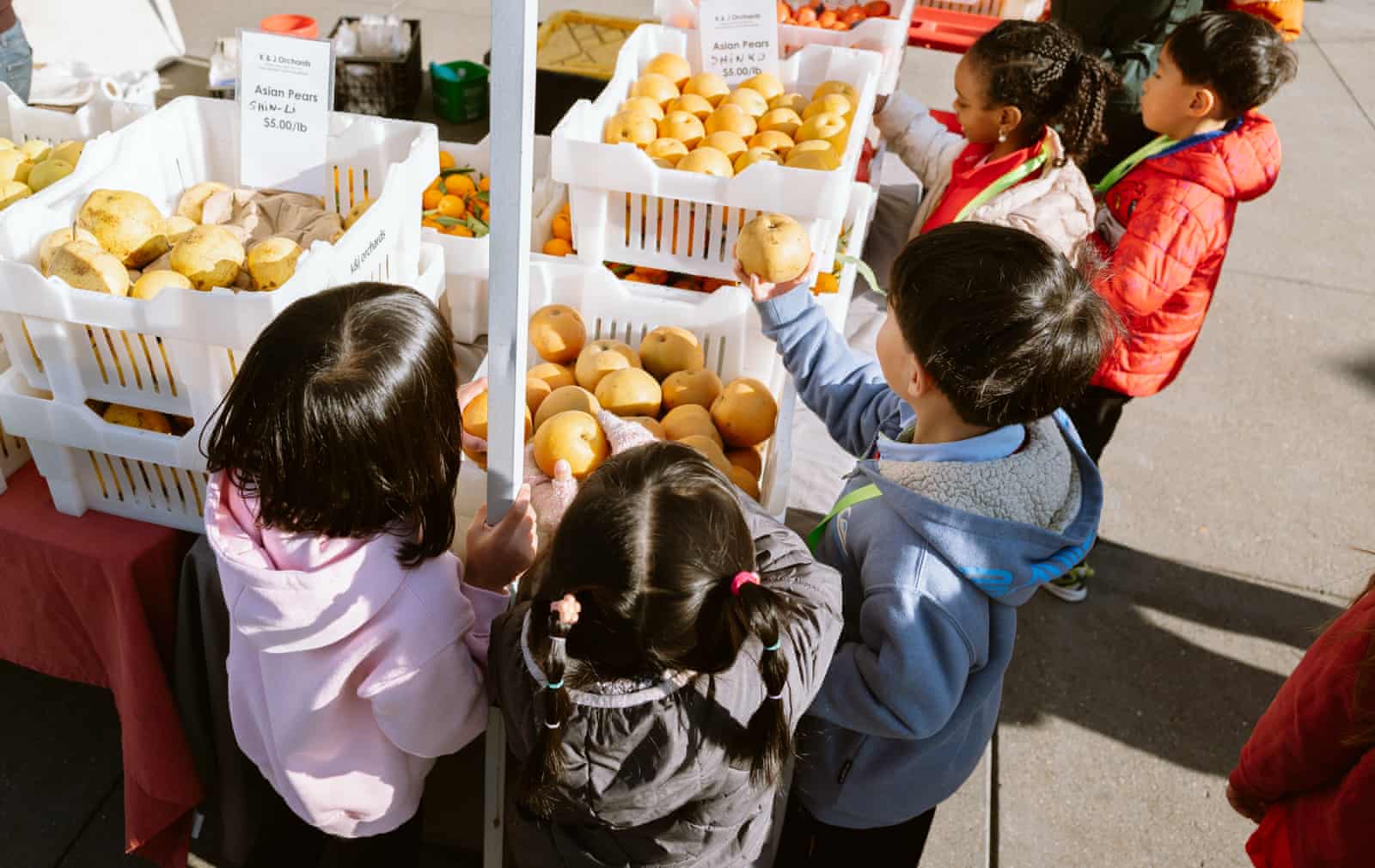
An organization called Foodwise Kids has brought more than 20,000 students to farmers’ markets to learn about the food system and taste new-to-them produce. Sometimes the teacher will challenge the students to join “the One-Bite Club.” 

When John came back from college the first time, one of the things he said, only half joking, was, “Why didn’t you tell me I liked mushrooms?”

He eats everything now, but as a kid, he had limited tastes, and I was no good at insisting he try something.

Today a special program for young children encourages tasting new things as part of a group.

Cecilia Nowell reports at the Guardian, “On a crisp winter morning in San Francisco, a team of six-year-olds declare that their favorite fruits and vegetables are peaches and broccoli – but then again, they have yet to venture out into the farmers’ market where produce they have never tried before awaits them. With handfuls of tokens, they will purchase persimmons, pomegranates, Asian pears, purple potatoes, kale and more from the farmers who grew them – then embark on a tasting journey, featuring new and familiar spices.

“The first-graders are visiting the Ferry Plaza Farmers Market – a Bay Area institution that draws more than 100 farmers to San Francisco’s waterfront three days a week – with 22 of their classmates from Lincoln elementary. That morning, the children had ridden the subway from their school in Oakland’s Chinatown into the city with parent chaperones and their teacher, Kathy Chen.

“Chen [knows] that at this age, her students are prone to becoming picky eaters – but what is cooked at home and what they try at school can change that. The hope is that after this field trip, when the cafeteria serves up an unfamiliar veggie or they’re offered a new fruit, the students might be a little more willing to take a bite.

“The trip is sponsored by Foodwise Kids, a nutrition and wellness program for elementary school students in the San Francisco Bay Area coordinated by the 30-year-old non-profit Foodwise. Since the program’s launch in 2012, it’s brought more than 20,000 local students out to the farmers’ market to learn about the food system. It’s focused primarily on schools with a high percentage of students of color or kids eligible for free or reduced-price school meals, and education director Tiffany Chung says the aim is to get ‘students excited about eating fruits and vegetables’ in the hopes that ‘they’ll incorporate them into their daily life and eventually lead to longer-term healthy eating options.’ …

“At folding tables, they introduce themselves to Foodwise’s staff and volunteers, and name their favorite fruits and vegetables. Chung jumps in for a moment to speak Mandarin with one student who doesn’t feel comfortable speaking English – she notes that many of the program’s volunteers are bilingual, usually in Spanish, to support the city’s diverse youth.

“While the majority of the classmates in her group prefer peaches, Temnit Desta says her favorite fruit is lemons. ‘She likes sour,’ her mom, Tehesh Hadush, explains. Although Temnit was born in California, her family is from Ethiopia and she has grown up eating lots of spicy foods. …

“Just a few years after the Loma Prieta earthquake devastated the highway running along San Francisco’s coast, community groups began discussing ways to connect downtown with the waterfront – and settled on a farmers’ market. Another aim was to educate urban dwellers about California’s farmland and sustainable agriculture while providing access to healthy, fresh produce. To this day, the market prioritizes urban families – not only by accepting Snap, previously known as food stamps, but by matching every dollar spent so families can double their Snap spending up to $15.

“After they’ve filled a basket with produce – so much that the six-year-olds are carrying the basket in teams of two – the small groups take off for a quick tour of the farmers market. When they return, Chung and other volunteers lead the groups in a game guessing which season different crops grow in. As they play, youth education manager Marcelo Clark starts chopping and roasting different trays of the produce – washing raspberries, flavoring cauliflower with jerk spice and roasting potatoes with cumin. He aims to use a mix of spices the children may have already tried at home – and others that might be new to them.

“ ‘A lot of our students are newer to America, and may not speak English,’ says Chung, but at the market ‘they’re able to see produce that is familiar to them. … They’re able to point out: “I know this. This is cilantro. I have this on tacos.” ‘ …

“When the food has been prepared, Clark carries trays of fruit and both raw and roasted veggies out to the class. The students dive into the purple potatoes, carrots, brussels sprouts, kale and cauliflower – but are more hesitant to try hummus and raw broccoli. Although her classmates and their parents exclaim at the fresh persimmon, Temnit is wary of the unfamiliar fruit.

“ ‘Today is all about trying new things and giving things a chance,’ Chung reminds the class, gently encouraging them to try just the smallest bite of everything.

“ ‘When students are unfamiliar with a fruit and vegetable, there is a lot of hesitation. We try to create this safe space where we’re telling them: “It’s OK if you don’t like it. The whole point is just to try it.” ‘ …

“By the end of the class, Temnit will be asking for more persimmon, and one of her classmates will be racing around trying to finish everyone’s leftover pomegranate seeds.”

More at the Guardian, here.

Read Full Post »