Feeds:
Posts
Comments

Posts Tagged ‘solve’

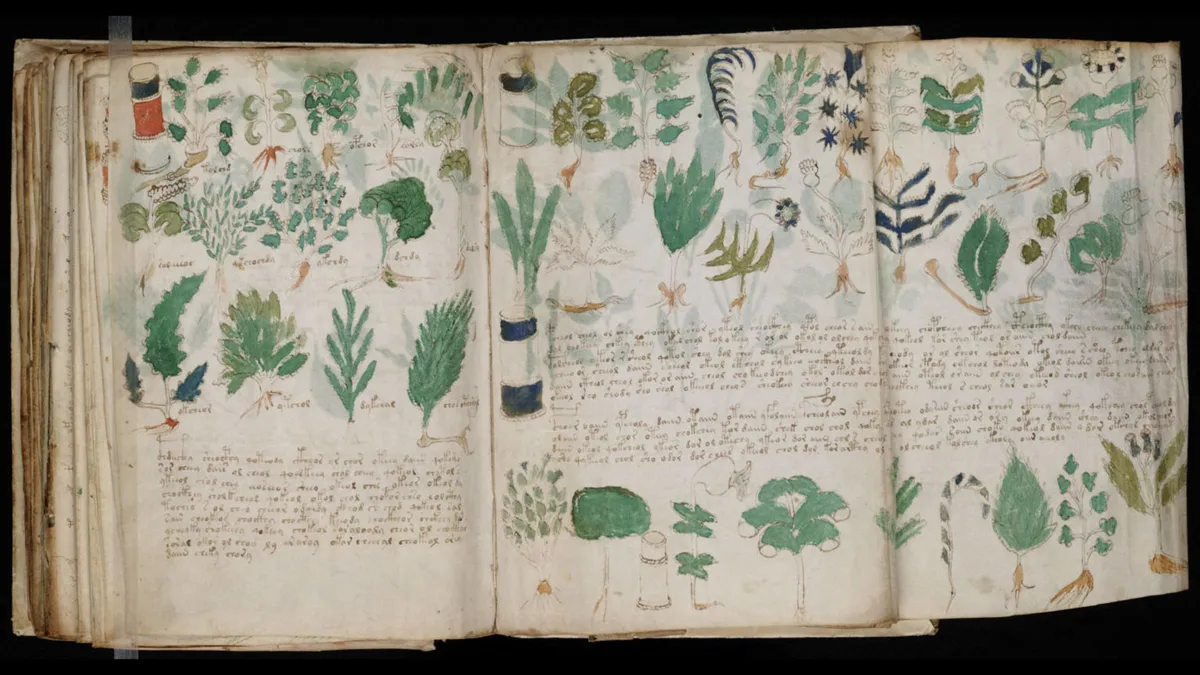
Photo: Art Collection 2 via Alamy.
The Voynich manuscript has never been deciphered. 

We love the French tv series called Astrid, whose autistic heroine can solve any puzzle and has never yet been stumped by a mysterious code. I wish Astrid could apply her unique way of thinking to the puzzle described in today’s article because skepticism about the solution remains.

Tom Metcalfe writes at Live Science, “A unique cipher that uses playing cards and dice to turn languages into glyphs produces text eerily similar to the glyphs in the Voynich manuscript, a new study shows. The finding suggests that an equivalent cipher could have been used to create the mysterious medieval manuscript.

“The new cipher — called ‘Naibbe,’ from the name of a 14th-century Italian card game — does not decode the medieval Voynich manuscript, but it offers an idea for how the manuscript was made.

“The Voynich manuscript, which has been radiocarbon-dated to the 15th century, contains roughly 38,000 words written in glyphs that have never been translated. Despite more than a century of intense scrutiny, the manuscript has not been explained conclusively. However, it continues to intrigue people, with its bizarre and inexplicable illustrations of plants, astrology and alchemy, including supposedly ‘biological’ depictions of bathing naked women.

“In the new study, published Nov. 26 in the journal Cryptologia, science journalist Michael Greshko investigated one way the manuscript may have come together. He told Live Science that he got the idea for the Naibbe cipher while researching stories about the Voynich manuscript. …

“Naibbe first uses the number from the throw of a die to break a block of Italian or Latin into single and double letters — so “gatto” (Italian for “cat”) could become “g”,”at” and “to.” The cipher then uses the draw of a playing card to determine which of six different tables is used to encrypt the letters into ‘Voynichese’ — the strange and undeciphered glyphs that are apparently grouped into words in the manuscript. The tables are ‘weighted’ by the corresponding number of cards so that the statistical occurrence of the mock-Voynichese glyphs is the same as seen in the manuscript itself.

“Greshko’s effort is among the leading attempts to explain how the manuscript was made. But it still only approximated Voynichese text, rather than fully replicating it, he said. …

“The manuscript now lies at a nexus of attempts to understand lost languages, yet experts are not entirely sure if Voynichese is even real.

“One theory, taken seriously, is that the manuscript is a medieval hoax, illustrated with suitably mysterious and salacious drawings, and that the text of Voynichese glyphs is completely meaningless.

“The hoax theory has grown stronger in recent years as more attempts to decipher Voynichese — some of which have used machine learning and other computerized artificial intelligence methods — have failed to crack the code, if there is a code.

“But theories that Voynichese is based on a real language and can be deciphered are still prominent, and Greshko’s Naibbe cipher is one of the closest attempts yet.

“The mock-Voynichese output of the Naibbe cipher has several important similarities to true Voynichese. … Those commonalities suggested that a similar method was used to create the original Voynich manuscript, Greshko said. …

” ‘Dice and playing cards were chosen as sources of randomness because it was essential for the cipher to be ‘hand-doable’ with the technology of the time. …

” ‘My hope is that this becomes adopted as a computational benchmark,’ Greshko said. ‘The points of difference between the cipher and the manuscript may point the way to how the text was actually created.’

“Former satellite engineer René Zandbergen, a renowned expert on the Voynich manuscript who was not directly involved in Greshko’s study, said he appreciated Greshko’s efforts to create an encoding method to approximate Voynichese.

“But Greshko ‘also makes it clear that he is not suggesting that this is how the manuscript text was generated,’ Zandbergen said in an email. ‘He just demonstrates that such a method can be found, and we may assume that there may be others.’ Zandbergen added that he is ‘essentially undecided’ about whether the Voynichese text is meaningful or a hoax.”

More at Live Science, here.
Read Full Post »

Image: The Dial.

I read a lot of murder mysteries. They are not the only type of book I like, but I like the puzzles and sometimes even the writing. So I was drawn to today’s article on the emergence of an unlikely crew that has gotten involved in solving tough cases.

Julia Webster Ayuso wrote recently at the Dial about forensic linguists.

“On the evening of October 16, 1984, the body of four-year-old Grégory Villemin was pulled out of the Vologne river in Eastern France. The little boy had disappeared from the front garden of his home in Lépanges-sur-Vologne earlier that afternoon. His mother had searched desperately all over the small village, but nobody had seen him.

“It quickly became clear that his death wasn’t a tragic accident. The boy’s hands and feet had been tied with string, and the family had received several threatening letters and voicemails before he disappeared. The following day, another letter was sent to the boy’s father, Jean-Marie Villemin. ‘I hope you will die of grief, boss,’ it read in messy, joined-up handwriting. ‘Your money will not bring your son back. This is my revenge, you bastard.’

“It was the beginning of what would become France’s best-known unsolved murder case. The case has been reopened several times, and multiple suspects have been arrested. Grégory’s mother, Christine, was charged with the crime and briefly jailed but later acquitted. Jean-Marie also served prison time after he shot dead his cousin Bernard Laroche, who had emerged as a prime suspect. …

“More than three decades after Grégory’s murder, police brought in a team of Swiss linguists from a company called OrphAnalytics to examine the letters and their use of vocabulary, spelling and sentence structure. Their report, submitted in 2020, and part of which was leaked to the press, pointed to Grégory’s great-aunt, Jacqueline Jacob. The results echoed earlier handwriting and linguistic analysis that had led to Jacob and her husband’s arrest in 2017. (The couple was freed later that year over procedural issues.)

“While the new evidence has not yet been presented in court, some believe it could help to solve the case that has haunted an entire generation. It has also shone a spotlight on the little-known field of forensic linguistics. In France, the use of stylometry — the study of variations in literary styles — has largely been confined to academic circles. The Grégory case is the first time it has been applied in a major criminal investigation.

“The use of forensic linguistics in the case was initially treated with skepticism. … The general prosecutor at the Court of Appeal of Dijon, Philippe Astruc … cautioned: ‘To imagine that it will suddenly be settled with a single report is an illusion.’

“ ‘The press didn’t understand it, and the lawyers are saying it can’t work,’ Claude-Alain Roten, CEO of Orphanalytics, told me over the phone from his office in Vevey, a Swiss town on Lac Léman. But he assured me his results are reliable. ‘We came to similar conclusions to the conclusions they had already reached by other means,’ he said, adding that OrphAnalytics last year completed another report commissioned by the general prosecutor of Dijon, who oversees the Villemin investigation, analyzing an additional anonymous letter. ‘It gives us a very precise idea of who the person who wrote the letter is.’

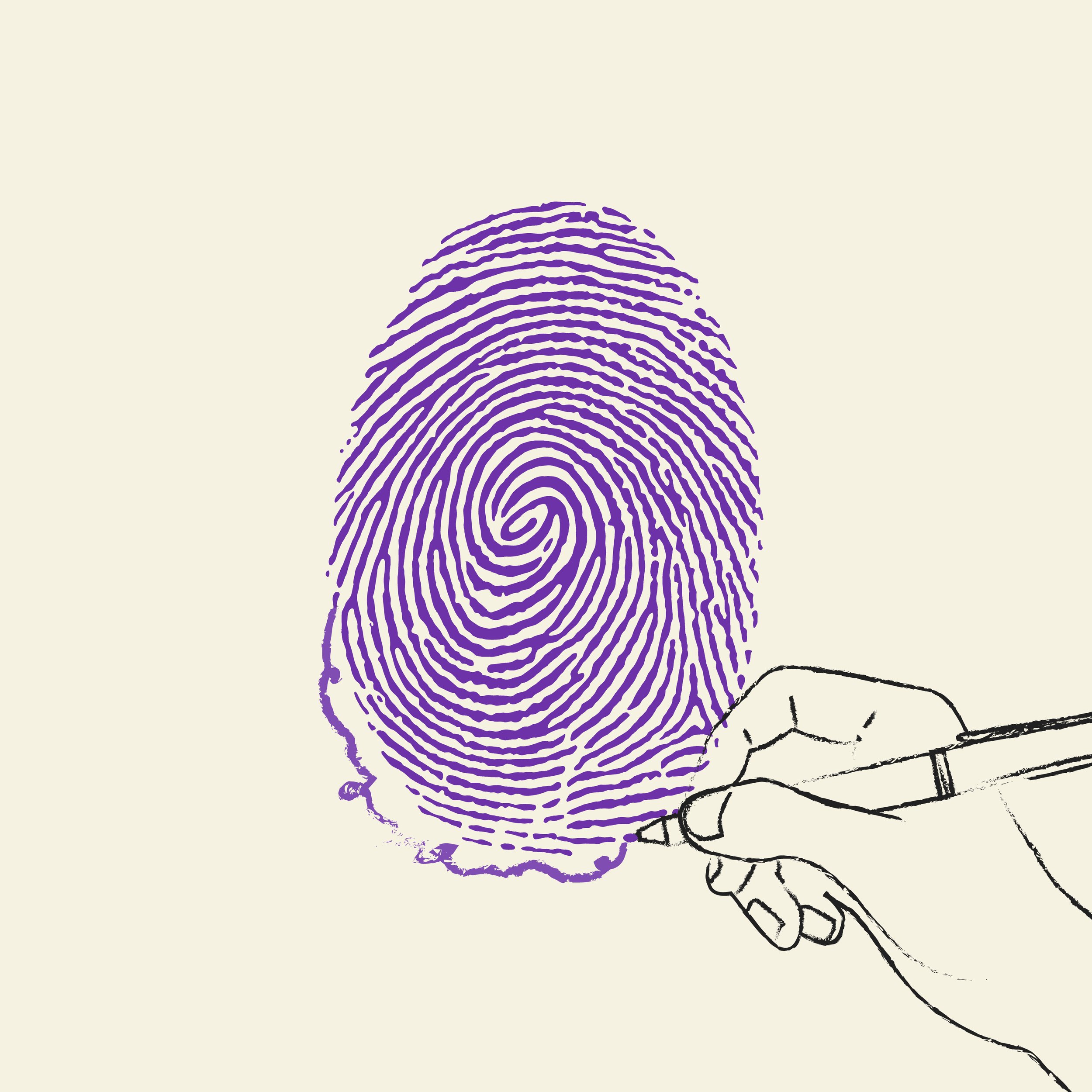
“According to forensic linguists, we all use language in a uniquely identifiable way that can be as incriminating as a fingerprint. … The term ‘forensic linguistics’ was likely coined in the 1960s by Jan Svartvik, a Swedish linguist who re-examined the controversial case of Timothy John Evans, a Welshman who was wrongfully accused of murdering his wife and daughter and was convicted and hanged in 1950. Svartvik found that it was unlikely that Evans, who was illiterate, had written the most damning parts of his confession, which had been transcribed by police and likely tampered with. The real murderer was the Evans’ downstairs neighbor, who turned out to be a serial killer.

“Today, the field is perhaps still best known for its role in solving the ‘Unabomber’ case in the United States. Between 1978 and 1995, a mysterious figure sent letter bombs to academics, businessmen and random civilians, killing three people and injuring at least 24. The lone bomber was careful not to leave any fingerprints or DNA traces, evading the authorities for 17 years and triggering one of the longest and most expensive criminal investigations in U.S. history. But in 1995, he made a crucial mistake. He told the police he would pause his attacks on the condition that a newspaper publish his 35,000-word anti-technology manifesto.

“When the document appeared in the Washington Post, the New York Times and Penthouse magazine, several people — including the perpetrator’s brother— reached out to say they recognized the writing style. Meanwhile, FBI linguist James Fitzgerald and sociolinguist Roger Shuy, who had been studying the bomber’s letters, had identified patterns in his language that helped narrow the list of suspects: Spellings such as ‘wilfully for ‘willfully’ and ‘clew’ for ‘clue’ pointed to someone from the Chicago area, for example. Eventually, the linguistic evidence was strong enough to issue a search warrant for the home of a reclusive mathematician named Theodore Kaczynski, raised in Chicago but living in rural Montana, where investigators found copies of the manifesto and homemade bombs. …

“At OrphAnalytics, Roten, who has a PhD in microbiology, explains that algorithms identify patterns in syntax much like in a DNA sequence. The difference, he tells me, is ‘there are very few errors in genome sequences, which is not the case when we compare texts,’ he said. Unlike with DNA, which a perpetrator can’t control, the author of a poison-pen letter is likely to try to obscure his writing style, for example by trying to sound less educated or to seem foreign.

“Still, linguists argue that style is almost impossible to hide because many of the choices we make are unconscious. Someone may decide to spell a word wrong, but forget to modify less noticeable details, such as their use of punctuation. ‘People say a lot about themselves when they’re trying to hide their writing,’ said Roten.”

More at the Dial, here. No firewall.

Read Full Post »