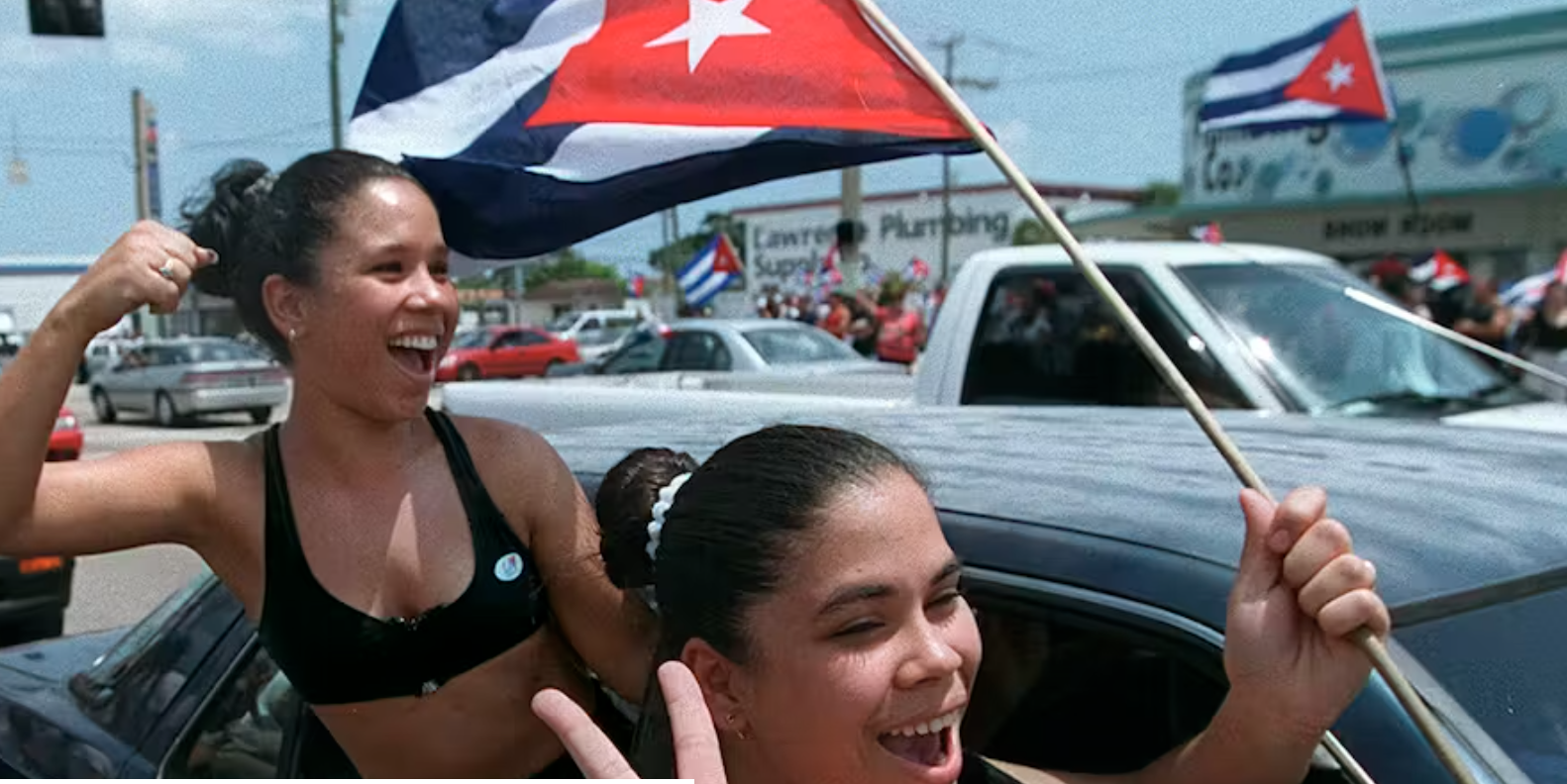
Photo: Miami Herald/Getty.
The English language in Miami is changing.
Here’s something for readers interested in the evolution of languages. Miami has such a vibrant Spanish-speaking community that it’s developing its own version of English.
Phillip M Carter of Florida International University describes the new dialect at the Conversation, ” ‘We got down from the car and went inside.’
“ ‘I made the line to pay for groceries.’
“ ‘He made a party to celebrate his son’s birthday.’
“These phrases might sound off to the ears of most English-speaking Americans. In Miami, however, they’ve become part of the local parlance.
“According to my recently published research, these expressions – along with a host of others – form part of a new dialect taking shape in South Florida. This language variety came about through sustained contact between Spanish and English speakers, particularly when speakers translated directly from Spanish.
“Whether you’re an English speaker living in Miami or elsewhere, chances are you don’t know where the words you know and use come from…. Borrowed words are far more pervasive than you might think.
“They’re all over English vocabulary: ‘pajamas‘ from Hindi; ‘gazelle‘ from Arabic, via French; and ‘tsunami‘ from Japanese.
“Borrowed words usually come from the minds and mouths of bilingual speakers who end up moving between different cultures and places. …
“One bilingual confluence famously changed the trajectory of the English language. In 1066, the Norman French, led by William the Conqueror, invaded England in an event now known as ‘the Norman Conquest.’
‘Soon thereafter, a French-speaking ruling class replaced the English-speaking aristocracy, and for roughly 200 years, the elites of England – including the kings – did their business in French.
“English never really caught on with the aristocracy, but since servants and the middle classes needed to communicate with aristocrats – and with people of different classes intermarrying – French words trickled down the class hierarchy and into the language.
“During this period, more than 10,000 loanwords from French entered the English language, mostly in domains where the aristocracy held sway: the arts, military, medicine, law and religion. Words that today seem basic, even fundamental, to English vocabulary were, just 800 years ago, borrowed from French: prince, government, administer, liberty, court, prayer, judge, justice, literature, music, poetry, to name just a few.
“Fast forward to today, where a similar form of language contact involving Spanish and English has been going on in Miami since the end of the Cuban Revolution in 1959.
“In the years following the revolution, hundreds of thousands of Cubans left the island nation for South Florida, setting the stage for what would become one of the most important linguistic convergences in all of the Americas.
“Today, the vast majority of the population is bilingual. In 2010, more than 65% of the population of Miami-Dade County identified as Hispanic or Latina/o, and in the large municipalities of Doral and Hialeah, the figure is 80% and 95%, respectively.
“Of course, identifying as Latina/o is not synonymous with speaking Spanish, and language loss has occurred among second- and third-generation Cuban Americans. But the point is that there is a lot of Spanish – and a lot of English – being spoken in Miami.
“Among this mix are bilinguals. Some are more proficient in Spanish, and others are more skilled English speakers. Together, they navigate the sociolinguistic landscape of South Florida in complex ways, knowing when and with whom to use which language – and when it’s OK to mix them.
“When the first large group of Cubans came to Miami in the wake of the revolution, they did precisely this, in two ways.
“First, people alternated between Spanish and English, sometimes within the same sentence or clause. This set the stage for the enduring presence of Spanish vocabulary in South Florida, as well as the emergence of what some people refer to as ‘Spanglish.’
‘Second, as people learned English, they tended to translate directly from Spanish. These translations are a type of borrowing that linguists call ‘calques.’
Calques are all over the English language.
“Take ‘dandelion.’ This flower grows in central Europe, and when the Germans realized they didn’t have a word for it, they looked to botany books written in Latin, where it was called dens lionis, or ‘lion’s tooth.’ The Germans borrowed that concept and named the flower ‘Löwenzahn‘ – a literal translation of ‘lion’s tooth.’ The French didn’t have a word for the flower, so they too borrowed the concept of ‘lion’s tooth,’ calquing it as ‘dent de lion.’ The English [brought] ‘dent de lion’ into English, calling it ‘dandelion.’
“This is exactly the sort of thing that’s been happening in Miami.”
Since people whose first language is Spanish live all over the US, I think any of us could come up with similar blends if we thought about it. Maybe there are some specific to English as spoken in England.
At the Conversation, here, you can read about the three kinds of calques the researchers identified in Miami. No firewall.

 Suzanne's Mom's Blog