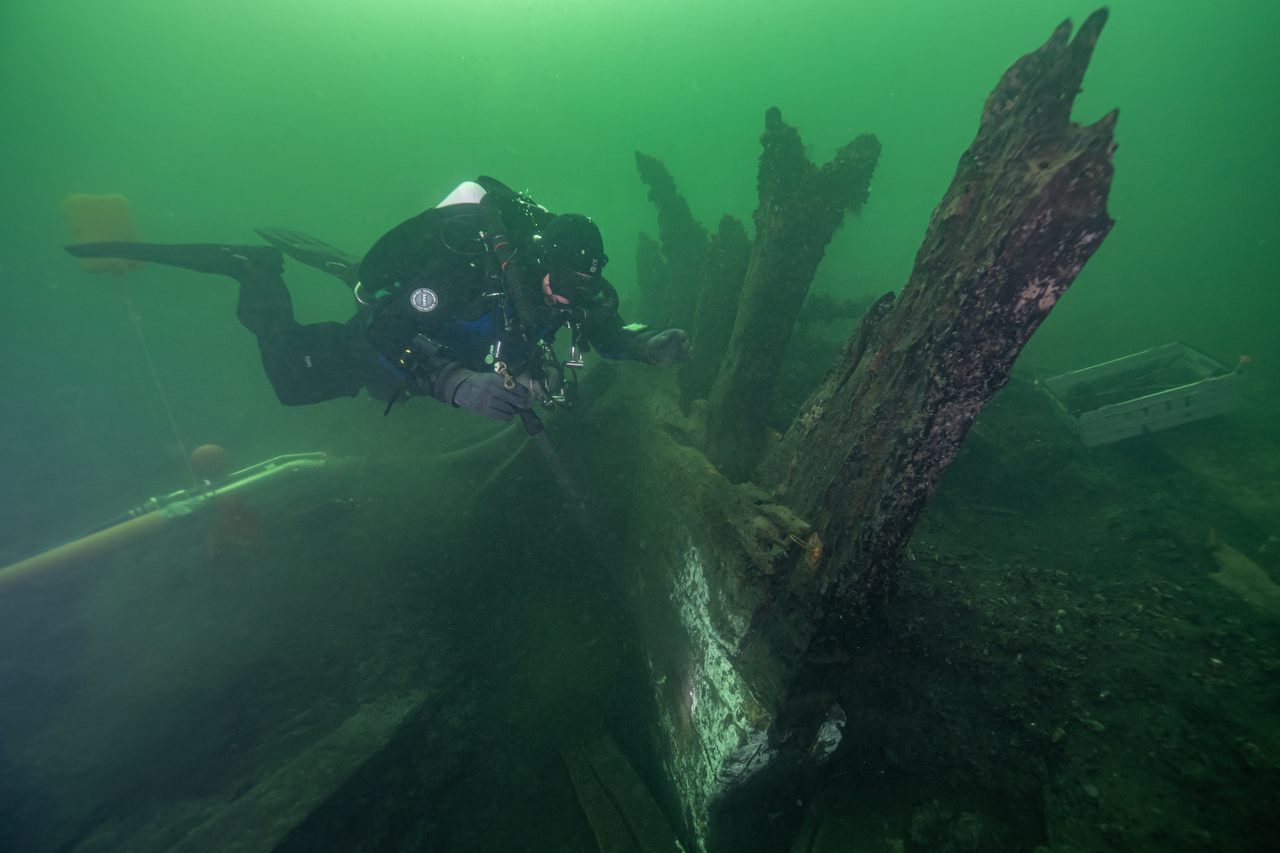
Photo: Brett Seymour.
A trove of spices was found in the stern of the ship by Brendan Foley and a team of archaeologists. It had been there for centuries.
For those of us who hope that one day the lost island of Atlantis will be found, any story about underwater discoveries of ancient artifacts is thrilling.
Line Sidonie Talla Mafotsing writes at Atlas Obscura, “Built 1485, the Danish warship Gribshunden served as the flagship and mobile seat of government for King Hans of Denmark and Norway. In the summer of 1495, Hans set sail for Kalmar, Sweden, where he was set to negotiate with Swedish leader Sten Sture the Elder. The goal of the mission was to convince Sten Sture and the Swedish council to give up their sovereignty and rejoin the Kalmar Union, which had unified much of Scandinavia under a single ruler (and which Sweden had left a few decades before, despite the union being named for a Swedish town).
“The ship itself had a role to play: to show Hans’s authority to the Swedish council. It was also laden with goods — from gunpowder weapons to artwork to delicacies — to demonstrate his power.
“However, while anchored in the Baltic Sea near the port of Ronneby, Sweden, Gribshunden mysteriously caught fire. Though the king wasn’t on board at the time, many crewmen were, in addition to all those pricey goods. Although the exact number of deaths is unknown, many of the crew of 150 were on board when the ship sank to the bottom of the Baltic with its precious cargo. …
“In the 1970s, a local diving club came across a mysterious wooden wreck there, in 33 feet of water. It wasn’t until 2001 that the first archaeological excavations of the ship began, after one of the divers told local archaeologists about what they had found. It was another decade before the remains were identified as those of Gribshunden. All through the excavation of the wreck, remarkably preserved by the cold waters of the Baltic, amazing and sometimes odd artifacts have emerged and attracted media attention. In 2015, there was a nearly perfectly preserved wooden ‘sea monster’ figurehead. In 2019, archaeologists discovered a well-preserved rare Atlantic sturgeon. Further excavations in 2021 revealed something even more remarkable: a treasure trove of spices, plant material, fruits, nuts, and cereals, that somehow survived underwater for more than 500 years.
“In a study published in the journal PLoS ONE, Brendan Foley and Mikael Larsson, archaeologists at Lund University in Sweden, examined the finds for new insights into how nobility lived and ate during the Middle Ages, and shed light on how these organic materials survived so long underwater.
“Foley and a team had been excavating the stern when they made the finds. ‘We think, but we’re not sure, that the back part of the ship is probably where the highest ranking individuals were situated,’ says Foley. They sifted through the sand and silt and revealed almond shells and peppercorns. They recovered thin strands of saffron by hand. ‘We took four samples of botanical assemblage that included both local and exotic spices, fruits, and vegetables,’ says Larsson, including black mustard, dill, clove, ginger, cucumber, grape, and berries such as blackberry and raspberry. ‘The botanical remains that really stand out are the exotic spices,’ he says. Clove, ginger, and saffron had never been found before in the medieval Baltic.
Larsson says that their work is the first anywhere in the world to find saffron in such a setting. …
“Though the geographical origins of saffron are not completely understood, it is thought to have originated in the eastern Mediterranean, and been grown in Southwest Asia and the Mediterranean basin. Ginger is believed to have originated in Southeast Asia, and cloves are native to Indonesia. Black pepper comes from South India. Despite this time being known as the ‘Dark Ages’ in Europe, the finds show that Scandinavia wasn’t just a backwater of the world economy. …
“[One] question focuses on how these delicate organic remains were able to survive in the Baltic. ‘It’s a mystery,’ says Foley. ‘We don’t know, we didn’t find any containers.’ When they found the saffron, it was just in a lump in the sediment. ‘No glass jar around it, no ceramic jar, no wooden box, no silver box,’ he says. It may have been stored in some sort of fine textile bag that disintegrated over the years—but somehow the spice remained.
“ ‘The Baltic Sea is really weird,’ Foley says. For one, it has the lowest salinity found in the global oceans. This, combined with low temperatures and low dissolved oxygen to feed microbes, have given the Baltic a reputation for remarkable preservation of archaeological material, specifically wooden shipwrecks.”
More at Atlas Obscura, here. No firewall.


 Suzanne's Mom's Blog