Feeds:
Posts
Comments

Posts Tagged ‘stanford’

Photo: Elisabeth von Boch/Stanford.
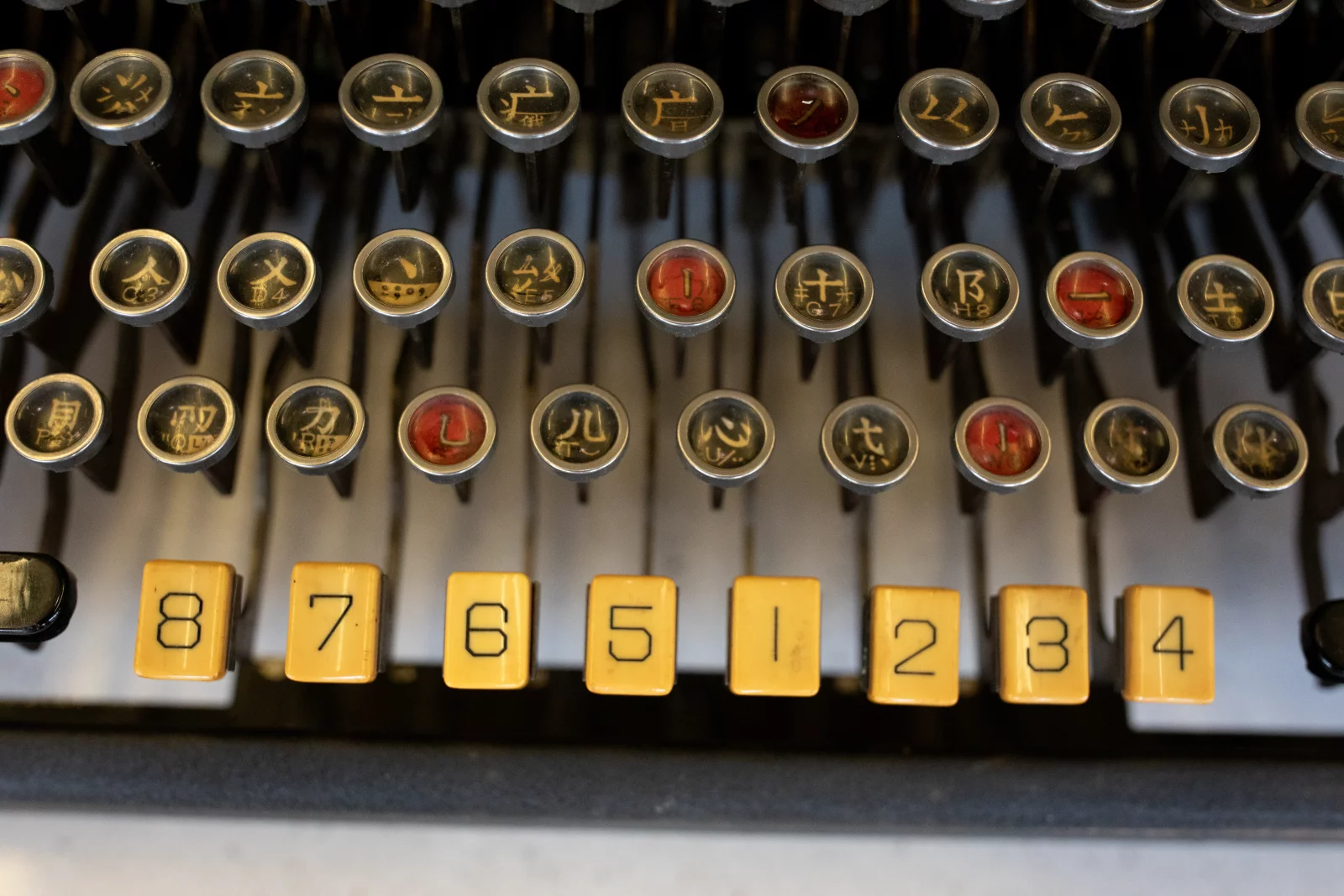
The MingKwai typewriter, crucial to the development of modern Chinese computing, has resurfaced. Its keys enable the typist to find and retrieve Chinese characters.

I love stories about finding long-lost treasures. The story of this old typewriter, the only one of its kind ever made, fits that category.

Emily Feng writes at National Public Radio (NPR), “Scholars in the U.S., Taiwan and China are buzzing about the discovery of an old typewriter, because the long-lost machine is part of the origin story of modern Chinese computing — and central to ongoing questions about the politics of language.

“China’s entry into modern computing was critical in allowing the country to become the technological powerhouse it is today. But before this, some of the brightest Chinese minds of the 20th century had to figure out a way to harness the complex pictographs that make up written Chinese into a typewriter, and later, a computer.

“One man succeeded more than any other before him. His name was Lin Yutang, a noted linguist and writer from southern China. He made just one prototype of his Chinese typewriter, which he dubbed the MingKwai. …

“Detailed U.S. patent records and diagrams of the typewriter from the 1940s are public, but the physical prototype went missing. Scholars assumed it was lost to history.

” ‘I had really, truly thought it was gone,’ says Thomas Mullaney, a history professor at Stanford University who has studied Chinese computing for two decades and is the author of The Chinese Typewriter.

Mullaney was at a conference last year when he got a message that someone in upstate New York had found a strange machine in their basement and posted a picture of it on Facebook.

” ‘It was a sleepless night.’ …

“Eventually, the owner reached out to him. They had acquired the typewriter from a relative who had worked at Mergenthaler Linotype, once of the most prominent U.S. makers of typesetting machines. The company helped craft the only known prototype of the MingKwai typewriter. …

” ‘It’s like a family member showing up at your doorstep and you had just assumed you would never see them,’ Mullaney says.

“The story of why such a typewriter even exists runs parallel to the political upheaval and conflict over Chinese identity and politics in the 20th century.

“Lin, its inventor, was born in 1895 in southern China during the tail end of a failing Qing dynasty. Student activists and radical thinkers were desperate to reform and strengthen China. Some proposed dismantling traditional Chinese culture in favor of Western science and technology, even eliminating Chinese characters altogether in favor of a Roman alphabet.

” ‘Lin Yutang charted a path right down the middle,’ says Chia-Fang Tsai, the director of the Lin Yutang House, a foundation set up in Taiwan to commemorate the linguist’s work. …

“Typing Chinese was a monumental challenge. Chinese has no alphabet. Instead, it uses tens of thousands of pictographs. When Lin started his work in the early 20th century, there was no standardized version of Mandarin Chinese. Instead, people spoke hundreds of dialects and languages, meaning there was no singular phonetic spelling of the sound of each word.

“Lin had financial backing from the American writer Pearl S. Buck to create the typewriter, but he also sunk much of his own savings into the project as costs ballooned.

” ‘He’d spent a lot of money. A lot,’ says Jill Lai Miller, Lin’s granddaughter. …

“The typewriter’s ingenuity comes from the way Lin decided to break down Chinese pictographs: by their shapes, not sounds. The typist can search for certain combinations of shapes by pressing down on the ergonomic keyboard. Then, a small screen above the keyboard (Lin called it his ‘magic eye’) offers the typist up to eight possible characters that might match. In this way, the typewriter boasts the ability to retrieve up to 90,000 characters. …

“Encoded in the machine’s engineering was an ambitious globalism. Lin’s way of breaking down languages by the shape of their words rather than their sounds or alphabets meant his machine theoretically can type English, Russian and Japanese as well, according to the typewriter’s manual.

” ‘One thing that was very interesting … in Li Yutang’s thinking about Chinese-ness and Chinese culture is that it must not be insular. It must have this porous border, it must be capacious and be able to communicate and talk with other cultures,’ says Yangyang Cheng, who first wrote about the typewriter’s discovery. …

“Mullaney is now researching the typewriter full-time, trying to understand how its mechanical innards work, with the far-off dream of one day replicating it. He recently found the typewriter’s ink spool was still fully intact inside.

” ‘You would need the sort of technology that they used on, like, discoveries of the Dead Sea Scroll and stuff like that, but you’ll notice that the ink spool is still there,’ he points out, using a dental mirror to peer inside the machine.

“The ink spool could contain traces of the last words Lin or his daughter typed on the machine — meaning perhaps the inventor’s own words are in his magical machine too.”

More at NPR, here. The New York Times also has a story on the typewriter. Read it here.

Read Full Post »

Photo: Mark Boss.
The Hoover Dam on the Colorado River, on the border between Arizona and Nevada, is one of the 2,400 hydroelectric plants that produce energy in the United States.

I toyed with calling this post “The Farmer and the Cowman Should Be Friends,” from a song in Oklahoma, but I didn’t think anyone besides Will would get it. I just wanted to convey the idea that when opposing sides negotiate in good faith, it’s possible to come to mutually satisfactory agreements. In the case of the energy-sector and environmental adversaries in today’s story, it took a couple of years.

Brad Plumer at the New York Times begins by saying, “The industry that operates America’s hydroelectric dams and several environmental groups announced an unusual agreement [in 2020] to work together to get more clean energy from hydropower while reducing the environmental harm from dams, in a sign that the threat of climate change is spurring both sides to rethink their decades-long battle over a large but contentious source of renewable power.

“The United States generated about 7 percent of its electricity [in 2019] from hydropower, mainly from large dams built decades ago, such as the Hoover Dam, which uses flowing water from the Colorado River to power turbines. But while these facilities don’t emit planet-warming carbon dioxide, the dams themselves have often proved ecologically devastating, choking off America’s once-wild rivers and killing fish populations.

“So, over the past 50 years, conservation groups have rallied to block any large new dams from being built, while proposals to upgrade older hydropower facilities or construct new water-powered energy-storage projects have often been bogged down in lengthy regulatory disputes over environmental safeguards.

“The new agreement signals a desire to de-escalate this long-running war. In a joint statement, industry groups and environmentalists said they would collaborate on a set of specific policy measures that could help generate more renewable electricity from dams already in place, while retrofitting many of the nation’s 90,000 existing dams to be safer and less ecologically damaging.

“The two sides also said they would work together to accelerate the removal of older dams that are no longer needed, in order to improve the health of rivers. More than 1,000 dams nationwide have already been torn down in recent decades.

“The statement, the result of two years of quiet negotiations, was signed by the National Hydropower Association, an industry trade group, as well as environmental groups including American Rivers, the World Wildlife Fund and the Union of Concerned Scientists. Another influential organization, The Nature Conservancy, listed itself as a ‘participant,’ signaling that it was not prepared to sign the full statement but would stay engaged in the ongoing dialogue over hydropower policies.

“Bob Irvin, the president of American Rivers, which has long highlighted the harm that dams cause to the nation’s waterways, said that growing concern over global warming had caused some environmentalists to reassess their longstanding opposition to hydropower.

“ ‘The climate crisis has become a lot more acute and we recognize that we need to generate carbon-free energy whenever and wherever we can,’ Mr. Irvin said. ‘And we do see that hydropower has a role to play there.’

“Mr. Irvin emphasized that his group would still oppose any effort to build new dams on rivers. But that still left plenty of room for compromise.” More at the Times, here.

Devon Ryan has an update from the Stanford Woods Institute for the Environment, where the work of compromise took place: “Key ideas and proposals from an agreement between the hydropower industry and environmental community, facilitated through a Stanford Woods Institute for the Environment Uncommon Dialogue, have been included in the $1 trillion infrastructure package adopted by the U.S. Senate.

“President Biden signed the infrastructure bill, ‘Infrastructure Investment and Jobs Act,’ into law on November 15, 2021, which included over $2.3 billion for the ‘3Rs’ dam infrastructure priorities set by agreements that came out of the Uncommon Dialogue led by Dan Reicher and hosted by the Stanford Woods Institute for the Environment.

In the fall of 2020, [amid] one of the most divisive periods in American history, the hydropower and river conservation communities, traditionally at odds, reached an agreement to work together to address the nation’s more than 90,000 dams.

“The momentous agreement was the result of a two-and-a-half-year Uncommon Dialogue, an ongoing process organized by the Stanford Woods Institute for the Environment that brings public and private sector leaders and researchers together to develop practical solutions to pressing sustainability challenges.

“Now, key ideas from that pact and a subsequent detailed proposal are incorporated into the bipartisan Senate infrastructure bill, including $2.3 billion for the ‘3Rs’ of U.S. dams: Rehabilitation for safety, Retrofit for power and Removal for conservation.”

More at Stanford, here.

Read Full Post »

orchestra-main

Photo: Ge Wang
The Stanford Laptop Orchestra rehearsing for its tenth anniversary concert last month.

Not sure I would enjoy the sound of an all-electronic orchestra even though I did think MIT professor Tod Machover’s partly electronic opera Resurrection was lovely. What I do like about the Stanford Laptop Orchestra is the idea that the most important requirement for taking the course is curiosity. I’m all for curiosity.

Arielle Pardes Gear writes at Wired magazine, “Ten days before the big concert, the members of the Stanford Laptop Orchestra are performing technology triage. Rehearsal has only just started, but already, things seemed to be falling apart. First there was trouble with the network that connects the laptops to one another. Then one of the laptops crashed. …

“The orchestra members have gathered at Stanford’s Center for Computer Research in Music and Acoustics to rehearse a new kind of musical composition. Together, sitting on meditation pillows in front of MacBooks, they create songs that stretch the definition of music. The orchestra plays laptops like accordions, turns video games into musical scores, and harnesses face-tracking software to turn webcams into instruments. …

“Fixing a broken network isn’t as simple as a replacing a snapped string on a violin. But in a laptop orchestra, the potential for disaster is part of the delight. Since it was founded in 2008, the SLOrk has been making music that surprises audiences while it subverts the concept of orchestral performance. The compositions, part-machine and part-human, don’t always go according to plan. Technical difficulties are all but guaranteed.  …

” ‘Nothing’s better at being a cello than a cello,’ says [Ge Wang, the SLOrk’s founder and director]. ‘So we’re not trying to make a cello. We’re trying to make something you don’t have a name for yet.’ …

“[The Stanford Laptop Orchestra is] a for-credit course at Stanford — Music 128, cross-listed in the computer science department as CS 170 — but getting in isn’t easy. The group of 15 students includes those with computer science credentials, and those with more traditional music backgrounds, but neither is enough to become a great laptop orchestra player. The most important thing is curiosity. ‘We’re unified by this interest to make music together with computers,’ says Wang, ‘and to figure out what that means.’ ”

More here.


Read Full Post »

In the Boston Globe‘s new “Stat” offering, Melissa Bailey has a story about a Boston doctor’s cost-effective bed for treating jaundiced African babies with blue-light.

“The invention looks like a space-age bassinet: A basket of reflective material, covered with canvas dotted with blue LED lights. It aims to treat an ancient problem. Jaundice — an excess of bilirubin that turns the skin yellow — kills 100,000 babies per year, many in developing countries. But exposure to plain blue light can cure it.

“The device, called the Bili-Hut, was inspired by inventor Donna Brezinski’s experience as a neonatal doctor at Boston Children’s Hospital. One day, about ten years ago, she was caring for a pair of jaundiced newborn twins at a community hospital that partnered with Children’s — but found only one available phototherapy lamp, the standard treatment for severe cases. When she looked into buying another lamp, she was shocked by the $4,000 price tag.

“Sewing together simple materials at her kitchen table in Winchester, she set about creating a cheaper and more portable alternative that could be used in the developing world. She came up with a bassinet that reflects blue light around the baby’s body. She started a company, Little Sparrows Technologies, to produce and distribute the device. It weighs less than three pounds, can be rolled up to fit inside a FedEx tube, and costs only $250 to make.

“While the device awaits clearance from the Federal Drug Administration for use in the United States, a rural hospital in Burundi has been testing out a prototype and has reported promising results.

“Dr. Alyssa Pfister, a pediatrician at Kibuye Hope Hospital in east central Burundi, found the Bili-Hut on the Internet and e-mailed Brezinski. The inventor sent a free prototype to the hospital, which started using it in September. …

“Brezinski said the device provides the same intensity and quality of light recommended by the American Academy of Pediatrics and used by other blankets and lamps approved by the FDA. She has tested it on synthetic skin samples and expects to hear back from the FDA within 18 months.” More here.

Interestingly, John’s company, Optics for Hire, was involved in a successful device for treating babies in the developing world called Firefly. See it here.

Photo: Alissa Ambrose/Stat

Read Full Post »

John-E-tughole

An article by Gretchen Reynolds at the New York Times “Well” blog details new research on the stress-reducing effects of walking in nature.

Reynolds writes, “City dwellers [have] a higher risk for anxiety, depression and other mental illnesses than people living outside urban centers …

“Various studies have found that urban dwellers with little access to green spaces have a higher incidence of psychological problems than people living near parks and that city dwellers who visit natural environments have lower levels of stress hormones immediately afterward than people who have not recently been outside.

“But just how a visit to a park or other green space might alter mood has been unclear. Does experiencing nature actually change our brains in some way that affects our emotional health? That possibility intrigued Gregory Bratman, a graduate student at the Emmett Interdisciplinary Program in Environment and Resources at Stanford University.

In his “new study, which was published last week in Proceedings of the National Academy of Sciences, Mr. Bratman and his collaborators decided to closely scrutinize what effect a walk might have on a person’s tendency to brood. … Such rumination [is] strongly associated with increased activity in a portion of the brain known as the subgenual prefrontal cortex.”

The results: “As might have been expected, walking along the highway had not soothed people’s minds. Blood flow to their subgenual prefrontal cortex was still high and their broodiness scores were unchanged. But the volunteers who had strolled along the quiet, tree-lined paths showed slight but meaningful improvements in their mental health, according to their scores on the questionnaire. They were not dwelling on the negative aspects of their lives as much as they had been before the walk.” More here.

As we used to chant to our overexcited dog when we picked her up after a grooming, “I’m calm, you’re calm.”

Try out this Derek Wolcott poem for your walk in the woods. It is read on SoundCloud by my husband’s college classmate, Jon Kabat-Zinn.

Read Full Post »

Even when I take my walk in the house on a bad day in winter, I find that walking helps me think. My pace indoors or out is not very energetic, but I like that all sorts of ideas and memories pop into my head as I walk.

At the NY Times blog called “Well,” Gretchen Reynolds describes new research that ties walking to creativity.

“A brief stroll, even around your office, can significantly increase creativity, according to a handy new study. Most of us have heard by now that exercise, including walking, generally improves thinking skills, both immediately and in the longer term. …

“Similarly, exercise has long been linked anecdotally to creativity. For millenniums, writers and artists have said that they develop their best ideas during a walk …

“Researchers at Stanford University recently decided to test that possibility, inspired, in part, by their own strolls. ‘My adviser and I would go for walks’ to discuss thesis topics, said Marily Oppezzo, at the time a graduate student at Stanford. ‘And one day I thought: “Well, what about this? What about walking and whether it really has an effect on creativity?” ‘

“With the enthusiastic support of her adviser, Daniel Schwartz, a professor in the Stanford Graduate School of Education, Dr. Oppezzo [gathered] her volunteers in a deliberately dull, unadorned room equipped with only a desk and (somewhat unusually) a treadmill, Dr. Oppezzo asked the students to sit and complete tests of creativity … Then the participants walked on the treadmill, at an easy, self-selected pace that felt comfortable. The treadmill faced a blank wall. While walking, each student repeated the creativity tests, which required about eight minutes.

“For almost every student, creativity increased substantially when they walked.”

The study was published this month in the Journal of Experimental Psychology: Learning, Memory, and Cognition.

 More here, where Reynolds notes that there was no difference when the volunteers walked outdoors instead of on a treadmill.

Embed from Getty Images

Read Full Post »