Feeds:
Posts
Comments

Posts Tagged ‘stars’

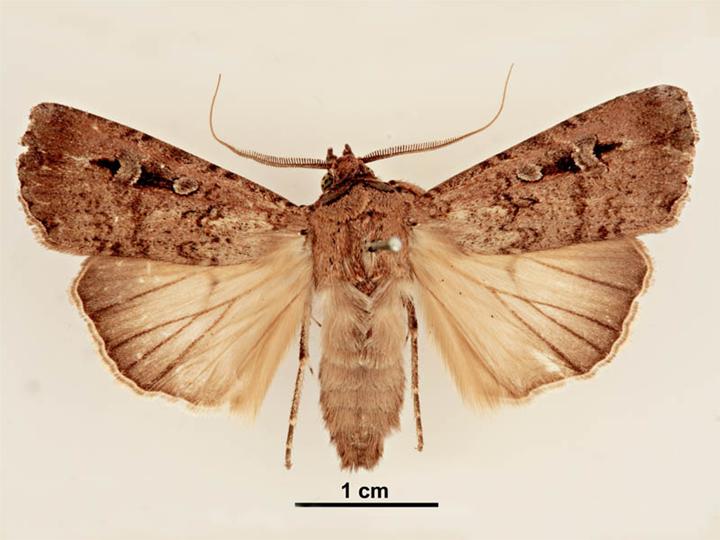
Photo: Lucinda Gibson and Ken Walker/Museum Victoria.
The endangered bogong moth can travel great distances to a place it has never been to before. It uses the stars to navigate.

Some of the least prepossessing critters in nature often have interesting attributes that could teach us a lot if we pay attention.

Ari Daniel reports at National Public Radio (NPR), “The Bogong moths of Australia aren’t much to look at, says Andrea Adden, a neurobiologist at the Francis Crick Institute. ‘They’re small brown moths with arrow-like markings on the wings. They’re pretty nondescript.’

“But these insects undertake an epic migration twice in their lifetime, traveling hundreds of miles in each direction.

“Researchers have shown that the Earth’s magnetic field helps the moths orient, but that alone wasn’t sufficient. ‘They needed something visual to go with it,’ says Adden.

“She wanted to know what that cue might be over such a vast landscape — especially at night when there’s little light.

“In a paper published in the journal Nature, Adden and her colleagues show that the cue comes from the heavens. That is, the starry sky allows the Bogong moths to both orient and navigate.

“Bogong moths follow an annual rhythm. They hatch in their breeding grounds in the spring in southeast Australia where it gets really hot in the summertime. ‘So if they were to reproduce immediately, their larvae would starve because there is not enough food,’ says Adden.

“Instead, the moths migrate over multiple nights more than 600 miles south to the Australian Alps where they settle in cooler caves, entering into a dormant phase called estivation (like hibernation but in the summer), by the millions. …

“In the fall, they return to their breeding grounds, mate, lay their eggs, and die.

” ‘Then the next year, the new moths hatch,’ says Adden. ‘And they’ve never been to the mountains. They have no parents who can tell them how to get there.’ And yet they make it.

“She suspected the stars might offer just the cue they need. To test her theory, Adden, who was doing her Ph.D. at Lund University in Sweden at the time, and her colleagues caught moths in the Australian Alps and ran them through one of two experiments in the dead of night.

“The first was a behavioral test. It involved placing a moth inside what was basically a mini-planetarium that contained a projection of the night sky and no magnetic field. … The result surprised the researchers.

” ‘They didn’t just circle and do twists and turns, but they actually chose a fairly stable direction,’ she said. ‘Not only that, it was their migratory direction.’ In other words, the moths were using the starry sky as a compass cue to orient and navigate.

“Adden’s next question involved what was happening in the moth’s brain. She recorded the electrical activity of individual neurons while rotating a projection of the Milky Way.

“When she looked in the brain regions that process visual information, the majority of neurons were active when the moth was facing south. This specific direction suggests that the moths’ brains encode direction by processing visual cues of the Milky Way. …

“The moths’ ability to use both visual and magnetic information to navigate can be essential for survival — in case it’s cloudy, say, or the magnetic field is unreliable. ‘If one fails, they have a backup system,’ says [biologist Pauline Fleischmann at the University of Oldenburg].

“The Bogong moths are endangered. Adden says her findings could help conserve these insects — and everything that relies on them for food.”

More at NPR, here.

Read Full Post »

Photo: Nicholas J.R. White.
A night sky above a copse of trees on Guirdil Bay on the Isle of Rum in Scotland.

In the summer, when we are staying in New Shoreham, we can see the stars at night, including the Perseid meteor showers. But the rest of the year, newspaper alerts about cool things happening in the night sky are wasted on us. I would love to see, at least for a little while, what the residents of the Isle of Rum can see.

Kat Hill writes at the New York Times, “Rum, a diamond-shaped island off the western coast of Scotland, is home to 40 people. Most of the island — 40 square miles of mountains, peatland and heath — is a national nature reserve, with residents mainly nestled around Kinloch Bay to the east. What the Isle of Rum lacks is artificial illumination. There are no streetlights, light-flooded sports fields, neon signs, industrial sites or anything else casting a glow against the night sky.

“On a cold January day, the sun sets early and rises late, yielding to a blackness that envelopes the island, a blackness so deep that the light of stars manifests suddenly at dusk and the glow of the moon is bright enough to navigate by.

‘For this reason, Rum was recently named Europe’s newest dark-sky sanctuary, a status that DarkSky International, a nonprofit organization focused on reducing light pollution, has granted to only 22 other places in the world. With the ever-increasing use of artificial lighting at night, places where people can gaze at the deep, ancient light of the universe are increasingly rare.

“Rum’s designation is the result of a long, meticulous bid by the Isle of Rum Community Trust. The effort was led by Alex Mumford, the island’s former tourism manager, and Lesley Watt, Rum’s reserve officer, with the support of Steven Gray and James Green, two astronomers who started Cosmos Planetarium, a mobile theater offering immersive virtual tours of the night sky. Rum ‘stands for something greater,’ Mr. Mumford said, and aspires to be ‘a haven for others to experience the darkness and the Milky Way.’

“A seven-mile walk from Kinloch through the wild and empty heart of the island leads to a Greek-style mausoleum, built in the 19th century, above Harris Bay on the west side of Rum. Locals regard it as the best spot on the island to take in the night sky; on a cloudy night with no moon, one resident said, ‘you can’t even see your hand in front of your face.’ But this night was clear, and stars and meteors wheeled spectacularly overhead as the Milky Way drew a glistening smudge above the brooding mountains, Askival and Hallival. Venus, Saturn and Jupiter stood in a line above the mausoleum’s sandstone pillars.

“Plans are in motion to renovate an abandoned lodge nearby into a place where tourists could stay in their quest for celestial splendor. ‘What you are seeing is not just a 2-D map, but the four dimensions of space and time,’ Dr. Green said. ‘You are looking back into the past.’ …

“On Rum, human life is lived in the small pools of light that spill from windows or glow from headlamps. One key to attaining dark-sky sanctuary status has been to help residents adapt to and embrace the darkness. Porch lights are recessed into doorways and point down; the pier has LED lights, also pointing downward, that provide just enough illumination for marine safety; a shop’s outdoor motion-sensor lights come on only for a few minutes when needed. When the community trust started its sanctuary application in 2022, roughly 15 percent of homes and shops followed the lighting recommendations outlined by the initiative; compliance is now at 95 percent.

“The blackness of night provides more than a cosmic spectacle for humans to enjoy; it is also essential for the environment. ‘Low light levels are important for nocturnal species,’ Ms. Watt said. ‘And artificial lighting can influence the feeding, breeding and migration behavior of many wild animals.’ …

“Education — of adults and children, locals and tourists — is central to dark-sky awareness. Andy McCallum, a teacher on Rum, showed off the models and maps of stars and planets that his handful of students had designed.

“ ‘For our pupils, it’s a powerful reminder that although we live on a small island, we’re part of a vast and interconnected universe,’ he said. It made them proud, he added, to help preserve a unique environment for future generations.”

More at the Times, here. Wonderful photos.

Read Full Post »

Photo: Erika Page/The Christian Science Monitor.
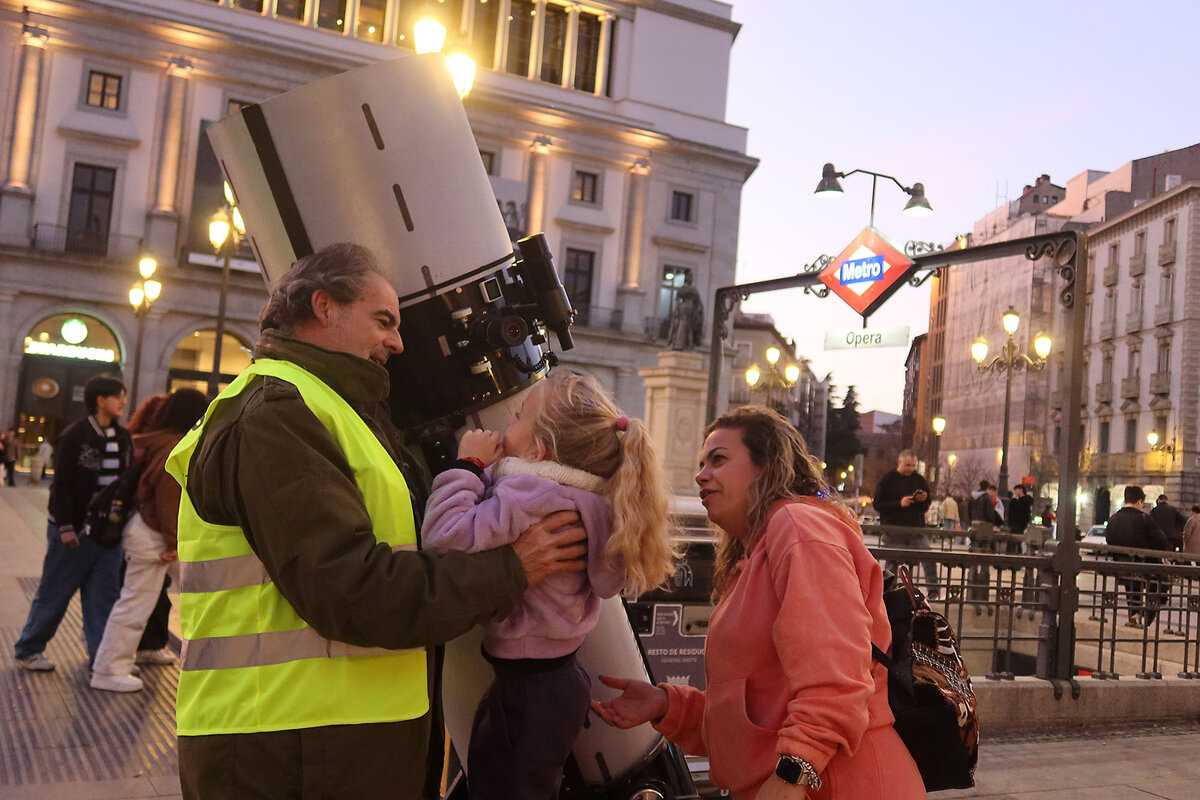
Alfredo Paniagua lifts a young girl up to see planet Jupiter through his telescope on a sidewalk in Madrid last February.

It seems that people are more likely to engage with the stars in the summer than at other times of year. I myself see a lot more stars when I vacation in New Shoreham in July because there are fewer sources of ambient light. The stars are more noticeable.

Today’s story is about a man in Spain who loves to show anyone who’s interested the wonders of astronomy.

Erika Page reports at the Christian Science Monitor, “As the rest of the city heads out on a Friday evening, Alfredo Paniagua dons a lime-green vest, loads his 180-pound telescope into a van, and drives into the center of Madrid.

“He sets up the telescope at the mouth of the busy Ópera metro station, a block from the Royal Palace. The sun still setting, he swivels the massive cylinder to an invisible point in the sky and fiddles with the focuser. And then he waits.

“It doesn’t take long for curiosity to pique. Children tug on sleeves and point. Friends dressed for an evening out stop to ask what’s up there.

“ ‘Jupiter,’ says Mr. Paniagua. ‘The view is spectacular tonight.’

“A line begins to take shape, curious passersby waiting their turn to peek through the lens. Mr. Paniagua places a footstool for those who need it and lifts the smallest kids up himself. He shows each viewer how to focus the image. Then he steps back for his favorite part. Eyebrows raised, he watches face after face light up at the sight: a perfectly round ball of bright gas marked by two clear stripes near its equator, tiny to the eye yet big enough to fit 1,321 Earths. Four moons stretch out in a straight line below. …

“It’s a nightly ritual Mr. Paniagua has performed for two decades, whenever the sky is clear. He often stays past midnight, sharing his telescope with hundreds of strangers free of charge. Many leave a donation, which he accepts. … ‘I like to think that they begin to ask themselves new questions.’ …

“[The immensity is] what Ana Afonso Martin says she felt looking through Mr. Paniagua’s telescope. She and three friends just arrived from the Canary Islands for a weekend in Madrid. Jupiter was the last thing she expected to find in the capital.

” ‘We are teeny, tiny, and this is immense,’ she says. ‘If you’re always stuck in your world, and you don’t look up at the sky, you don’t realize that.’

“It’s also what pulled Mr. Paniagua into the fold 25 years ago. At the time, he was working odd jobs, mostly as a metalworker, on the outskirts of Madrid. He heard word of a free astronomy course offered by someone in his neighborhood, and signed up.

“It was Saturn that hooked him, on the last day of the class. From there, he and a few others formed the Agrupación Astronómica Madrid Sur (South Madrid Astronomical Association) and began bringing an old telescope to schools, hospitals, small towns, and whoever invited them. Most of what he has learned he taught himself, though he eventually became a certified astronomy monitor through the Starlight Foundation, a nonprofit dedicated to promoting and protecting the night sky. Over time he realized that to reach the most people, he needed to be out on the street. …

‘A growing dark-sky movement is working to protect the night from light pollution, which grew by nearly 10% every year between 2011 and 2022.” More at the Monitor, here.

Read Full Post »

Every once in a while reporter Ted Nesi adds a tidbit to his valuable “Saturday Morning Post” that doesn’t seem to fit with the news from Rhode Island and yet fits everywhere. This link from the Virginia Quarterly Review (VQR), a “national journal of literature and discussion,” is one such example.

Amanda Petrusich writes in part, “Darkness is a complicated thing to quantify, defined as it is by deficiency. … Unihedron’s Sky Quality Meter is the most popular instrument for this kind of measurement, in part because of its portability (about the size of a garage-door opener) and also because it connects to an online global database of user-submitted data.

“According to that database, Cherry Springs State Park — an eighty-two-acre park in a remote swath of rural, north-central Pennsylvania, built by the Civilian Conversation Corps during the Great Depression—presently has the second darkest score listed …

“The International Dark-Sky Association (IDA), a nonprofit organization that recognizes, supports, and protects dark-sky preserves around the world, designated it a Gold-tier International Dark Sky Park in 2008, only the second in the United States at the time, following Natural Bridges National Monument in San Juan County, Utah.

“Earlier this year, I drove the six hours to Cherry Springs from New York City to meet Chip Harrison, the park’s manager, his wife, Maxine, and a park volunteer named Pam for a 4:30 p.m. dinner of baked fish. Afterward, Chip had promised, we’d go see stars.  …

“On a clear night, from the proper vantage, watching constellations emerge over Cherry Springs is like watching a freshly exposed photograph sink into a bath of developer, slowly becoming known to the eye: a single crumb of light, then another, until the entire tableau is realized. Pam pointed the telescope toward Jupiter, which had risen over the east end of the field. The four Gallilean moons—Io, Europa, Ganymede, and Callisto—were clearly visible through the lens. …

“When I got back to New York, I visited with Matt Stanley, a beloved colleague at the university where I teach. Stanley … has a particular interest in how science has changed from a theistic practice to a naturalistic one. He leads a seminar called ‘Achilles’ Shield: Mapping the Ancient Cosmos,’ and another called ‘Understanding the Universe.’

“ ‘I’ve found that probably 95 percent of my students come from either an urban or suburban environment, which means they can only see a dozen stars at night, and no planets,’ Stanley said. ‘When you say the Milky Way to them, they imagine a spiral galaxy, which is fine, but that’s not what the Milky Way looks like — it’s a big, whitish smear across the sky. I have to do a lot of work to orient them to what human beings actually saw when they looked at the sky. They don’t know that stars rise and set. Their minds explode.’ ” More here.

In Rhode Island, New Shoreham offers a pretty good look at the night sky. There are shooting stars in August. I feel lucky about that and hope that the five nearby offshore wind turbines don’t change anything.

Photo: Gary Honis

Read Full Post »

Joe Palca, at National Public Radio, recently had a nice report about astronomy and optics.

I thought of John and his OpticsForHire team.

“It used to be that if astronomers wanted to get rid of the blurring effects of the atmosphere,” says Palca, “they had to put their telescopes in space. But a technology called adaptive optics has changed all that.

“Adaptive optics systems use computers to analyze the light coming from a star, and then compensate for changes wrought by the atmosphere, using mirrors that can change their shapes up to 1,000 times per second. The result: To anyone on Earth peering through the telescope, the star looks like the single point of light it really is.

“The reason the atmosphere blurs light is that there are tiny changes in temperature as you go from the Earth’s surface up into space. The degree to which air bends light depends on the air’s temperature.

“With adaptive optics systems, telescopes on Earth can see nearly as clearly as those in space.” More at NPR.

Photo: Heidi B. Hammel and Imke de Pater
The near-infrared images of Uranus show the planet as seen without adaptive optics (left) and with the technology turned on (right).

Read Full Post »