Feeds:
Posts
Comments

Posts Tagged ‘state fair’

Photo: Burl Community Art Gallery.
Artist Julie Peters Krohn painted the rejected Minnesota State Fair entry “The Corn King” as an homage to Ron Kelsey, former superintendent of farm crops at the state fair.  It is on view for the “State Fair Rejects” exhibition at the Douglas Flanders & Associates gallery in Minneapolis.

Do you remember the Museum of Bad Art in Massachusetts? I wrote about it a few times (for example here). The art in today’s story about entries that were rejected by the Minnesota State Fair are not necessarily bad art; they just didn’t fit the taste of this year’s judges. It’s a nice challenge for the rest of us anyway. Would we reject these for an exhibition that doesn’t claim to offer high art in the first place?

A gallery in Minneapolis decided that some of these pieces really deserved to be judged by ordinary folk.

As Alex V. Cipolle reported at Minnesota Public Radio (MPR), “The Fine Arts Competition at the State Fair is one of the most competitive juried exhibitions in Minnesota. This year, artists submitted a total of 2,835 pieces; only 336 were accepted.

“Minneapolis artist Mike Welton says: Don’t take it personally. Welton submitted his painting, “QUEER,” part of a series of LGBTQ-themed signage that Welton has photographed around the country. It didn’t make the cut. In his career, Welton estimates he’s shown in about a dozen Fine Art Competitions, and been rejected from about seven or eight. …

“Welton has unique insight, too. Each year Jim Clark, the fine arts superintendent, chooses artists to curate the show. In 2017, Welton was one of those artists.

“ ‘The year I curated, I couldn’t even pick pieces I wanted to because not all of them could go in,’ Welton says.

“Welton — and many other artists — are taking their rejected entries elsewhere. “Queer” will be on view for ‘State Fair Rejects,’ an exhibition … at the Douglas Flanders & Associates gallery in Minneapolis. …

“ ‘There was a lot of professional artists complaining about being rejected all the time, and I thought, well, maybe we should do a reject show,’ Douglas Flanders says. Last year was the gallery’s first reject show with 50 artist submissions. This year, Flanders says there are almost 80 artworks, from sculpture and paintings to textiles and photography. …

“ ‘People loved coming and supporting it and having another opportunity, obviously, to show their work, too, at a gallery that maybe they would otherwise never have the chance to,’ [Gallery manager Syril McNally] says. “So this year, that’s even more popular, just [by] word of mouth.”

“Beth Stoneberg of the Burl gallery [in St. Paul] says it’s the fifth time they’ve hosted ‘Rejected!’

“ ‘It’s probably one of our most anticipated exhibits of the year. It draws a remarkable crowd. It sparks a lot of conversation,’ Stoneberg says. ‘People are really rooting for the underdog.’ …

“One of her favorite submissions this year is ‘The Corn King’ by artist Julie Peters Krohn. The painting depicts Ron Kelsey, Minnesota ‘corn historian’ and the former superintendent of farm crops at the fair’s Agriculture Horticulture building. Krohn has painted Kelsey with seed sacks (Kelsey may have the largest collection of seed sacks in the world at 1,400).

“ ‘I was inspired while attending the Minnesota State fair last year after I met Ron Kelsey and his scarecrow in the agriculture building,’ Peters Krohn said in her artist statement. 

“I learned about the fair honoring him with a lifetime membership for his many years of involvement, which has included, but is not limited to, corn producer, corn judge, seed art competition creator, scarecrow competition creator and the display of his collection of vintage seed bags. I saw humor in creating a painting of a sculpture of a man so involved but so little known.’ ” More at MPR, here.

You can find a piece that actually won a 2025 State Fair prize by clicking here. It’s called “There Might Be Dragons.”
Read Full Post »

Photo: Isabella Segalovich/Hyperallergic.
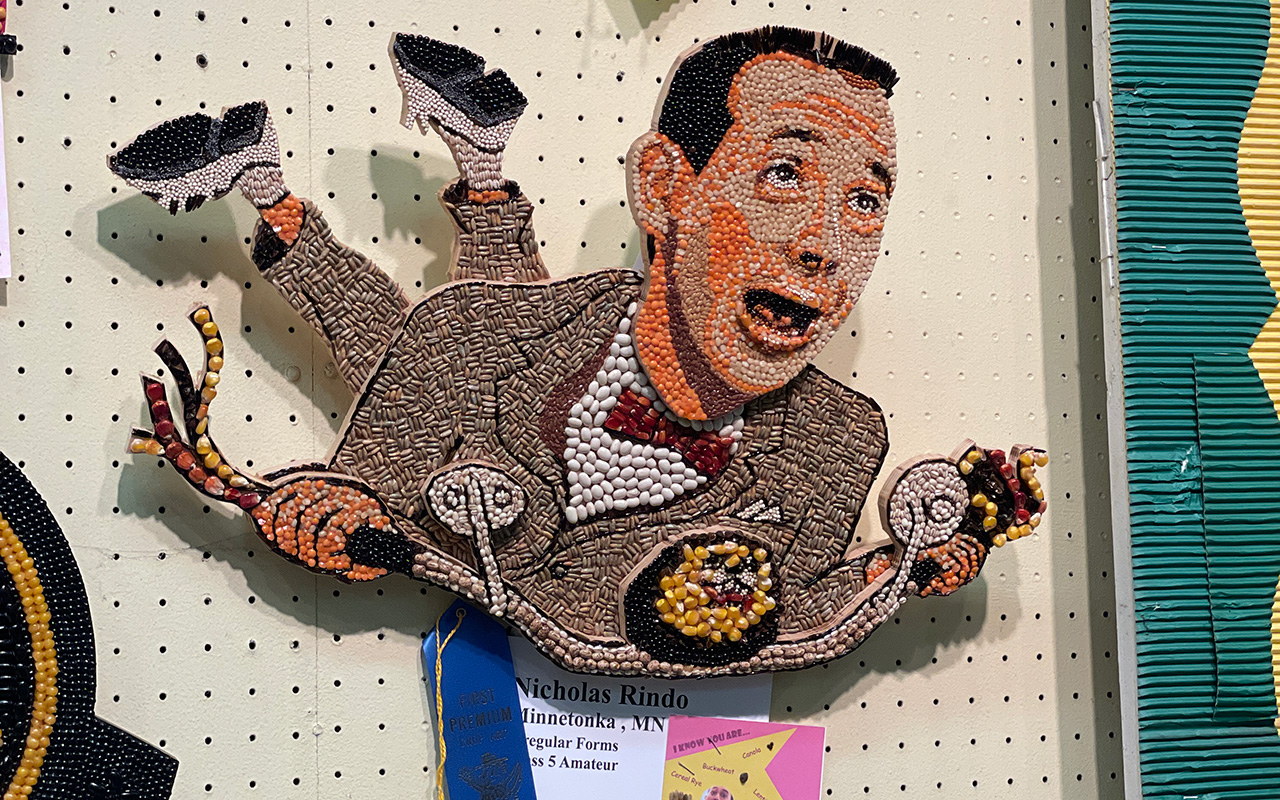
Nicholas Rindo’s “I know you are…” (2023), is made from cereal rye, buckwheat, flax, pearled barley, poppy, quinoa, rainbow flint corn, sweet lupine, red millet, viking corn, wild rice, navy beans, lentils.

What is your favorite exhibit at state fairs? One of mine is seed art. It looks like it would be fun to try.

Isabella Segalovich of the art magazine Hyperallergic went to the Minnesota State Fair and has this report on the seed art of 2023.

“The longest line at the second biggest state fair in the United States wasn’t for the prize cows, roller coaster rides, or various deep-fried foods served on a stick: It was for the seed art. 

“The wait was worth it. Past scores of vintage seed sacks and neatly stacked corn cobs vying for Best of Show ribbons, visitors craned their necks to marvel at the bounty of intricate mosaics made completely out of seeds at the Minnesota State Fair, which ran from August 24 to September 4. While the vast majority of participating crop artists were Minnesotans, the country’s only state fair seed art competition has also graciously expanded its dozens of categories to include out-of-state competitors, as long as they stick to one rule:

Every seed must be grown in Minnesota. 

“I was struck not just by this craft’s painstaking nature but also by the diversity of its subject matter, which ranges from impressive portraits and still lifes to timely pop culture references and biting political commentary. This year’s show included tributes to lost luminaries (Judy Heumann, Paul Reubens aka Pee Wee Herman), hot pink Barbie memorabilia, OceanGate (‘the little sub that couldn’t’), excitement over Minnesota’s marijuana legalization, displays of support for trans youth and adults, clap backs to Ron DeSantis (‘Minnesota, where woke goes to bloom!’), and lots and lots of yacht-smashing orcas. 

“This year there were over 400 submissions of crop art, which covered both seed art and the adjacent (also delightful) scarecrow competition.

“ ‘It has grown tremendously from the very beginning,’ said Ron Kelsey, superintendent of farm crops at the fair, who was 24 when seed art first bloomed in 1965. …

“During those first years, most artists arranged seeds into natural scenes, like flowers and landscapes, until hairstylist Lillian Colton changed the game by introducing seed art portraiture. Her hyperrealistic mosaics of figures like Abraham Lincoln, Ernest Hemingway, and Barbra Streisand raised the bar for crop artists at the fair. 

“Today, artist Liz Schreiber sits where Colton once did at the demonstration table, meticulously placing tiny quinoa and flax seeds to create a bullfrog. Schreiber is the artist behind this year’s commemorative fair poster, an incredibly detailed and boldly designed amalgamation of iconography that Minnesota fairgoers hold dear. ‘It’s very meditative,’ Schreiber told MPR News. ‘It’s kind of like doing a puzzle.’ 

“ ‘A crop art picture can take dozens and, in many cases, hundreds of hours to complete,’ said Joel Alter, a former political researcher and seed art newcomer who won a second premium ribbon this year. Many find that time passes quickly, as they enjoy the thrilling and addictive process. ‘Some people get started with it and they can’t stop,’ ” said Kelsey.”

More at Hyperallergic, here. There’s no paywall but subscriptions are encouraged.

Read Full Post »

gv7u3lqeeqt8vvhtlhnv3k-650-80

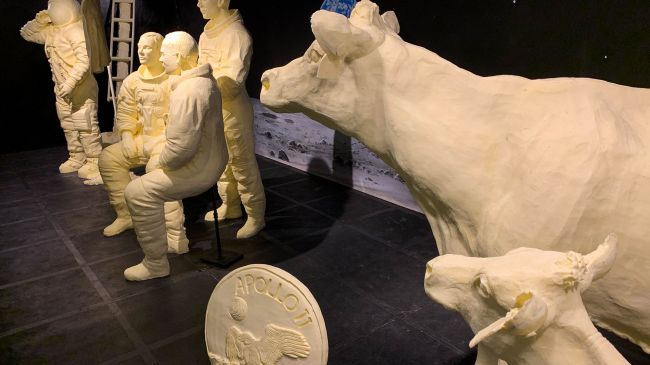
Astronaut-honoring butter sculpture at the Ohio State Fair. Butter sculptures are traditional at many Midwest state fairs.

How I remember the kooky state-fair butter sculptures I saw when I lived in Minnesota! This year, to honor the 50th anniversary of the moon landing, there was a particularly unusual one at the Ohio state fair.

Elizabeth Howell wrote at Space.com in July, “The Ohio State Fair is buttering up its visitors with a sculpture series to celebrate the big moon-landing anniversary 50 years ago.

“The sculptures are of the Apollo 11 moon crew – Neil Armstrong, Buzz Aldrin and Michael Collins – as well as a separate buttery interpretation of Armstrong in his spacesuit by the lunar module, Eagle. There’s also a butter cow and calf standing beside the Apollo 11 patch. This took more than 2,200 pounds (1,000 kilograms) of butter to create. …

“Said Jenny Hubble, senior vice president of communications for the American Dairy Association Mideast, [the sculpture] pays special tribute to Armstrong, who is originally from Wapakoneta, Ohio. …

“In between gazing at the yellow sculptures of the crew, visitors will have a choice of many dairy foods, including ice cream, milkshakes, cheese sandwiches — and of course, milk.

“While the butter connection seems at first to be a stretch, Armstrong did buy a dairy farm in Ohio after leaving NASA in 1971, two years after his epic first steps on the moon, according to a 2012 article in the Independent.” More.

According to Wikipedia, “Butter sculptures often depict animals, people, buildings and other objects. They are best known as attractions at state fairs in the United States as lifesize cows and people. … Butter carving was an ancient craft in Tibet, Babylon, Roman Britain and elsewhere. The earliest documented butter sculptures date from Europe in 1536, where they were used on banquet tables. The earliest pieces in the modern sense as public art date from ca. 1870s America, created by Caroline Shawk Brooks, a farm woman from Helena, Arkansas. The heyday of butter sculpturing was about 1890-1930, but butter sculptures are still a popular attraction at agricultural fairs, banquet tables and as decorative butter patties.”

Butter Art: Caroline Shawk Brooks, 19th century Arkansas farm woman
“Dreaming Iolanthe” depicts Yolande, Duchess of Lorraine, the heroine of Henrik Hertz’s play
King René’s Daughter. Says Wikipedia, “It was this 1876 masterpiece that ignited popular interest in butter sculpting as a public art form. The bowl was kept cool with ice underneath it.”
800px-the_dreaming_iolanthe_from_henrik_hertz27s_play_king_renc3a927s_daughter_1876

Read Full Post »