Feeds:
Posts
Comments

Posts Tagged ‘stone’

Photo: Álvarez-Alonso et al.
The archaeologists excavating on the outskirts of Segovia, Spain, noticed there was something odd about this stone.

Today we ask ourselves the timeless question, “Did Neanderthals ever just horse around?”

Sam Jones has a scenario at the Guardian, “One day around 43,000 years ago, a Neanderthal man in what is now central Spain came across a large granite pebble whose pleasing contours and indentations snagged his eye.

“Something in the shape of that quartz-rich stone – perhaps its odd resemblance to an elongated face – may have compelled him to pick it up, study it and, eventually, to dip one of his fingers in red pigment and press it against the pebble’s edge, exactly where the nose on that face would have been.

“In doing so, he left behind what is thought to be the world’s oldest complete human fingerprint, on what would appear to be the oldest piece of European portable art.

The discovery, which could enrich our understanding of how Neanderthals saw and interpreted the world, has come to light after almost three years of research by a team of Spanish archaeologists, geologists and police forensic experts.

“The dig team noticed there was something odd about the stone – which is just over 20cm [~8 inches] in length – as soon as they found it while excavating the San Lázaro rock shelter on the outskirts of Segovia in July 2022. It did not look like something that had been used as a hammer or an anvil; it didn’t look like a tool at all.

“ ‘The stone was oddly shaped and had a red ochre dot, which really caught our eye,’ said David Álvarez Alonso, an archaeologist at Complutense University in Madrid. … We were all thinking, ‘This looks like a face.’ But obviously that wasn’t enough.

” ‘As we carried on our research, we knew we needed information to be able to advance the hypothesis that there was some purposefulness here, this was a symbolic object and that one possible explanation – although we’ll never know for sure – is that this was the symbolization of a face.’ …

“The team enlisted the help of other experts. Further investigations confirmed that the pigment, which contained iron oxides and clay minerals, was not found elsewhere in or around the cave.

“ ‘We then got in touch with the scientific police to determine whether we were right that the dot had been applied using a fingertip,’ said Álvarez Alonso. ‘They confirmed that it had.’ The print, they concluded, was human and could be that of an adult male. …

“Álvarez Alonso argues that the dot’s existence raises questions that all point in the same direction.

“ ‘It couldn’t have been a coincidence that the dot is where it is – and there are no markings to indicate any other use,’ he said. ‘So why did they bring this pebble from the river to the inside of the cave? And, what’s more, there’s no ochre inside the cave or outside it. So they must have had to bring pigment from elsewhere.’

“The team’s findings, reported in the journal Archaeological and Anthropological Sciences, reinforce the idea that Neanderthals – who died out some 40,000 years ago – were capable of acts of artistic and symbolic creation, meaning modern humans were not the first to use art as a means of expression.

“ ‘The fact that the pebble was selected because of its appearance and then marked with ochre shows that there was a human mind capable of symbolizing, imagining, idealizing and projecting his or her thoughts on an object,’ the authors write.

“ ‘Furthermore, in this case, we can propose that three fundamental cognitive processes are involved in creating art: the mental conception of an image, deliberate communication, and the attribution of meaning. These are the basic elements characterizing symbolism and, also prehistoric – non-figurative – art. Furthermore, this pebble could thus represent one of the oldest known abstractions of a human face in the prehistoric record.’ …

“ ‘We’ve set out our interpretation in the article, but the debate goes on,’ he said. ‘And anything to do with Neanderthals always prompts a massive debate. If we had a pebble with a red dot on it that was done 5,000 years ago by Homo sapiens, no one would hesitate to call it portable art. But associating Neanderthals with art generates a lot of debate.’ I think there’s sometimes an unintentional prejudice.’ “

More at the Guardian, here.
Read Full Post »

Photo: José Hevia.
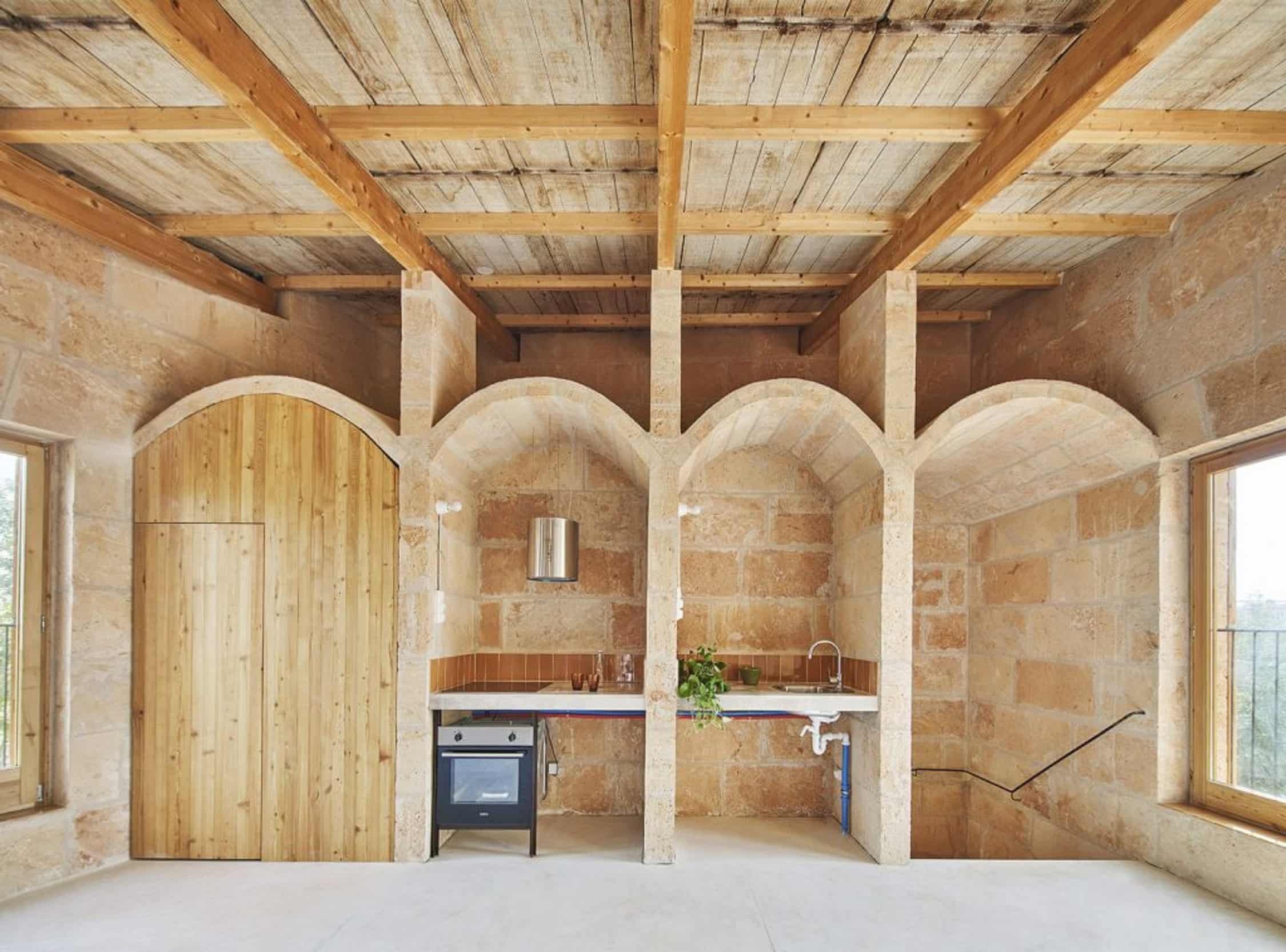
The Guardian reports on “affordable housing near Palma, Mallorca, built by Balearic social housing institute Ibavi, constructed from load‑bearing stone quarried locally.” 

The materials we use these days for constructing new buildings are generally harmful to the environment, at least in their creation. Now some architects are advocating for the old ways, the more sustainable and beautiful old ways.

Rowan Moore writes at the the Guardian, “Imagine a building material that is beautiful, strong, plentiful, durable and fireproof, whose use requires low levels of energy and low emissions of greenhouse gases. It is one of the most ancient known to humanity, the stuff of dolmens and temples and cathedrals and Cotswolds cottages, but also one whose sustainability makes it well-suited to the future. Such a material, according to a growing body of opinion in the world of construction, is among us. It’s called stone.

“Last week I sat in the roof garden of a hefty pile of masonry in central London, talking to three advocates of this magnificent substance: engineer Steve Webb, Pierre Bidaud of the Rutland-based Stonemasonry Company and architect Amin Taha. … The building on top of which we met is their joint creation: the six-storey, five-year-old Clerkenwell block where Taha has his office and his home.

“Their point is that stone has been supplanted in the industrial era by steel, concrete and mass-produced bricks, and is used (if at all) mostly as a thin cosmetic facing, while the hard work of holding up a building is done by the upstart alternatives. They argue that solid stone can once again form the walls and structure of building, with benefits for the environment and for the beauty of architecture. Any form of the material – limestone, sandstone, basalt, granite – can, depending on its properties, be used.

“Webb explains how the strength of stone compares well with steel and concrete, yet its environmental impact is far lower. The latter require several different energy-consuming activities, including extraction, smelting, transport, processing and installation. Stone only needs to be cut out from a quarry, taken to a site and put in place. Where the many ingredients of steel and concrete require multiple holes to be dug in the ground, not to mention such things as blast furnaces and rolling mills, the stonework for a given project only needs one.

“The planet, as Taha points out, is made mostly of stone. … We are in no danger of running out. For the same reason, stone should almost always be locally available, which keeps the environmental costs of transport down. The material is long-lasting and recyclable. ‘Any stone building is a quarry,’ says Bidaud. ‘It can be dismantled.’

“At the same time, 21st-century engineering allows stone to be used more effectively than ever before. The material is naturally strong in compression – that is, when loads are pushed down on it – which means it is good for walls, columns and arches, but less so if it is stretched or bent, as in beams or floor slabs.

It is now possible to combine stone with a (sparing) use of steel such that it can perform like reinforced concrete. …

“Next year, a 10-storey residential tower is due for completion on Finchley Road in north London (by Taha’s practice Groupwork and Webb’s firm Webb Yates Engineers), whose load-bearing stone structure will make it one of the most remarkable buildings in modern Britain. The three are collaborating on a grand new private house whose masonry vaults look almost medieval in their craftsmanship.

“They also cite works by others, such as an eight-storey, all-stone social housing building in Geneva by local architects Atelier Archiplein, and the Salvador Espriu project on the edge of Palma, Mallorca, whose graceful stone ceilings belie the fact that these are affordable homes built by a government housing institute called Ibavi. …

“Webb, Bidaud and Taha argue that stone doesn’t have to be costly. Taha, for example, has demonstrated that you can cut stone into bricks at the same cost or cheaper than the more usual fired-clay kind, with less than one fortieth of the carbon emissions, which has led to 10 quarries offering them as a commercial product. The problem is rather ‘forces of habit in the building industry.’ …

“Meanwhile, [2 billion] bricks of the traditional, energy-hungry, carbon-intensive kind are bought in this country every year. Steel and concrete remain the standard options for a wide range of building tasks. Webb is scathing about professional inertia on the subject, about architects ‘who protest about climate emergency, cycle to work and eat locally grown tomatoes’ but don’t examine their own decisions about construction techniques.

“You can get a glimpse of the highly appealing alternatives in a display at the Design Museum in London, How to Build a Low-Carbon Home, where the work of Taha, Webb and Bidaud is on show (until March 2024) alongside structures in wood and straw. …

“Who could look at the solid stone structure of, for example, the Mallorcan social housing, where the forces of nature and the work of humans is evident in the fabric, and prefer the processed surfaces and plasticized finishes of their British equivalents? And the great thing about stone is that, having been used for millennia, it’s well tested.” More at the Guardian, here.

Construction in the UK is often shoddy. Consider the tragic Grenfell Tower fire, here, and the completely avoidable death toll. “The fire was started by an electrical fault in a refrigerator on the fourth floor. This spread rapidly up the building’s exterior, bringing flames and smoke to all residential floors, accelerated by dangerously combustible aluminum composite cladding and external insulation, with an air gap between them enabling the stack effect.”

My husband has been following that story and says more has been spent on lawyers than on fixing the materials in buildings or adding sprinklers.

Read Full Post »

Photo: Iñaki LL

One of my Facebook friends shared an entertaining page on “rare and strange instruments” (you have to see it to believe it), leading me to seek more information on an instrument called the txalaparta. It may not be as unusual as the piano that makes cats meow but is nevertheless worthy of investigation.

According to Wikipedia, the txalaparta is “a specialized Basque music device of wood or stone. In some regions of the Basque Country, zalaparta (with [s]) means ‘racket,’ while in others (in Navarre) txalaparta has been attested as meaning the trot of the horse, a sense closely related to the sound of the instrument. …

“During the last 150 years, txalaparta has been attested as a communication device used for funeral (hileta), celebration (jai) or the making of slaked lime (kare), or cider (sagardo). After the making of cider, the same board that pressed the apples was beaten to summon the neighbours. Then, a celebration was held and txalaparta played cheerfully, while cider was drunk. …

“Traditional txalaparta was almost extinct in the 1950s with a handful of pairs of peasants maintaining the tradition. It was then revived by folklorists, such as Jesus and Jose Antonio Artze from the group Ez dok amairu.” Now you can hear it on YouTube, below.

More at Wikipedia.

Video: The Give and Take of Wood and Stone. Oreka Tx Brings Once Threatened Basque Sounds and New Global Resonances to the U.S. in September 2010 and on Nömadak Tx.

Read Full Post »