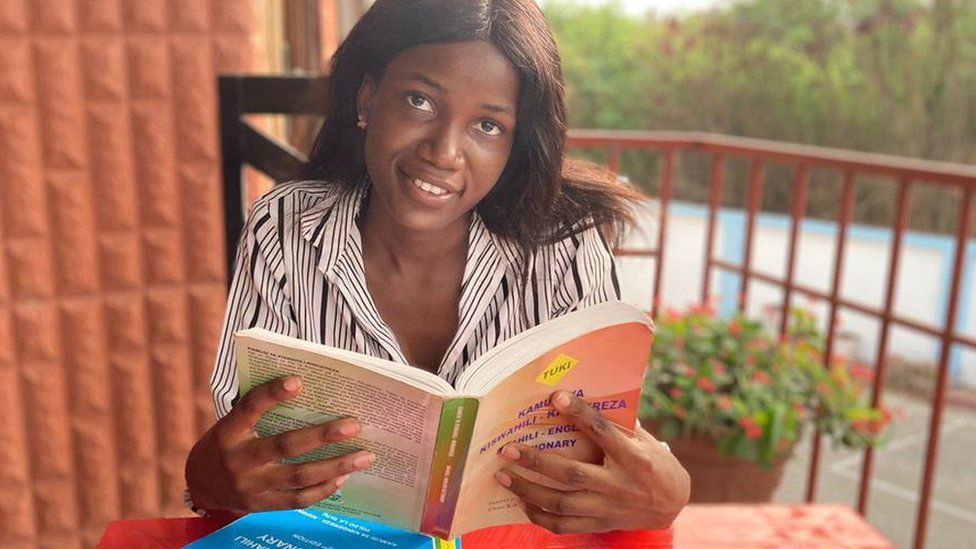
Ghanaian Swahili student Annabel Naa Odarley Lankai is advocating to make Swahili the lingua franca of Africa.
The BBC reports on renewed efforts to make Swahili the Esperanto of Africa, the universal language on the continent.
“With more than 200 million speakers, Swahili, which originated in East Africa, is one of the world’s 10 most widely spoken languages and, as Priya Sippy writes, there is a renewed push for it to become the continent’s lingua franca.
” ‘It’s high time we move from the colonizer’s language.’
“This is not part of a rousing speech by a pan-African idealist but rather the sentence is uttered quietly and calmly by Ghanaian Swahili student Annabel Naa Odarley Lankai. … Africa should ‘have something that is of us and for us,’ the 23-year-old adds.
“In its heartland, Swahili and its dialects stretch from parts of Somalia down to Mozambique and across to the western parts of the Democratic Republic of Congo. But Ms Lankai’s classroom at the University of Ghana in the capital, Accra, is some 4,500km (2,800 miles) west of Swahili’s birthplace – coastal Kenya and Tanzania. The distance could be seen as a measure of the spread of the language and its growing appeal. …
“Swahili, which takes around 40% of its vocabulary directly from Arabic, was initially spread by Arab traders along East Africa’s coast. It was then formalized under the German and British colonial regimes in the region in the late 19th and early 20th Centuries, as a language of administration and education. …
“At its recent heads of state meeting, the African Union (AU) adopted Swahili as an official working language. It is also the official language of the East African Community (EAC), which DR Congo is poised to join.
“In 2019, Swahili became the only African language to be recognized by the Southern African Development Community (SADC). Shortly after, it was introduced in classrooms across South Africa and Botswana. Most recently, Ethiopia’s Addis Ababa University announced it would start teaching Swahili. …
“Tom Jelpke, a researcher of Swahili at London’s School of Oriental and African Studies, argues that as connections grow across the continent, people will want a common way to communicate. He believes that its closeness to other languages in east and central Africa will cement its position there. But beyond those regions there may also be an ideological element. …
“Says Ally Khalfan, a lecturer at the State University of Zanzibar … ‘It is about our property and our identity as Africans.’ …
“Currently, English is the official or second language in 27 out of the 54 countries in Africa, and French is the official language in 21 of them.
” ‘English is still the language of power,’ says Chege Githiora, a linguistics professor in Kenya, in recognition of the political and economic reality. He advocates what he calls ‘fluent multilingualism,’ where people are comfortable speaking more than one trans-national language. …
“But whereas Swahili has an appeal in east, central and southern Africa, it has more competition in the west and the north. Arabic is dominant in the north, but in the west there are African languages – such as Hausa, Igbo and Yoruba – which could vie for the status of lingua franca.
“If Swahili is to become truly pan-African it will take political will, an economic imperative and financial investment to reach all regions.”
More at the BBC, here. No firewall.

 Suzanne's Mom's Blog