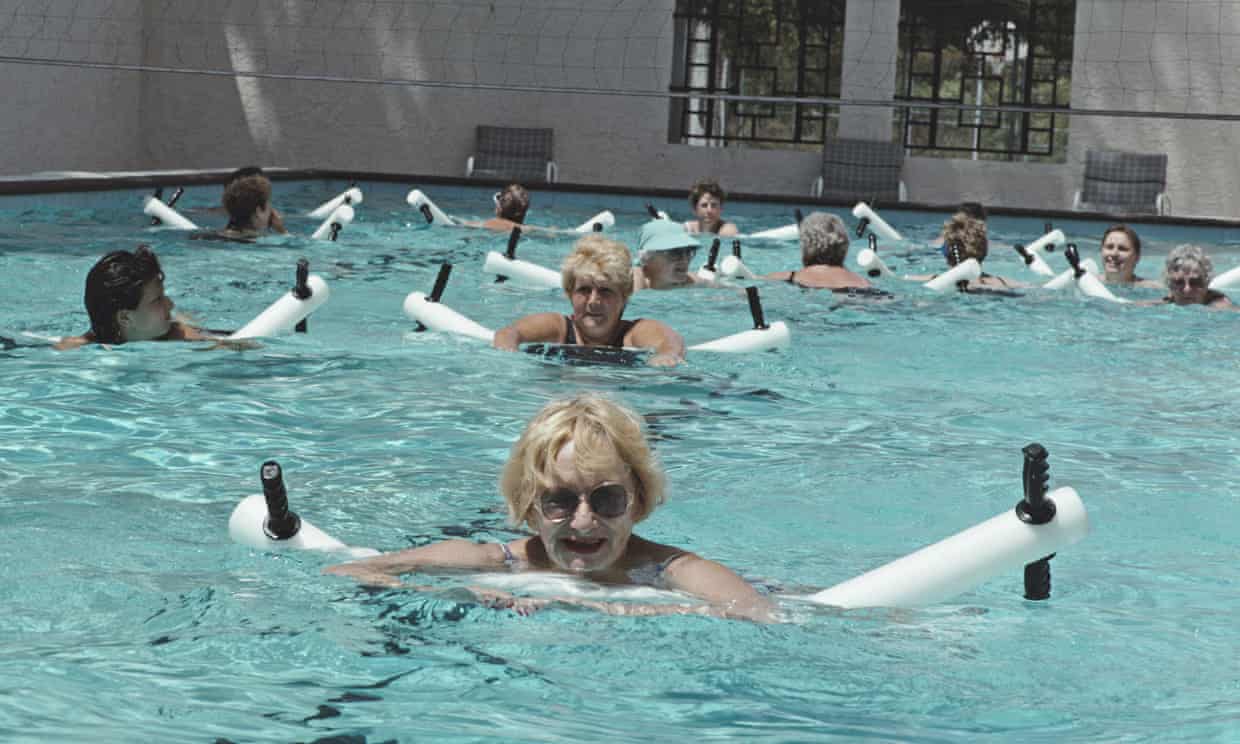
Photo: Barbara Alper/Getty Images.
Aqua aerobics is pitched at those who are ‘young at heart, recovering from pregnancy, or rehabilitating,’ writes Kate Leaver.
Since I moved to a retirement community with many excellent exercise instructors, I’ve been impressed to see how many seniors are really serious about staying in shape — even people close to 100. Today’s story is about a particular kind of class for older people, but not just older people. It comes from Sydney, Australia, via the Guardian.
Kate Leaver writes about her experience with a water aerobics class.
“At my first class, we sang Barbara ‘Happy Birthday.’ She was turning 80, doing fly-kicks underwater with the rest of us. …
“That’s the main demographic for aqua aerobics at the Manly’s Andrew Boy Charlton aquatic center in Sydney: women born in the era of Barbaras, Margarets and Gladyses, many of them wearing a full face of makeup and gold earrings. They keep their faces immaculate by extending their necks and keeping their heads above water (I’ve asked).
“Each week, 30 people turn up for 45 minutes of guided exercise, half-submerged in a heated, chlorinated lap pool. It’s popular: tickets go on sale three days in advance and it’s sold out within hours. …
“Aqua aerobics is pitched at those who are ‘young at heart, recovering from pregnancy, or rehabilitating.’ My mum and I are in that third category: rehab. She, from cancer; me, from long Covid (I contracted the virus at a Harry Styles concert in June 2022 and am yet to fully recover). Having spent a displeasing number of days/months/years lying down, we felt ready for some gentle exercise.
“It’s probably the most fun I’ve ever had in the pursuit of mild fitness. … The vibes are unmatched – it’s all ‘Very nice, Susan’ and ‘Lift those legs, Carol,’ never ‘No pain, no gain.’ One time, a young man with a six-pack walked the length of the pool in Speedos and I watched as a wave of giggles spread across the pool in his wake. …
“It’s a great workout, too, especially for anyone easing back into movement. The buoyancy of the water reduces strain on your joints and makes injuries less likely than routines on dry land. It’s adaptable in that you can glide your limbs for a mobility exercise or you can work up a sweat against the resistance of the water. I have to take it slow, but if you went hell for leather with some of these moves, you could really get your heart pumping.
“We do knee raises, lunges, kicks, punches and bicep curls. We jog back and forth in the water. We hold on to the edge of the pool and kick, kick, kick. We dance underwater to get our heart rates up and alternate between cardio and strengthening. Our leader is a loud, fit, flexible, brilliant middle-aged woman who has a special place in my heart because of the way she speaks to anyone who looks as though they might be struggling with her choreo. ‘You OK there, Maggie?’ she’ll say. ‘Don’t make me come in there and get you.’ She remembers people’s names, gently reminds the gossipers down the shallow end to concentrate, and winks at anyone who needs encouragement.
“She has a Britney microphone and a killer playlist of hits from the 70s and 80s. I don’t think I had truly lived until I’d done a kick-jump-kick sequence underwater while singing ‘There lived a certain man in Russia long ago / He was big and strong, in his eyes a flaming glow’ (Rasputin by Boney M, 1978).
“I will never again take a spin class run by a shouting bodybuilder or think of exercise as punishment. Not when this is an option. It’s a joy from start to finish, a truly adorable mother-daughter activity.” More at the Guardian, here.
I’m zeroing in on the soundtrack. In one of my classes we’ve had the same ’50s-’60s mix twice a week for 10 months. As much as I love music from those decades, would welcome a change to almost anything!


 Suzanne's Mom's Blog