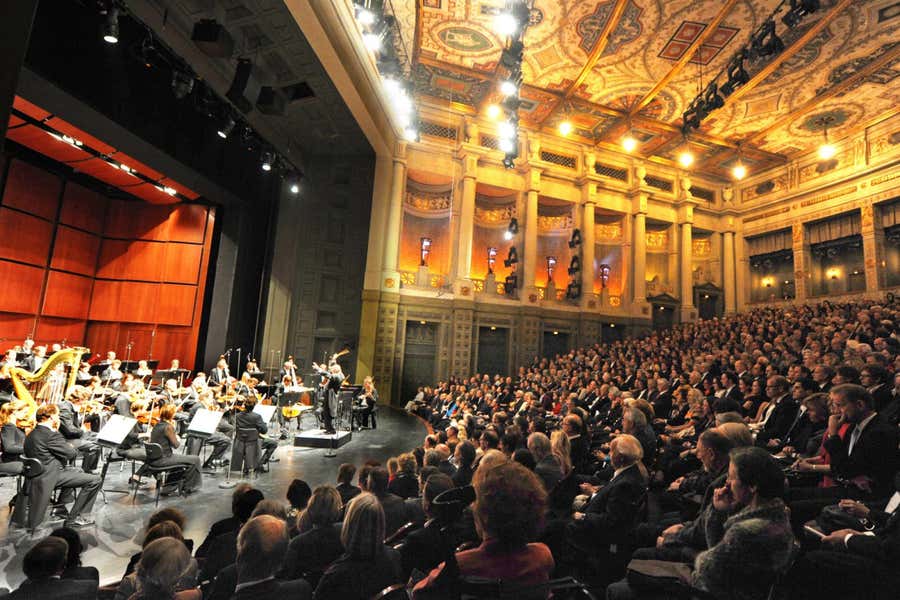
Photo: Stephan Rumpf/Süddeutsche Zeitung Photo/Alamy.
Research involving self-reported personality traits shows that music can synchronize the heartbeats of some members of an audience.
For about a year or so, I have been learning to breathe. Ha. I always made fun of that sort of thing, but noticing your breathing is supposed to be good for your health, and I have found it often does lower my blood pressure.
So, what was my delight to read this related research! It’s about how classical music often synchronizes the heartbeats of an audience.
Jason Arunn Murugesu wrote at New Scientist, “Audience members’ heartbeats, breathing speeds and even degree of sweating synchronize when they watch a classical music concert together.
“Wolfgang Tschacher at the University of Bern in Switzerland and his colleagues monitored 132 people who were separated into three groups to watch different concerts of the same pieces of music – Ludwig van Beethoven’s Op. 104 in C minor, Brett Dean’s Epitaphs and Johannes Brahms’s Op. 111 in G major – while wearing body sensors.
“Various measurements became more synchronized during the concerts, such as the participants’ heart rates, breathing speeds and their skin conductance, which measures how much someone is sweating based on their skin’s varying electrical properties.
“Prior to the concerts, the researchers asked the participants to complete a personality test. They found that this synchronization was more likely to occur among people who considered themselves to be agreeable or open. …
“Tschacher expects that this synchronization would also apply to non-classical music genres and would probably be stronger still outside a trial setting. Due to covid-19 restrictions at the time of the experiment, the audience members were socially distanced. In a normal music concert, where audience members often engage with one another, the synchrony may be more pronounced, he says.
“The timing of the participants’ breathing, such as when they inhaled and exhaled, didn’t synchronize, however. Otherwise, you might think that a synchronized heart rate somehow leads to a synchronized breathing pattern, says Daniel Richardson at University College London. Instead, perhaps a person’s heart rate is influenced by their enjoyment of the music, he says.” More at New Scientist, here.
Aristos Georgiou at Newsweek adds, “Synchronization between humans is usually observed in physical bodily responses, such as breathing. Most frequently, this synchronization is the result of direct social interaction with another person. But it can also be induced by other external factors that are not related to such social interactions.
” ‘Synchrony is an important part of social interaction, and psychology has started to measure how much people become synchronized in different settings,’ such as in psychotherapy, discussions between spouses, and other conversations, Wolfgang Tschacher, an author of the study from the University of Bern’s Hospital of Psychiatry and Psychotherapy in Switzerland, told Newsweek. …
“While the researchers found that the audience members shared the same heart rate during the concerts, the heartbeats themselves were likely not all occurring at the same time, Tschacher said. The same applied to their breathing. The rate at which the audience members breathed was synchronized, but the individual ‘in’ and ‘out’ breaths of each attendee did not necessarily all occur at the same time.
“In addition, the researchers found that the [self-reported] personality traits of a listener were associated with the likelihood of their physical responses being synchronized with other audience members. Those participants who rated more highly for personality traits such as agreeableness or openness were more likely to become synchronized. On the other hand, those with neurotic or extraverted traits were less likely to become synchronized. …
“Alexander Khalil, a researcher in the Department of Music at University College Cork in Ireland, who was not involved in the study, told Newsweek that the scale and scope of the latest research is notable.
” ‘Typically, musical synchrony studies only address a small number of parameters at a time and in a relatively small group of people,’ he said. ‘Here, we have data on interpersonal synchrony amongst audience members attending a concert recorded from a large group of people.’ …
“The study is ‘particularly interesting and useful’ because individual variation across these different parameters has been compared with the subjective experience and personality traits of audience members, Khalil said. …
” ‘It tells us that that urge to tap your foot, nod your head, or sway from side to side is just the tip of the iceberg: from head to toe, body and mind are in motion with those of other listeners.’ ” More at Newsweek, here.

 Suzanne's Mom's Blog