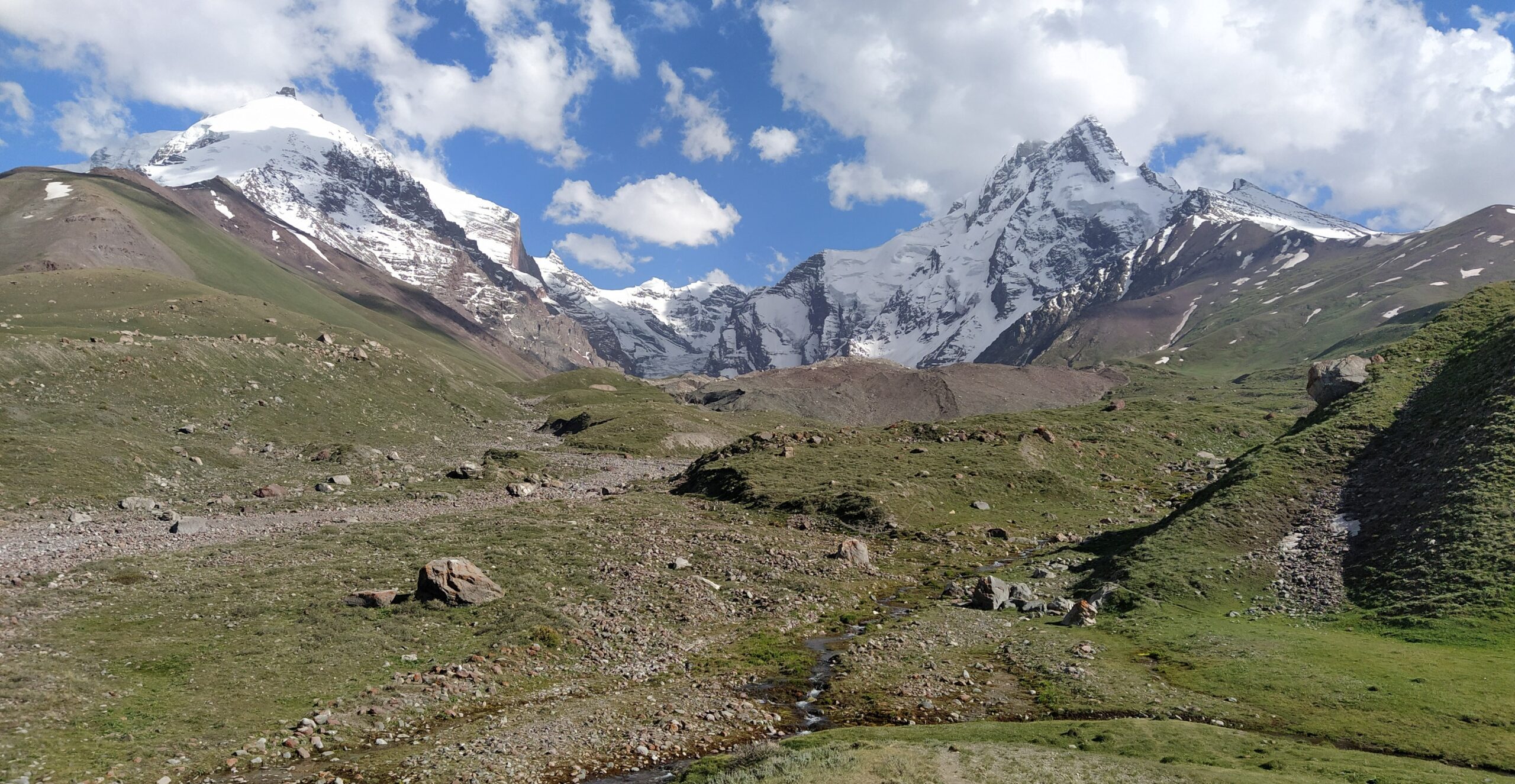
Photo: Achille Jouberton at the Pamir Project.
Swiss scientists are tackling the mysteries of ice in countries that can be dangerous to work in.
Today Levi Bridges at the great international radio show The World brings you the latest on glaciers in Kyrgyzstan and Tajikistan, countries that could be more important to us than we realize as we wallow in the anxieties of our own places, those bits of Earth we imagine are the only important ones.
“On a sunny summer day two years ago,” Bridges reports, “a massive chunk of ice broke off from a glacier on a mountain in the Central Asian country of Kyrgyzstan. An avalanche quickly raced down the mountain toward a group of hikers below, which one man caught on film.
“The hikers braced themselves for impact as the cascade of snow and ice poured down the mountain toward them. Miraculously, the group survived with only several people receiving minor injuries.
“The event highlighted the challenges facing the world’s glaciers. This year, the UN declared that climate change reached record levels in 2023. And glaciers, which hold most of the Earth’s freshwater, are melting at an unprecedented rate.
“But some glaciers located in mountainous parts of Central Asia aren’t melting and, in some cases, are actually growing. This cold, arid region, known as the Third Pole, is one of the only places in the world outside the interior of Antarctica where ice has so far been relatively unaffected by the climatic changes associated with rising temperatures.
“Even during the summer it remains so cold in parts of Tajikistan that ice on a glacier’s surface can turn into a gaseous state instead of melting through a process known as sublimation. That can cause spectacular ice formations on a glacier’s surface that look like inverted icicles or ice pyramids, according to Evan Miles, a glaciologist at the Swiss Federal Research Institute who studies Tajikistan’s glaciers. …
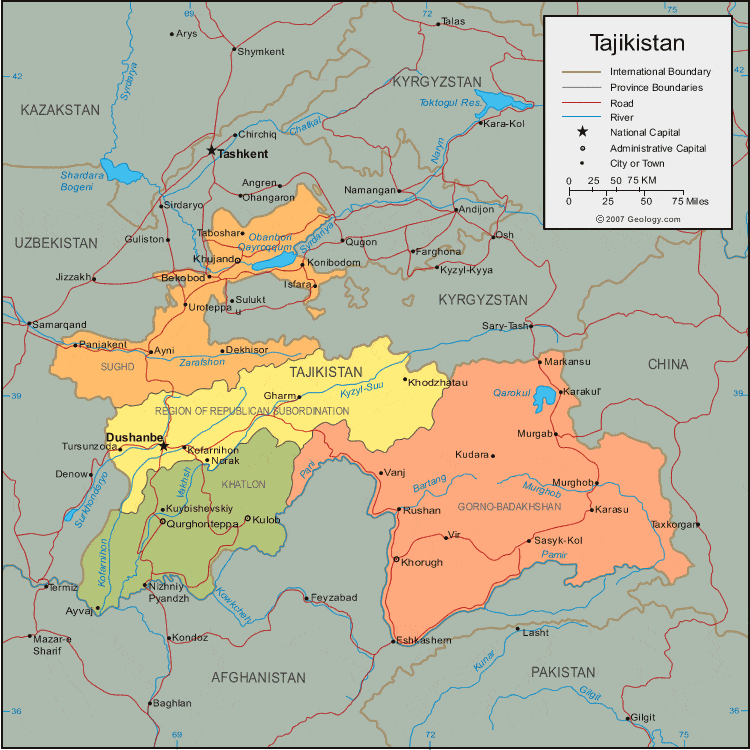
“Miles is the scientific coordinator for a team of Swiss and international scientists who have formed a research group known as the Pamir Project that hopes to discover what makes some of the region’s glaciers so unique. Each summer, they travel to isolated locations in Tajikistan’s mountains to study glaciers. Scientists must spend days trekking up to altitudes sometimes as high as 15,000 feet just to visit their research sites, carrying in supplies and scientific equipment by donkey.
“Miles said the remote locations the team visits in Tajikistan pose different challenges than research sites he has visited on Mount Everest where there are established trails and usually other people nearby.
“ ‘In Tajikistan, there’s nobody — there’s no helicopter that’s going to come rescue you if something goes wrong,’ he said.
“But understanding these glaciers is worth the risk because millions of people in Asia depend on them as a water source.
“Scientists believe these glaciers aren’t melting because water is evaporating from vast, irrigated farmland in nearby Pakistan, China and Uzbekistan. An increase in atmospheric moisture drives changes in weather patterns, so more snow gets dumped on Tajikistan’s glaciers and helps their size remain stable.
“These mountains are just one of many unsolved mysteries glaciologists are working on. It can be difficult for scientists to predict how much ice most glaciers will lose — and when — because there are still basic unanswered questions, like how much snowfall many mountains get. …
“Scientists who are part of the Pamir Project have [teamed up] with historians and geographers who are searching for Soviet documents that contain earlier data about Tajikistan’s glaciers. Some members are also conducting oral histories with locals in Tajikistan’s mountains.
“Sofia Gavrilova, a researcher at the Leibniz Institute for Regional Geography in Germany that’s helping with the initiative, met a Tajik schoolteacher as part of her oral history work who kept dated records of changes in the level of a local river.
“ ‘This is really very valuable, large-scale data that you cannot necessarily capture any other way,’ Gavrilova said. …
“Although some of Tajikistan’s glaciers remain stable for the moment, scientists predict that they, too, will eventually start to melt and get smaller. Researchers believe it will prove very difficult to stop that process after it starts.
“ ‘Let’s say that we actually manage to withdraw carbon from the atmosphere effectively by 2050, there’s still actually going to be quite some time, probably 20 to 30 years, that the glaciers will continue shrinking and losing mass,’ said Miles, of the Pamir Project.
“He stressed that every effort we make to stop global warming — even by lowering the Earth’s temperature by just a tenth of a degree — can help save the world’s glaciers in the long run.”
More at The World, here. There’s no paywall, and you might enjoy some delightful pictures of the local people in that part of Asia.

 Suzanne's Mom's Blog