
Feeds:
Posts
Comments

Posts Tagged ‘tennessee’

Photo: Troy Aidan Sambajon/The Christian Science Monitor.
Tyrie Daniel poses in the library at the Charlestown campus of Bunker Hill Community College in Boston, Sept. 10, 2024.

I think most people would agree — maybe even college presidents would agree — that the cost of higher education has gotten out of hand. Two of our grandchildren, being half Swedish, could get educated for free in Sweden, but free higher ed is not an option for most Americans. That’s why Massachusetts is joining the states that have been offering options to students who could use the help.

Troy Aidan Sambajon writes at the Christian Science Monitor, “Cambridge resident Tyrie Daniel was almost at the finish line when he dropped out of Bunker Hill Community College in 2015. He just needed 16 more credits to transfer to a four-year school. But life just came hard. His family was scammed, he says, and their Social Security numbers were stolen.

“ ‘When your stomach keeps growling and you have nothing in your fridge, you can’t even focus on school,’ says Mr. Daniel, who is 33 years old. His family was struggling to pay bills at home and provide for their household of six. … ‘I had to choose between school or food on the table.’

“With five classes to go, he dropped out. He worked as a cleaner, in his family’s spice business, and in real estate. More than thrice, he contemplated returning to school. But he couldn’t reenroll until his overdue fees were paid.

“Now, Mr. Daniel is back at Bunker Hill. This time, he is debt-free and his tuition is covered by MassReconnect. The program, which started in 2023, made community college tuition free for Massachusetts residents over 25 who don’t have a degree. Mr. Daniel says he feels both enormous relief and a new motivation to succeed. …

“Says the cybersecurity major, ‘Now, I’m actually back in school to further my career in something that I really am interested in and passionate about.’

“This fall, Massachusetts is widening the halls of higher education even further. For the first time, all residents with a high school diploma can attend one of its 15 community colleges for free. Since Tennessee first pioneered tuition-free community college for all in 2017, it has spread rapidly in both red and blue states.

“With the launch of MassEducate, the Bay State becomes the 20th to offer tuition-free community college regardless of age, income, or GPA. Another 14 states offer programs targeting specific demographics, such as people over 25, or high-demand majors, such as nursing. …

“Douglas Harris, chair of the economics department at Tulane University and director of the National Center for Research on Education, Access, and Choice [says] promising universal access to community college ‘wipes away that complexity and the risk and uncertainty that goes with it.’

“ ‘Going to college is complicated,’ he says. … ‘When it gets cheaper and simpler, it makes people say yes.’ …

“ ‘This is going to change family trees for generations to come, for the better,’ says Nate Mackinnon, executive director of the Massachusetts Association of Community Colleges. … ‘More families are turning to public higher education and discovering that these institutions offer excellent quality at an affordable price.’

“Why free tuition now? The Bay State needs workers. Massachusetts has 42 available workers for every 100 open jobs, categorizing its workforce shortage as ‘most severe,’ according to the U.S. Chamber of Commerce. Meanwhile, 700,000 residents have some college credits but no degree. …

“In MassReconnect’s first year, 2023-24, some 8,411 students enrolled through MassReconnect. That was a 45% increase in students over 25 from the previous academic year. …

“As of this August, with the launch of MassEducate, total enrollment is up another 20% compared with last year. ‘It’s like the advertising value of free college is giving you a pretty big bang for your buck,’ says David Deming, an economist from the Harvard Kennedy School. … ‘The challenge in the long term is maintaining the quality of education with more students. If local colleges themselves are not getting any extra funding to accommodate the influx, the quality of the service itself might decline.’ …

“For recent high school graduates like Erick Peguero, free tuition means his family can save money while he takes classes in the hopes of transferring to a four-year program. … When he graduated from Brooke High School in June, Mr. Peguero didn’t have plans to go to college this fall. It wasn’t that the resident of the Dorchester neighborhood wasn’t interested, but his family lives in Section 8 low-income housing. When community college became free last month, he jumped at the chance to continue his education.  …

“Some community college leaders say they welcome the challenges that more students in classes bring.

“ ‘I’ve been waiting my entire professional life for this moment,’ says [Pam Eddinger, president of Bunker Hill Community College]. ‘I’ll be damned if I’m going to turn anyone away. Because if I turn somebody away now, where it takes so much for them to come to me, they may not come back.’ ”

More at the Monitor, here.
Read Full Post »

Photo: Ariel Cobbert.
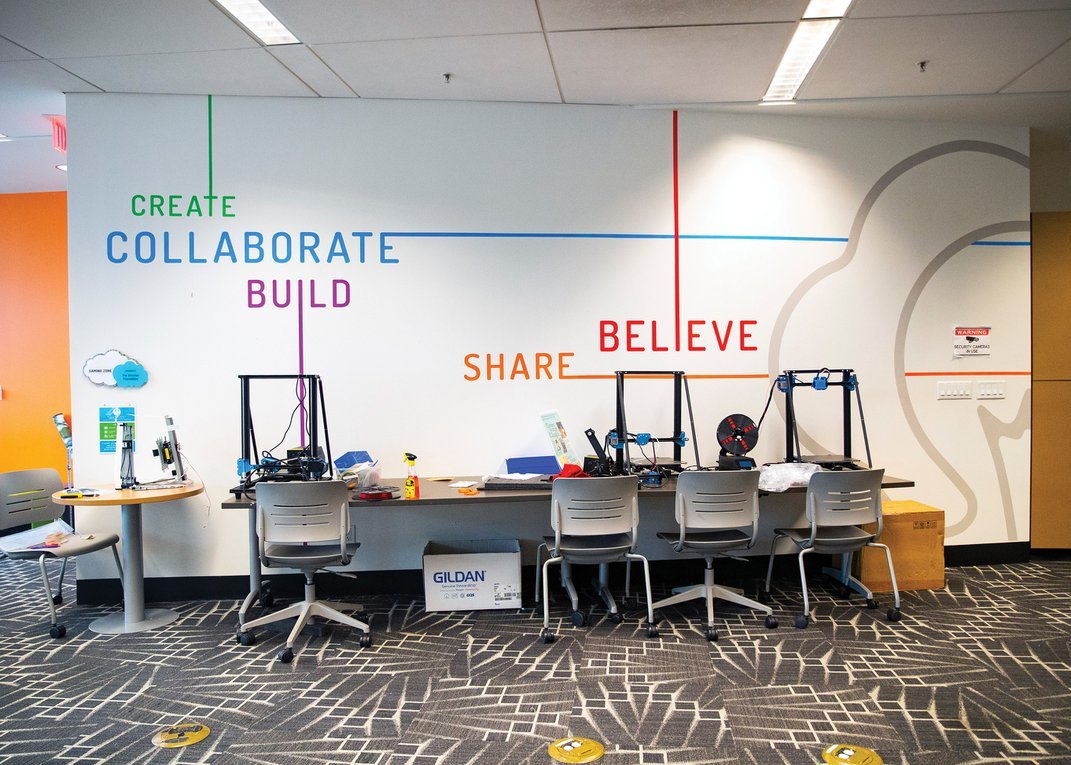
At the Memphis, Tenn., library, Cloud901’s maker space is equipped with such high-tech tools as laser cutters and 3-D printers. The workshop is open to all ages, not just teens.

Today’s story is about an astonishingly innovative library in Memphis, Tennessee. It makes me ashamed to recall that my younger tradition-bound self thought libraries should never spend money on anything but books! Who knew the extended role libraries were going to play in people’s lives — from providing shelter during Ferguson, Missouri, protests to launching kids on undreamed-of careers. My own local library was recently renovated, and I wouldn’t give up a single 3-D machine.

Richard Grant writes at the Smithsonian magazine, “The Benjamin L. Hooks Central Library, a building of pale concrete and greenish glass, rises four stories in midtown Memphis. Walking through its automatic doors on a weekday afternoon, I hear unexpected sounds, muffled but unmistakable, almost shocking in a library context: the deep, quaking bass beats of Memphis hip-hop, plus a faint whine of power tools cutting through metal. …

“Here at the Central branch in Memphis, ukulele flash mobs materialize and seniors dance the fox trot in upstairs rooms. The library hosts U.S. naturalization ceremonies, job fairs, financial literacy seminars, jazz concerts, cooking classes, film screenings and many other events — more than 7,000 at last count. You can check out books and movies, to be sure, but also sewing machines, bicycle repair kits and laptop computers. And late fees? A thing of the past.

“The hip-hop beats and power tool noise are coming from an 8,300-square-foot teenage learning facility called Cloud901 (the numerals are the Memphis area code). Two stories high, it contains a state-of-the-art recording studio staffed by a professional audio engineer, a robotics lab that fields a highly competitive team in regional and national championships, and a video lab where local teens have made award-winning films. Cloud901 also features a fully equipped maker space (a kind of DIY technology innovation workshop), a performance stage, a hang-out area and an art studio. …

“Many cities have slashed their library budgets and closed branches. Memphis, Tennessee, one of the poorest cities in the nation, chose instead to invest, recently opening three new branches, for a total of 18, and increasing the library budget from $15 million in 2007 to almost $23 million today. Attendance at library programs has quadrupled in the last six years. In 2019, before the pandemic, more than 7,000 people attended the annual Bookstock festival, a celebration of literacy and education.

Memphis Public Libraries (MPL) is the only public library system in the country with its own television and radio station, and its branches receive more than two million visits a year.

“ ‘How did this happen?’ I asked Mayor Jim Strickland, who is serving his second term in office. He was sitting in his seventh-floor office with a view of downtown and the Mississippi River. ‘I’m a strong believer in libraries as a force for good,’ he said. ‘But none of this would have happened without our library director Keenon McCloy. She is amazing. We’ve got library people coming from all over the country to see what she’s done here.’

“McCloy is high-energy, fit from running, always busy, sometimes frenetic. Though passionate about public libraries, she has no training in the highly specialized field of librarianship, not even an undergrad degree in library science, and this provoked dismay and even uproar when she took over the Memphis system in January 2008. 

“ ‘I was the director of public services and neighborhoods for the city, and the mayor — it was Mayor Herenton at the time — appointed me without doing a search for other candidates,’ McCloy says over a salad lunch near her office in the Central branch. ‘It caused quite a stir in Libraryland.’ …

“McCloy’s first big task was to reorganize the funding and administration of the library system. Then she went looking for advice. She talked with directors from other states and visited acclaimed public libraries. ‘I wanted to meet the rock stars of Libraryland with the most progressive ideas,’ McCloy says. ‘And they all wanted to help me and share what they’d learned, because that’s how library people are. No one is proprietary and we’re not competitive with each other. We’re all about the greater good.’

“In Chicago, she toured the Harold Washington Library Center, where a 5,500-square-foot facility called YOUmedia opened in 2009. It was the first dedicated teen learning center in an American library, and it had a maker space and an in-house production studio to record teenage musicians. ‘That’s where I got the idea for Cloud901,’ says McCloy. ‘People kept saying the biggest problem at the Central library was all the teens hanging around, and I thought, well, they’re in our library, let’s find a way to redirect their energy.’

“The next step was to meet with the Memphis Library Foundation, a volunteer fundraising organization with connections in the business community and social elite. ‘I asked them if they would support a teen center at the Central branch,’ says McCloy. ‘Well, not immediately, but then they started raising money, and we decided to double the expense and really go for it.’

“Instead of a basic recording studio, McCloy and her team wanted a professional-quality studio. The legendary Memphis music producer Lawrence ‘Boo’ Mitchell, co-owner of Royal Studios and a longtime supporter of the libraries, agreed to design it. For the maker space, they hired a native Memphian who had been overseeing such facilities in the Bay Area. He stocked the workshop with 3-D printers and other equipment, and brought in FedEx, a Memphis-based corporation, as a supporter. It was the same approach with the video and robotics labs: hire experts, buy the best equipment, recruit sponsors. Cloud901 opened in 2015, at a cost of $2.175 million. …

“When [when Janay Kelley, now 18] first arrived at the video lab, an instructor there, Amanda Willoughby, taught her how to use the equipment — cameras, lights, editing software. …

“The first film that Kelley made here was titled The Death of Hip-Hop. She lit and filmed herself. … ‘I was going to upload it onto YouTube, but Amanda insisted on entering it into the Indie Memphis Youth Film Fest.’ “

Read the rest of the story at the Smithsonian, here. It’s free. It’s a long article with fascinating testimonials. Pretty sure Laurie Graves will want to read the whole thing!

Read Full Post »

Photo: Alan Cressler.
Archaic Period pictograph of a hunter and prey dated to 6,500 years ago. Indigenous art like this in the American Southeast is less well known than that in the Southwest.

You knew that tribes in the Southwest made paintings centuries ago, but did you know that indigenous people were also making art in the caves of the American Southeast? Jan Simek, a professor of anthropology at the University of Tennessee, fills in the blanks for us at the Conversation.

“On a cold winter’s day in 1980,” he writes, “a group of recreational cavers entered a narrow, wet stream passage south of Knoxville, Tennessee. They navigated a slippery mud slope and a tight keyhole through the cave wall, trudged through the stream itself, ducked through another keyhole and climbed more mud. Eventually they entered a high and relatively dry passage deep in the cave’s ‘dark zone’ – beyond the reach of external light.

“On the walls around them, they began to see lines and figures traced into remnant mud banks laid down long ago when the stream flowed at this higher level. No modern or historic graffiti marred the surfaces. They saw images of animals, people and transformational characters blending human characteristics with those of birds, and those of snakes with mammals.

“Ancient cave art has long been one of the most compelling of all artifacts from the human past, fascinating both to scientists and to the public at large. Its visual expressions resonate across the ages, as if the ancients speak to us from deep in time. And this group of cavers in 1980 had happened upon the first ancient cave art site in North America.

“Since then archaeologists like me have discovered dozens more of these cave art sites in the Southeast. We’ve been able to learn details about when cave art first appeared in the region, when it was most frequently produced and what it might have been used for.

We have also learned a great deal by working with the living descendants of the cave art makers, the present-day Native American peoples of the Southeast, about what the cave art means and how important it was and is to Indigenous communities.

“Few people think of North America when they think about ancient cave art. … As the earliest expressions of human creativity, some perhaps 40,000 years old, European paleolithic cave art is now justifiably famous worldwide.

“But similar cave art had never been found anywhere in North America, although Native American rock art outside of caves has been recorded since Europeans arrived. Artwork deep under the ground was unknown in 1980, and the Southeast was an unlikely place to find it given how much archaeology had been done there since the colonial period.

“Nevertheless, the Tennessee cavers recognized that they were seeing something extraordinary and brought archaeologist Charles Faulkner to the cave. He initiated a research project there, naming the site Mud Glyph Cave. His archaeological work showed that the art was from the Mississippian culture, some 800 years old, and depicted imagery characteristic of ancient Native American religious beliefs. Many of those beliefs are still held by the descendants of Mississippian peoples: the modern Cherokee, Chickasaw, Choctaw, Coushatta, Muscogee, Seminole and Yuchi, among others.

“After the Mud Glyph Cave discovery, archaeologists here at the University of Tennessee, Knoxville initiated systematic cave surveys. Today, we have cataloged 92 dark-zone cave art sites in Tennessee, Alabama, Georgia, Kentucky, Virginia and West Virginia. There are also a few sites known in Arkansas, Missouri and Wisconsin. …

“The Mississippian Period (A.D. 1000-1500) is the last precontact phase in the Southeast before Europeans arrived, and this was when much of the dark-zone cave art was produced. Subject matter is clearly religious and includes spirit people and animals that do not exist in the natural world. There is also strong evidence that Mississippian art caves were compositions, with images organized through the cave passages in systematic ways to suggest stories or narratives told though their locations and relations.

“In recent years, researchers have realized that cave art has strong connections to the historic tribes that occupied the Southeast at the time of European invasion.

“In several caves in Alabama and Tennessee, mid-19th-century inscriptions were written on cave walls in Cherokee Syllabary. This writing system was invented by the Cherokee scholar Sequoyah between 1800 and 1824 and was quickly adopted as the tribe’s primary means of written expression.

“Cherokee archaeologists, historians and language experts have joined forces with nonnative archaeologists like me to document and translate these cave writings. As it turns out, they refer to various important religious ceremonies and spiritual concepts that emphasize the sacred nature of caves, their isolation and their connection to powerful spirits. These texts reflect similar religious ideas to those represented by graphic images in earlier, precontact time periods. …

“That archaeologists were unaware of the dark-zone cave art of the American Southeast even 40 years ago demonstrates the kinds of new discoveries that can be made even in regions that have been explored for centuries.”

More at the Conversation, here.

Read Full Post »

One of the better aspects of the 2015 Massachusetts Conference for Women was hearing speakers like Candy Chang, an artist who engages ordinary people in public discourse.

At the December conference, Chang focused on Neighborland, a service co-founded with Dan and Tee Parham, that helps “residents and organizations collaborate on the future of their communities.”

This is how it works. Organizations start by posing a question. For example, they might hand out cards that say, “I want [blank] in my neighborhood,” and a resident might write in, “a night market.” Next, using Neighborland tools, ideas are collected from workshops, public installations, SMS, and Twitter. They are then discussed and voted on. The website says Neighborland has “sophisticated moderation, clustering, and de-duplication tools for organizers to aggregate all of the data from residents. Our reports make it easy for organizers to see trends in the data, make decisions, allocate resources, and keep participants involved in the fun part – making their neighborhoods better places.”

In this example, National Gardening Association’s Jenna Antonio DiMare reports on Adam Guerrero,  his Memphis, Tennessee, team of blight-busting ″Smart Mules,″ and their efforts to create a greener and more sustainable city.

“During the month of October, National Gardening Association (NGA) partnered with Neighborland to challenge Memphis residents to propose innovative projects to make their city and neighborhoods more sustainable. With a $1,000 grant awarded to the most promising project, Neighborland’s simple platform empowered local Memphis residents to ‘connect and make good things happen.’

“Despite receiving many inspiring project proposals, from founding an urban agriculture school to growing a newly established community garden, it was clear to NGA that the ‘Smart Mules’ project would have the greatest impact with the $1,000 award. …

″ ‘We are fighting [urban] blight, raising neighborhood morale, engaging our local government, and investing in a future for the neighborhood, all at the same time,’ writes the ‘Smart Mules’ team. To accomplish these goals, ‘Smart Mules’ provides work for many young, at-risk males who have been ‘largely dismissed’ or disenfranchised, according to team leader Guerrero.” More here about the work these young men are doing for sustainability.

(A couple years ago, I wrote about Candy Chang’s “Before I Die” interactive street art.)

Photo: Neighborland.com

Read Full Post »

Early this month, my colleague Bo went to Tennessee with friends to see synchronous fireflies.

The one week of firefly watching is a real happening. Bo told me that, to get tickets, he went online twice at exactly 10 a.m. The first time he missed out. They go fast. He said that these special fireflies (which start flashing together and stop together) were long known in Southeast Asia but thought to exist nowhere in North America.

The way he heard it, one day a woman from Tennessee was chatting with a firefly expert somewhere in the South and happened to mention the behavior of some fireflies she loved to watch back home. And that was the first time the word got out to the scientific community that synchronous fireflies existed in North America. Now it’s practically Disney World out there — controlled, but crowded.

The Great Smoky Mountains National Park website posted this before the great annual event: “The firefly shuttle operating dates for 2015 will be June 2-9. Advance reservations of parking passes have sold out, however an additional 85 passes will be available for each day of the event. These 85 passes will go on sale online at 10:00 a.m. the day before the event and will be available until 3:30 p.m. on the day of the event or until the passes are all reserved. Passes can be purchased at www.recreation.gov or by calling (877) 444-6777.

“During the program operating dates, a parking pass is required for evening access to the Sugarlands parking lot and the firefly shuttle to the Elkmont viewing area. There is a limit of one parking pass per household per season. …

“Synchronous fireflies (Photinus carolinus) are one of at least 19 species of fireflies that live in Great Smoky Mountains National Park. They are the only species in America whose individuals can synchronize their flashing light patterns.

“Fireflies (also called lightning bugs) are beetles. They take from one to two years to mature from larvae, but will live as adults for only about 21 days. …

“Their light patterns are part of their mating display. Each species of firefly has a characteristic flash pattern that helps its male and female individuals recognize each other. … Peak flashing for synchronous fireflies in the park is normally within a two-week period in late May to mid-June.”

More at the great Smoky Mountains National Park.

Personally, I’d be happy to see any kind of firefly at all. There used to be so many. They were like fairies. I’ve read that lawn chemicals are responsible for their decline. The video below covers both the science and the happening. See the fireflies flash.

Read Full Post »

When a river is full of trash, polluted, and maybe locked in a below-street culvert,  returning it to glory may seem too great a task. But that is what cities around the country are doing, “daylighting” urban rivers, cleaning them up, and ensuring they become the featured assets they were meant to be.

Sometimes this starts with just one person.

John tweeted an article about such a person today. CNN’s Kathleen Toner and Erika Clarke wrote from Memphis, “In the past 15 years, Chad Pregracke has helped pull more than 67,000 tires from the Mississippi River and other waterways across the United States. But that’s just scratching the surface.

“He’s also helped retrieve 218 washing machines, 19 tractors, 12 hot tubs, four pianos and almost 1,000 refrigerators.

” ‘People intentionally dumped [these] in river and also littered,’ Pregracke said. ‘Even 100 miles away, [trash] will find its way into a creek or a storm drain and into, ultimately, the Mississippi River.’

“For Pregracke, removing this debris has become his life’s work. Sometimes called ‘The Rivers’ Garbageman,’ he lives on a barge about nine months out of the year with members of his 12-person crew. Together, they organize community cleanups along rivers across the country.

” ‘The garbage got into the water one piece at a time,’ Pregracke said. ‘And that’s the only way it’s going to come out.’

“It’s a dirty job, but Pregracke, 38, took it on because he realized that no one was doing it. It began as a solo effort, and over the years his energy, enthusiasm and dedication have helped it grow. To date, about 70,000 volunteers have joined his crusade, helping him collect more than 7 million pounds of debris through his nonprofit, Living Lands & Waters.”

More here. You can vote for Pregracke as Hero of the Year if you click there.

Read Full Post »