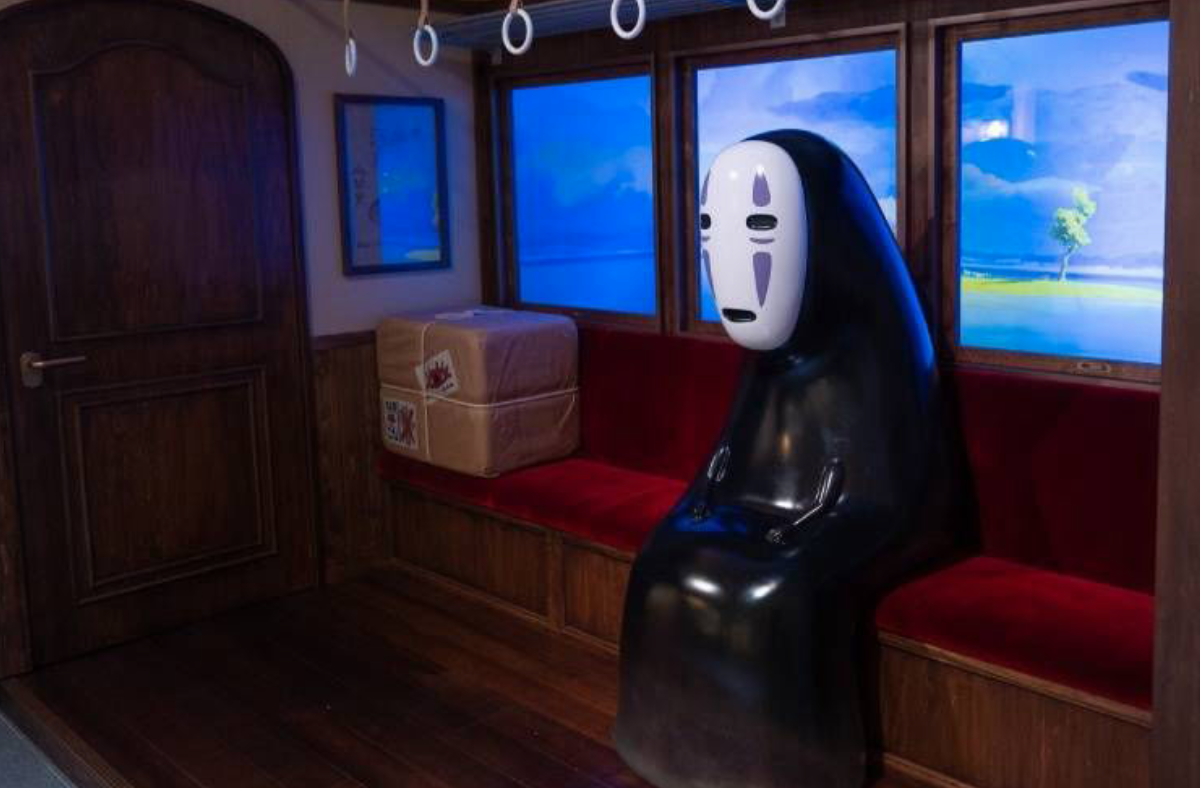
Photo: Studio Gibli via Comicbook.com.
Here’s a life-sized No Face from the wild imagination of “the world’s greatest living animator,” Hayao Miyazaki. You can see other beloved characters if you visit a new theme park in Japan.
All you friends of Japanese animator Hayao Miyazaki, how would you like to get up close to some of his delightful, scary characters? I can’t imagine it’s quite as powerful as seeing them on the screen, but amusement-park developers in Japan are betting on fans wanting to enter the Miyazaki movies and take selfies with characters.
Sam Anderson writes at the New York Times, “As an American, I know what it feels like to arrive at a theme park. The totalizing consumerist embrace. The blunt-force, world-warping, escapist delight. I have known theme parks with entrance gates like international borders and ticket prices like mortgage payments and parking lots the size of Cleveland. … This is a theme park’s job: to swallow the universe. To replace our boring, aimless, frustrating world with a new one made just for us.
“Imagine my confusion, then, when I arrived at Ghibli Park, Japan’s long-awaited tribute to the legendary animation of Studio Ghibli.
“Like filmgoers all over the world, I had been fantasizing about a visit to Ghibli Park since the project was announced more than five years ago. … Hayao Miyazaki, the studio’s co-founder, is one of the all-time great imaginary world-builders — right up there with Lewis Carroll, Jim Henson, Ursula K. Le Guin, Charles Schulz, Maurice Sendak and composers of the Icelandic sagas. Even Miyazaki’s most fantastical creations — a castle with giant metal chicken legs, a yellow bus with the body of a cat — feel somehow thick and plausible and real.
“Miyazaki started Studio Ghibli in 1985, out of desperation, when he and his co-founders, Isao Takahata and Toshio Suzuki, couldn’t find a studio willing to put out their work. The films were brilliant but notoriously artsy, expensive, labor-intensive. Miyazaki is maniacally detail-obsessed. He agonizes over his children’s cartoons as if he were Michelangelo painting the Sistine Chapel. He will pour whole oceans of effort and time and money into the smallest effects: the way a jumping fish twists as it leaps, individual faces in a crowd reacting to an earthquake, the physics of tiles during a rooftop chase scene. …
“ ‘Ghibli’ is an Italian word, derived from Arabic, for a hot wind that blows across Libya. The plan was for the company to blow like a hot wind through the stagnant world of animation. It succeeded. For more than 35 years, Studio Ghibli has been the great eccentric juggernaut of anime, cranking out classic after odd classic: Castle in the Sky (1986), My Neighbor Totoro (1988), Kiki’s Delivery Service (1989), Only Yesterday (1991), Princess Mononoke (1997), Spirited Away (2001). …
“Did I find myself stepping into the wonders of Ghibli Park? My first impression was not awe or majesty or surrender or consumerist bliss. It was confusion. For a surprisingly long time after I arrived, I could not tell whether or not I had arrived. There was no security checkpoint, no ticket booths, no ambient Ghibli soundtrack, no mountainous Cat Bus statue. Instead, I found myself stepping out of a very ordinary train station into what seemed to be a large municipal park. A sea of pavement. Sports fields. Vending machines. It looked like the kind of place you might go on a lazy weekend to see a pretty good softball tournament. …
I wandered into and out of a convenience store. I saw some children wearing Totoro hats and started to follow them.
“It felt like some kind of bizarre treasure hunt — a theme park where the theme was searching for the theme park. Which was, in a way, perfectly Studio Ghibli: no pleasure without a little challenge. And so I headed down the hill, trying to find my way in.
“Like many non-Japanese viewers, I first encountered Studio Ghibli through the 2001 film Spirited Away. It is Miyazaki’s masterpiece, a popular and critical supertriumph that won the Oscar for best animated feature and became, for two decades, the highest-grossing film in Japanese history. Critics all over the world simultaneously fell out of their armchairs to praise it in the most ecstatic possible terms. …
“I, on the other hand, am not a film critic. I am an ordinary American … which means that my entertainment metabolism has been carefully tuned to digest the purest visual corn syrup. Sarcastic men with large guns. Yearning princesses with grumpy fathers. Explosive explosions explosively exploding. When I watched Spirited Away, at first I had no idea what I was looking at. In the simplest terms, the film tells the coming-of-age story of a 10-year-old girl named Chihiro. It takes place in a haunted theme park — where, almost immediately, Chihiro’s parents are turned into pigs, and Chihiro is forced to sign away her name and perform menial labor in a bathhouse for ghosts (ghosts, spirits, monsters, gods — it’s hard to know exactly what to call them, and the film never explains). …
“But plot isn’t really the point. The majestic thing about Spirited Away is the world itself. Miyazaki’s creativity is radically dense; every little molecule of the film seems charged with invention. The haunted bathhouse attracts a proliferation of very weird beings: giant yellow ducklings, a sentient slime-blob, fanged monsters with antlers, a humanoid radish spirit who appears to be wearing an upside-down red bowl for a hat. There is a trio of green disembodied heads, with black mustaches and angry faces, who bounce around and pile up on top of one another and grunt disapprovingly at Chihiro. There are so many creatures, stuffed into so many nooks and crannies, that it seems as if Miyazaki has been spending multiple eternities, on multiple planets, running parallel evolutionary timelines, just so he can sketch the most interesting results. As a viewer, you have to surrender to the abundance. Crowd-surf into the hallucination.
“Miyazaki knows that his work can be difficult — and he is, at all times, righteously defiant. ‘I must say that I hate Disney’s works,’ he once declared. ‘The barrier to both the entry and exit of Disney films is too low and too wide. To me, they show nothing but contempt for the audience.’ …
“Let’s pause here, briefly, to make sure we all fully appreciate No Face. The very best Miyazaki characters, the ones that hit on the deepest spiritual levels, are the ones that do not speak. Totoro, the Cat Bus, soot sprites, kodama (the little rattle-headed forest spirits in Princess Mononoke). And the greatest of all these — one of the great strange miracles in the history of cinema — is No Face. No Face is a lonely ghost who appears, out of thin air, in the middle of Spirited Away. He is so simple and deep, so eloquently silent, that it is hard to even describe him. Words themselves hesitate. This, in fact, is partly what No Face is about: the failure of language. …
“This was the one experience I absolutely wanted to have at Ghibli Park, the thing I had been fantasizing about from thousands of miles away: to sit next to No Face. I wanted to enter Miyazaki’s most iconic scene: No Face, sitting, expressionless, on a red velvet seat on an ethereal train near the end of Spirited Away. I needed to sit there with him, to put my real 3-D body next to his fake 3-D body. I needed to feel that I was gliding over the water, lonely but not alone, on his sad hopeful journey.
“Unfortunately, this turned out not to be possible. Everyone else in Japan seemed to have come to Ghibli Park to take this photo.”
Read Anderson’s long, wonderful article at the Times, here. Better yet, find the movies and watch them.

 Photo:

 Suzanne's Mom's Blog