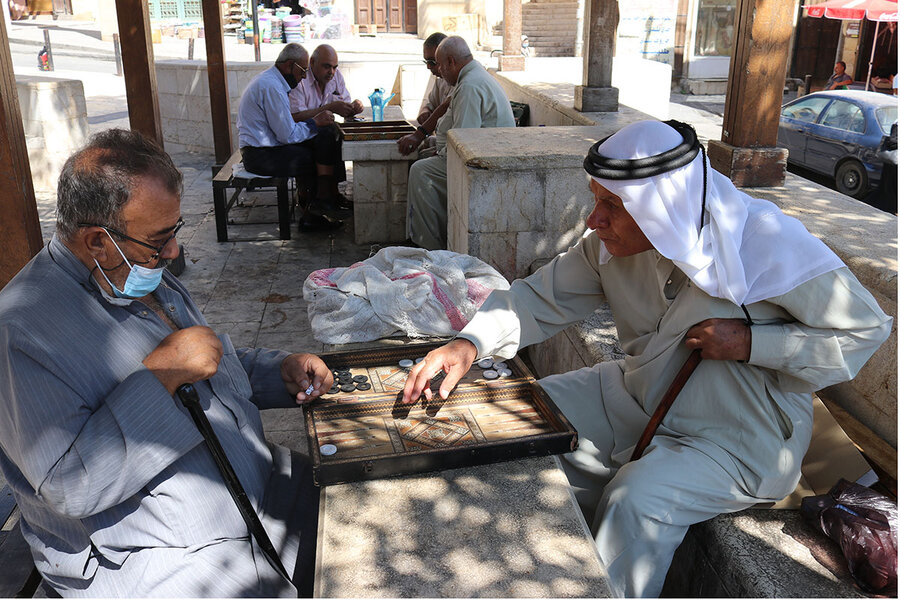
Elders in Salt, Jordan, play a daily game of backgammon in the town square. Salt is a new UNESCO World Heritage Site. It is known for remarkable hospitality.
Pretty much every religion adjures believers to welcome the stranger, but every day we see that the size of the need overwhelms even those who have not forgotten about that. Except in Salt, Jordan.
Taylor Luck writes at the Christian Science Monitor, “Welcome to the world’s newest UNESCO World Heritage Site, a breezy hillside town perched above the Jordan Valley that is celebrated for, well, its legendary hospitality.
“In Salt, history and economics have helped create a unique mix of cultures and faiths and a harmony of yellow-gold stone buildings and community. Don’t believe it? Simply ask the city’s elders.
“You can find them every day gathered in the Ain Plaza, formerly the site of fresh springs and now the town square in the twin shadows of Salt’s Great Mosque and Anglican Church. They will gladly tell you how their hospitality and way of life were passed from generation to generation – if they have time.
“For most of the day, they huddle around stone tables locked in intense games of backgammon and mancala, exhibiting the steely concentration of professional athletes. They say they welcome the UNESCO designation as a chance to share what they call ‘hospitality and harmony’ with the world.
“ ‘Here we welcome all, and we embrace every person,’ says Abu Ali, awaiting his turn at backgammon. He pointed to his compatriots of different faiths and tribes embroiled in matches.
‘We don’t see Muslim, Christian, tribes, or urbanites – we see each other’s humanity, and the humanity in all who visit.’
“Dating back to the Iron Age, Salt is located strategically on the trade and pilgrimage routes between Damascus and Jerusalem, and between the Mediterranean Sea and the Arabian Peninsula. The agricultural village grew into a flourishing hillside city in the 17th, 18th, and 19th centuries, attracting residents from across the Levant, Turkey, Arabia, the Caucasus, and west Asia.
“The constant, diverse flow of visitors and merchants created neighborhoods in which each street and hill had a mix of Christians and Muslims – Palestinians, Syrians, Turks, Circassians, Chechens, and members of local tribes all building their homes together.
“For centuries, Salt families would house and feed travelers, including merchants, Christian pilgrims on their way to Jerusalem, or Muslims heading east for the Hajj – offering at least three days of lodging, no questions asked.
“Not a single hotel was built in the town, as it was considered ‘shameful’ not to host a guest in one’s home. Only in the past two years have guest-houses emerged; but the idea of a guest paying for lodging is still highly controversial.
“ ‘Please have lunch with me,’ strangers told Jordanian visitors and a reporter, during a visit in mid-August.
“In its announcement in late July that Salt had been added to the World Heritage list, UNESCO highlighted the city’s unique makeup as a ‘Place of Tolerance and Urban Hospitality.’
“ ‘In Salt, there is not a single area here that is segregated by race, religion, or origin,’ says former Mayor Khaled Al Khashman. ‘This is very rare in this region and, historically, rare in the world.’
“The town’s traditional architecture has long encouraged community. Most of Salt’s yellow sandstone homes consisted of a single room with a domed roof, with two or four homes sharing a communal courtyard, walls, rooftop, and entrance.
“Families would sit in their communal courtyard, cooking or drinking evening tea together while their children played. Neighbors shared food, drink, and supplies, and took part in each other’s celebrations, religious holidays, and family milestones. The layout meant neighbors were often closer than blood relatives. …
“Salt resident Nadia Abu Samen, a Muslim, restored one of these compounds. … She says her mother was raised by her family’s Christian neighbors, and her uncles and aunts were given Christian first names to honor their neighbors.
“For the past decade Ms. Abu Samen has carefully preserved an abandoned compound of four joined rooms – two homes belonging to Christian families, two homes belonging to Muslim families – and turned them into a cultural center, exhibition, and cafe. She traces Salt’s trademark harmony to the ‘uniform simplicity of traditional life.’ ” More at the Monitor, here.
If your ethnicity or religion is not mentioned in the article, I hope you will visit sometime and let us know if you were welcomed. A town that has been given such a high award for hospitality has a reputation to uphold!


 Suzanne's Mom's Blog