Feeds:
Posts
Comments

Posts Tagged ‘transformation’

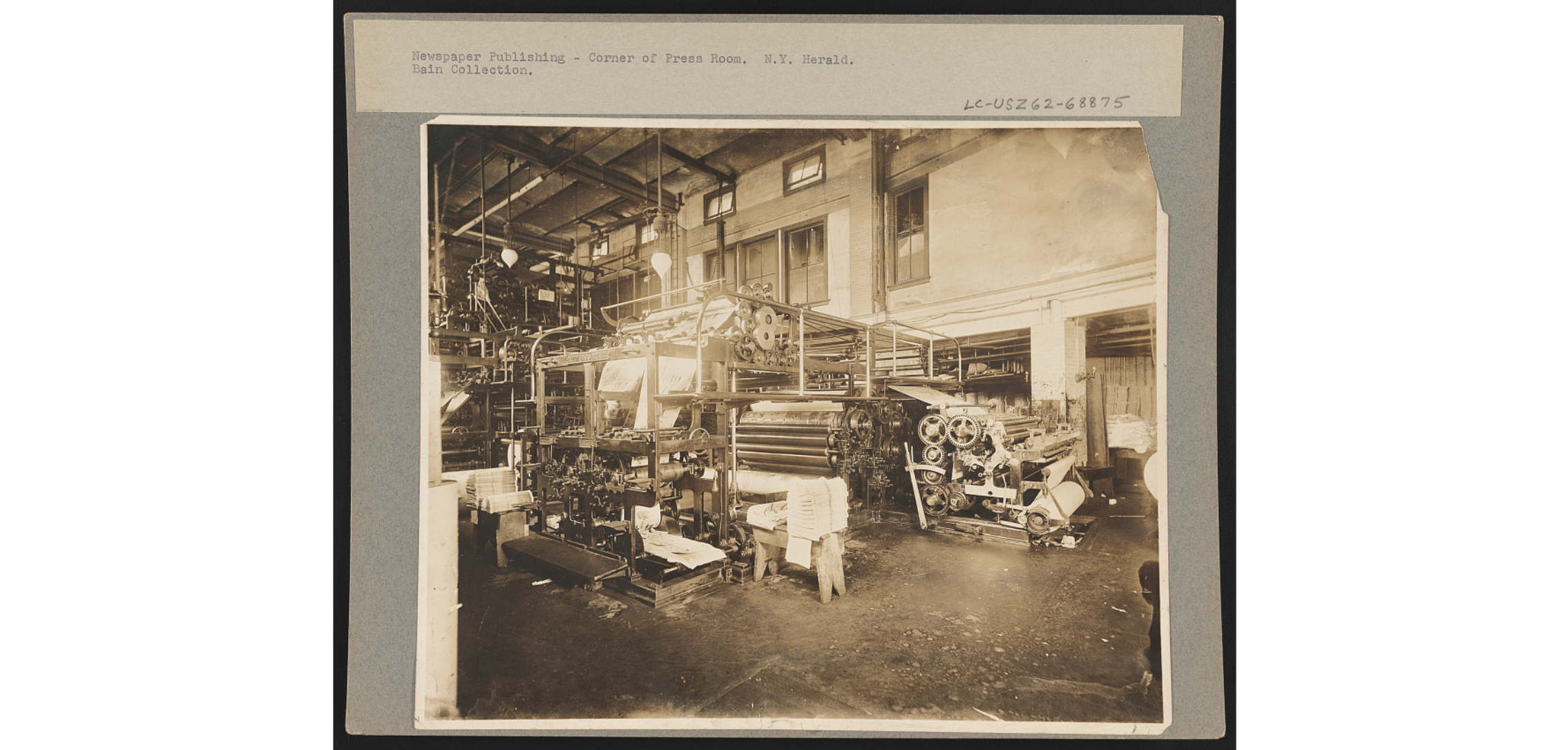
Photo: Library of Congress.
New York Herald press room back in the day. Times change.

To stay relevant, businesses need to keep moving forward. That’s what an Austrian journal with a long history decided recently. It has a few tips for other businesses thinking of modernizing.

Lucinda Jordaan writes at the World Association of News Publishers, “A government-owned national daily founded in 1703 in Vienna, Austria, Wiener Zeitung had faced the possibility of closure for most of this century. In October 2022, the threat was realized when a new law was adopted by the Austrian parliament that effectively cut off the main revenue stream of what was the official government gazette until 2020.

“Government job ads and companies’ annual financial results – required by law to be published in the paper – had largely funded WZ’s [annual] revenue. That would be stripped away by the end of 2022.

“This led to, arguably, the fastest, most radical transformation in newsroom history. ‘It was super quick; we had to do it in no time,’ acknowledges Editor-in-Chief Katharina Schmidt. ‘The law made us a publicly-funded news outlet in May 2022; we started the product development process in December 2022 and, by 1 July 2023, everything had changed.’

Wiener Zeitung is now WZ, an about-face from its roots in print and an aging audience. WZ has  a dedicated website, several newsletters, podcasts, and a growing following on TikTok and Instagram.

“Schmidt, the paper’s first female editor, shared the company’s challenges and learnings with a packed audience at WAN-IFRA’s recent World News Media Congress in Copenhagen. 

“In October 2022, Wiener Zeitung’s newspaper subscription totaled 8,000, within a population of about 9 million. ‘Most of our 8,000 subscribers were over 90 years old,’ [Schmidt says]. …

“Along with revenue loss, the newsroom faced multiple challenges in its reconstruction, as it fought for sustainability. They not only had to reduce staff by 60 percent (from 55 to 20) – and overcome internal resistance to this – but were also restricted by law in the topics they could cover.

“ ‘We really had to focus because, of course, there were so many ideas that we really wanted to put in practice, but we couldn’t. So we just focused on constructive journalism, and our target audience: the 20 to 29-year-olds. …

” ‘And of course, we checked out their needs. We had many focus groups and usability testing so that we could really focus on, on the needs of our audience.’

“The development process was also a reiterative process of testing and developing, then adapting to needs. ‘This is very important in this process; you cannot fixate on some framework,’ explains Schmidt. …

“Within weeks of the launch, they saw positive results: WZ had 750,000 unique monthly users, and Instagram figures increased by a third in the first three weeks. In September, they launched a newsletter dedicated to politics; subscription is at 12,000, with other topic-focused newsletters in planning.

“By November 2023, WZ’s relaunched and refreshed website has had up to 3 million users; their new TikTok channel had 11,500 followers, and Instagram followers went up by 46 percent from July to November 2023.

“Here’s how they did it. “1) Make friends in high places – get the publisher on your side; 2) Form a core group, comprising an interdisciplinary team – but don’t underestimate the number of editors you need; 3) Renew your news product following a development process – learn from other areas to adapt to your need ; 4) Focus your journalism: stay on track, and find your audiences.; 5) Involve the rest of the editorial team in the process. Over-prepare yourself. … Let the motivation of the core group carry your load; 6) Lead by example: say goodbye to hierarchical leadership, and find allies in-house, and externally, within the industry; 7)  Know that change takes time – this relates to new editorial direction, as well as mentally.” More here.
Read Full Post »

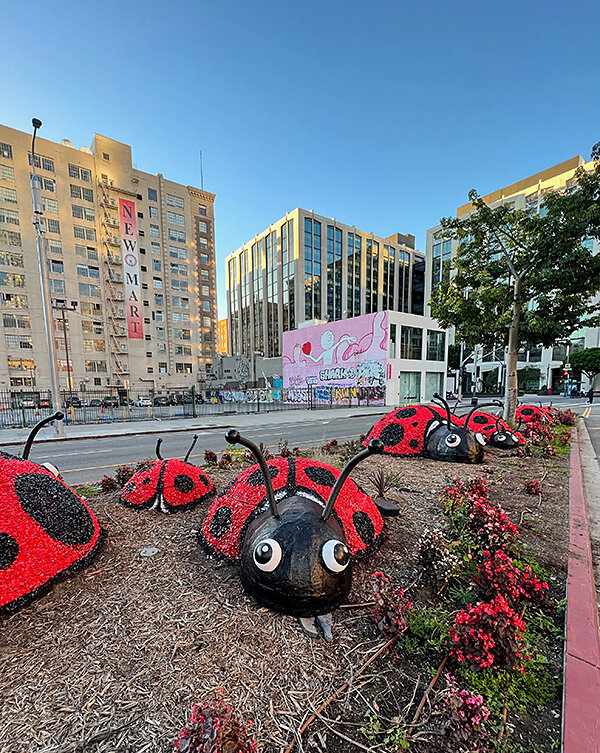
Photo: S.C. Mero.
Ladybugs nestle into the intersection of 9th, Main, and Spring Streets in Los Angeles, spring 2023. LA’s Fashion District commissioned S.C. Mero to create a series of installations to decorate the median, which had fallen into disrepair.

Art can lift up a community. It can be an outlet for feelings of all kinds. Whether it’s the art of graffiti (see Manny’s documentary Stations of the Elevated), the art of whimsy, or any other kind.

In today’s post, Ali Martin interviews a whimsical street artist, S.C. Mero, for the MonitorDaily.

“In downtown Los Angeles, absurdity interrupts urban blight: A fire hydrant sprouts stockinged legs; a winged telephone leaps from a phone booth; a mailbox towers, inaccessible, over passersby. 

“The city’s historic business district and surrounding neighborhoods are the backdrop for contemporary street artist S.C. Mero, who sees opportunity in a landscape dogged by disappointment and deferred dreams.

“The Minnesota native embraced the area, known as DTLA, after graduating from the University of Southern California (USC) a decade ago. Today, her rogue installations are part of downtown’s creative fabric – and local authorities are in on it. She’s been honored by the city for her contributions to the Skid Row neighborhood and commissioned by the nearby Fashion District to decorate a median at an intersection.

“Transformation governs her art. Ms. Mero’s first pieces were mosaics made of pennies which she altered with heat, dye, and tools. Other projects reshape abandoned spaces into commentaries on politics and humanity. 

“Her work insists on hope, which she describes as rebellious. ‘To put something like cute little turtles on a median with downtown the way it is, it’s resisting something, right? It’s resisting the default, which is to be negative,’ says Ms. Mero.

“The Monitor spoke with Ms. Mero at Something Poetic, her venue for performance art. The space, offered to her during the pandemic by the Historic Core Business Improvement District, has become a hub for local artists. The conversation has been edited for clarity and length. 

Monitor: Why downtown? You joined an artist collective on Skid Row after graduating from USC. I’m guessing there were other options. 
“S.C. Mero: I think my mom asked me the same question all the time. I just feel like it’s a good fit for what I’m doing. It’s really a creative vortex. … You have the Arts District, the Flower District, the Fashion District, Little Tokyo, you have the Industrial District, the Financial District. And maybe that’s typical of most cities, but I feel like there’s a lot happening here and it’s good for cultivating ideas.  I’ve just felt like I want to see it through, too. Look at these [historic, vacant] buildings. I think this could come back to life and they’re not there yet. So I want to be part of that transition. …

You look at a pothole, you look at something breaking down around you, and you see whimsy and light. How does that happen? 
“Because nobody cares about it anymore. It’s free game, right? Nobody’s going to stop you from really, truly doing anything on a pay phone right now, or a newspaper stand, or – in certain areas – a pothole. … To do anything to it, people are like, ‘Oh, you know, it’s better than what was there.’ 

What do you want people to take away from your art? 
“I feel like wanting people to take away something is in a way thinking that I want something from them. … I’m thankful that they are even allowing me to do it. So the fact that their reaction is positive, I’m just even more grateful for that – it makes it a little easier to be able to keep doing it. So I don’t know if I want a certain reaction from people. I just hope that they can find something that they do that they love as much as what I’m doing. 

Is there a theme or an idea that pulses through your work?
“Yes. At first I didn’t really see it. … The age-old idea of spiritual growth and transformation. And I think that that’s evident in a lot of my work – the whole idea that something can lose its identity or lose its value, but then come back even stronger. 

“A lot of my work is critical of our government, but I still maintain hope that there is a better way. It speaks to the truth because it’s not really about a payphone or a penny. We’re no different than that, right? Something is that way, but it can be better. What does it take for that to happen? It takes a belief, for one. It’s not going to get better by not thinking or imagining or seeing it that way. 

What is the relationship between your work and the downtown community?
“They’re as much of a part of [the art] as I am. It’s that we’re-in-this-together kind of vibe. Whether they like the piece or not, they get it because they’ve seen that pothole. They’ve seen a payphone like that. … It has that sense of camaraderie, I think.”

More at the Monitor, here. Note the funny mailbox, among other things.

Read Full Post »

An article in the UK’s Guardian addresses the fact that downtowns are changing now that so much retail activity is online. Some “big thinkers” were asked their thoughts on the future of downtowns.

Writes Tim Lewis, “Across Britain, one in seven shops is now boarded up, as consumers drive to out-of-town malls or wait out the recession with their hands in their pockets. Then there is the one-click efficiency of online shopping: the UK is Europe’s leading e-retail economy, with sales estimated at £68.2bn for 2011; the market grew 16% in 2011 and is predicted to increase by a further 13% this year. That is why high street chains such as Woolworths, Zavvi and Habitat have made way for an endless parade of mobile-phone stores and charity shops.”

In response, Mary Portas, who since May 2011 has been “heading up an independent review for David Cameron’s government,” solicited ideas from a variety of creative thinkers, beyond the usual urban planners. Here are a few of the ideas that surfaced.

* Artist Martin Boyce: turn high streets into urban playgrounds
* Retailer Jane Shepherdson: offer lower rents to attract new talent
* Architect David Adjaye: bring public buildings on to the high street
* Fashion magazine editor Lorraine Candy: “create a lust for bespoke shopping”

For details on how such things might be implemented to transform the high streets and their boarded-up storefronts, read the article.

Illustration about downtowns becoming more playful: Patrick Morgan for the Observer

high street

The artist: Martin Boyce
The idea: turn high streets into urban playgrounds

Read Full Post »