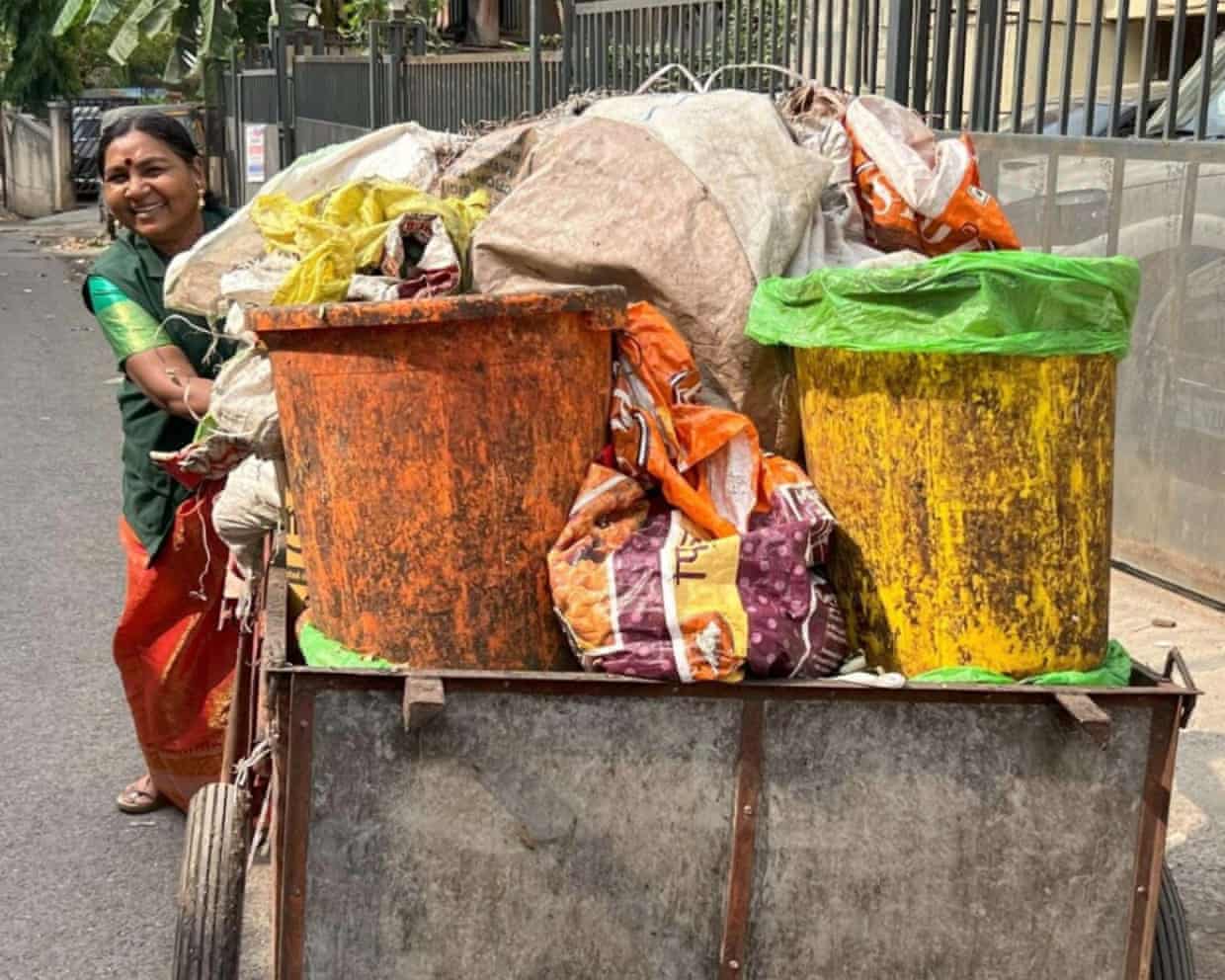
Photo: Swach Cooperative, Pune.
More than 70% of Swach waste collectors in Pune, India, are women.
I like stories about win-win-wins. Today Shatakshi Gawade writes at the Guardian about a cooperative in Pune, India, that is diverting waste from the landfill and cleaning a city while also alleviating poverty. Trash collection is a job the mostly female workforce fought hard to retain when the city failed to renew the contract.
“Three decades ago, Rajabai Sawant used to pick and sort waste on the streets of Pune with a sack on her back. The plastic she collected from a public waste site would be sold for some money that saved her children from begging.
“Today, dressed in a dark green jacket monogrammed with the acronym Swach (solid waste collection and handling) over a colourful sari, the 53-year-old is one among an organized group of waste collectors and climate educators who teach residents in urban Pune how to segregate and manage waste, based on a PPPP – a pro-poor private public partnership.
“ ‘Even though we were earning money and running our homes by collecting and selling recyclable waste in the past, our job was not valued and we were not respected for the work we did,’ Sawant says as she pushes a loaded four-wheeled metal cart up a gentle slope. …
“Swach was set up in 2005 by a trade union of waste pickers, Kagad Kach Patra Kashtakari Panchayat (KKPKP), which was not in favor of contractor-run private models and envisioned a scheme that enhanced waste collectors’ work instead of displacing them.
“Lakshmi Narayan, one of the co-founders of Swach and KKPKP, says: ‘Contractor models typically end up hiring males and displacing the people who traditionally did the work. We strongly felt that a person who has been doing the work for so long brings in the knowledge, experience and intelligence to handle the material in a particular way, and should be the first claimant of that work.’ …
“Rehabilitating the waste workers by teaching them a new skill such as embroidery, and taking them away from their work of waste collection, segregation and sale was not the long-term solution, Narayan says. ‘The waste sector generates a large number of jobs not just in Pune but across the world.’ …
“Through detailed discussions with waste pickers, KKPKP realized that they were diverting a significant amount of waste from the landfill. Segregation at source, plus recycling material recovered from the waste, was contributing to climate change mitigation by minimizing landfill waste, reducing greenhouse gas (particularly methane) emissions, lowering the demand for scarce raw materials and saving taxpayers money by reducing solid waste management costs. …
“The waste sector is the third-largest source of anthropogenic methane emissions, one of the most potent of greenhouse gases, and Swach calculates that its work saves 100,000 tons of CO2 every year.
“In negotiations over a global plastics treaty in Busan, South Korea, last year, the chair’s text highlighted that countries should take measures to ‘promote a just transition for plastic waste management workers, especially waste pickers and other informal workers.’
“Narayan says: ‘We have argued that waste collection itself is green work but it’s not necessarily decent work. And there has to be a way to make it decent.’ Narayan says the Swach model helped transition the work of waste collectors from the informal sector, in which they spent their whole day at public bins and roadsides in tattered clothes, to a more formalized setup, where they began wearing a uniform and started speaking directly to residents.
“Rani Shivsharan, a waste picker and board member of Swach, says: ‘We did not know how to talk to people, since we had never been included in society. We wouldn’t have dared to talk in front of even two people, but now we can fearlessly articulate our demands and thoughts with conviction in front of an audience of 500.’ “
Read at the Guardian, here, about current threats to employment of the traditional waste picker. This story is an abridged version of a piece originally published by Mongabay.

 Suzanne's Mom's Blog