No, I’m not thinking of the 19th century, of George Eliot (Mary Ann Evans), Currer Bell (Charlotte Brontë), or George Sand (Amantine-Lucile-Aurore Dupin). Masculine names are taken more seriously than feminine ones nowadays, too.
Here is a woman who put it to the test.
Catherine Nichols writes at the Jezebel blog, “The plan made me feel dishonest and creepy, so it took me a long time to send my novel out under a man’s name. But each time I read a study about unconscious bias, I got a little closer to trying it.
“I set up a new e-mail address under a name—let’s say it was George [Suzanne’s Mom asks, ‘What is it about the name George?’] Leyer, though it wasn’t—and left it empty. Weeks went by without word from the agents who had my work. I read another study about how people rate job applicants they believe are female and how much better they like those they believe are male. …
“So, on a dim Saturday morning, I copy-pasted my cover letter and the opening pages of my novel from my regular e-mail into George’s account. I put in the address of one of the agents I’d intended to query under my own name. I didn’t expect to hear back for a few weeks, if at all. It would only be a few queries and then I’d close out my experiment. I began preparing another query, checking the submission requirements on the agency web site. When I clicked back, there was already a new message, the first one in the empty inbox. Mr. Leyer. Delighted. Excited. Please send the manuscript.
“Almost all publishers only accept submissions through agents, so they are essential gatekeepers for anyone trying to sell a book in the traditional market rather than self-publishing. …
“I sent the six queries I had planned to send that day. Within 24 hours George had five responses — three manuscript requests and two warm rejections praising his exciting project. For contrast, under my own name, the same letter and pages sent 50 times had netted me a total of two manuscript requests. …
“I wanted to know more of how the Georges of the world live, so I sent more. Total data: George sent out 50 queries, and had his manuscript requested 17 times.
He is eight and a half times better than me at writing the same book.
“Fully a third of the agents who saw his query wanted to see more, where my numbers never did shift from one in 25. …
“Most of the agents only heard from one or the other of us, but I did overlap a little. One who sent me a form rejection as Catherine not only wanted to read George’s book, but instead of rejecting it asked if he could send it along to a more senior agent. Even George’s rejections were polite and warm on a level that would have meant everything to me, except that they weren’t to the real me. George’s work was ‘clever,’ it’s ‘well-constructed’ and ‘exciting.’ No one mentioned his sentences being lyrical or whether his main characters were feisty. …
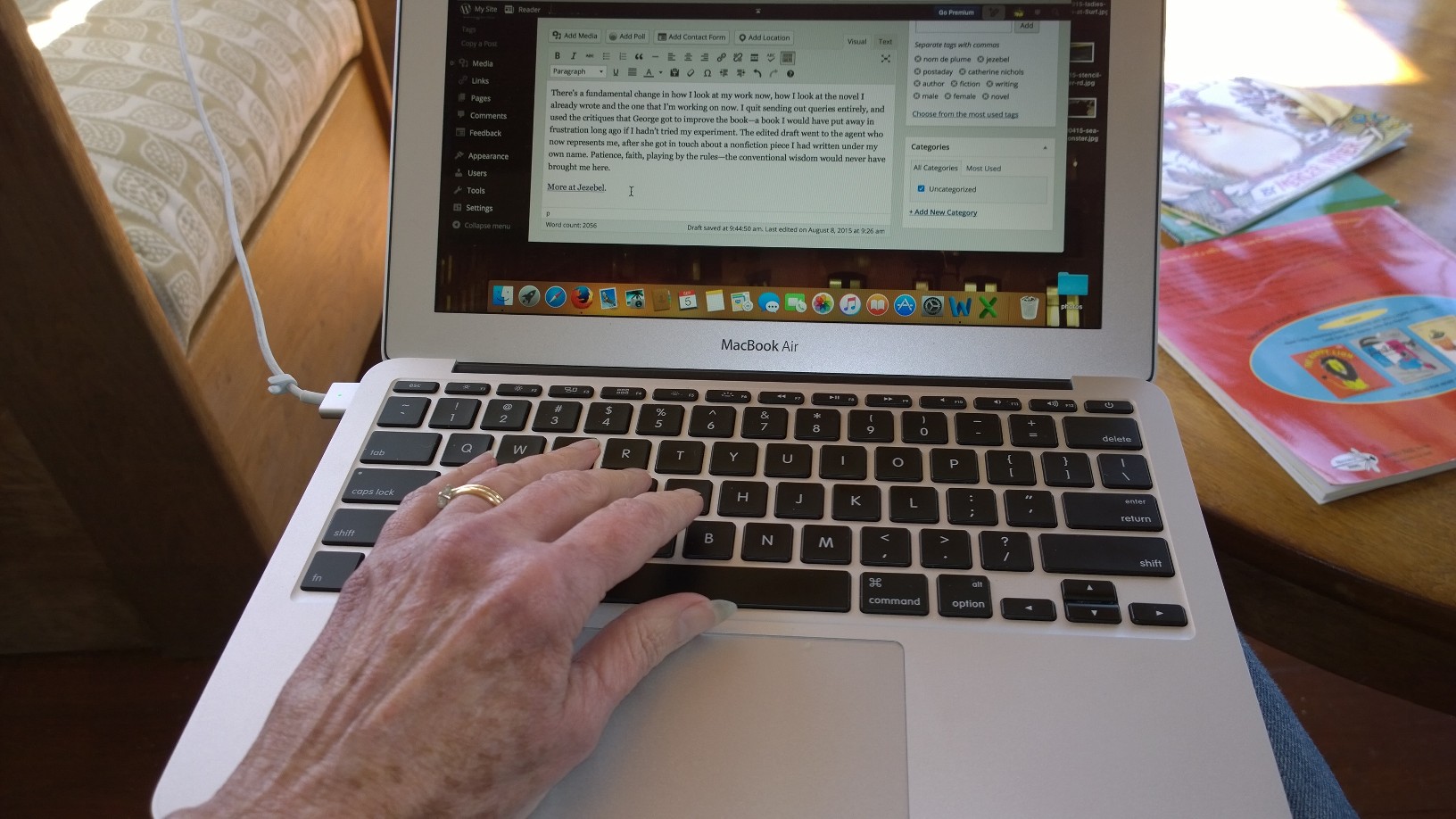
“I quit sending out queries entirely, and used the critiques that George got to improve the book — a book I would have put away in frustration long ago if I hadn’t tried my experiment. The edited draft went to the agent who now represents me, after she got in touch about a nonfiction piece I had written under my own name. Patience, faith, playing by the rules—the conventional wisdom would never have brought me here.” More at Jezebel.
Whew. Now I’m wondering if the fantastic (male) nonfiction writer ML Elrick got some rejection letters because recipients thought he was a female masquerading as a male. Like JK Rowling. Who now writes mysteries as Robert Galbraith.

 Suzanne's Mom's Blog