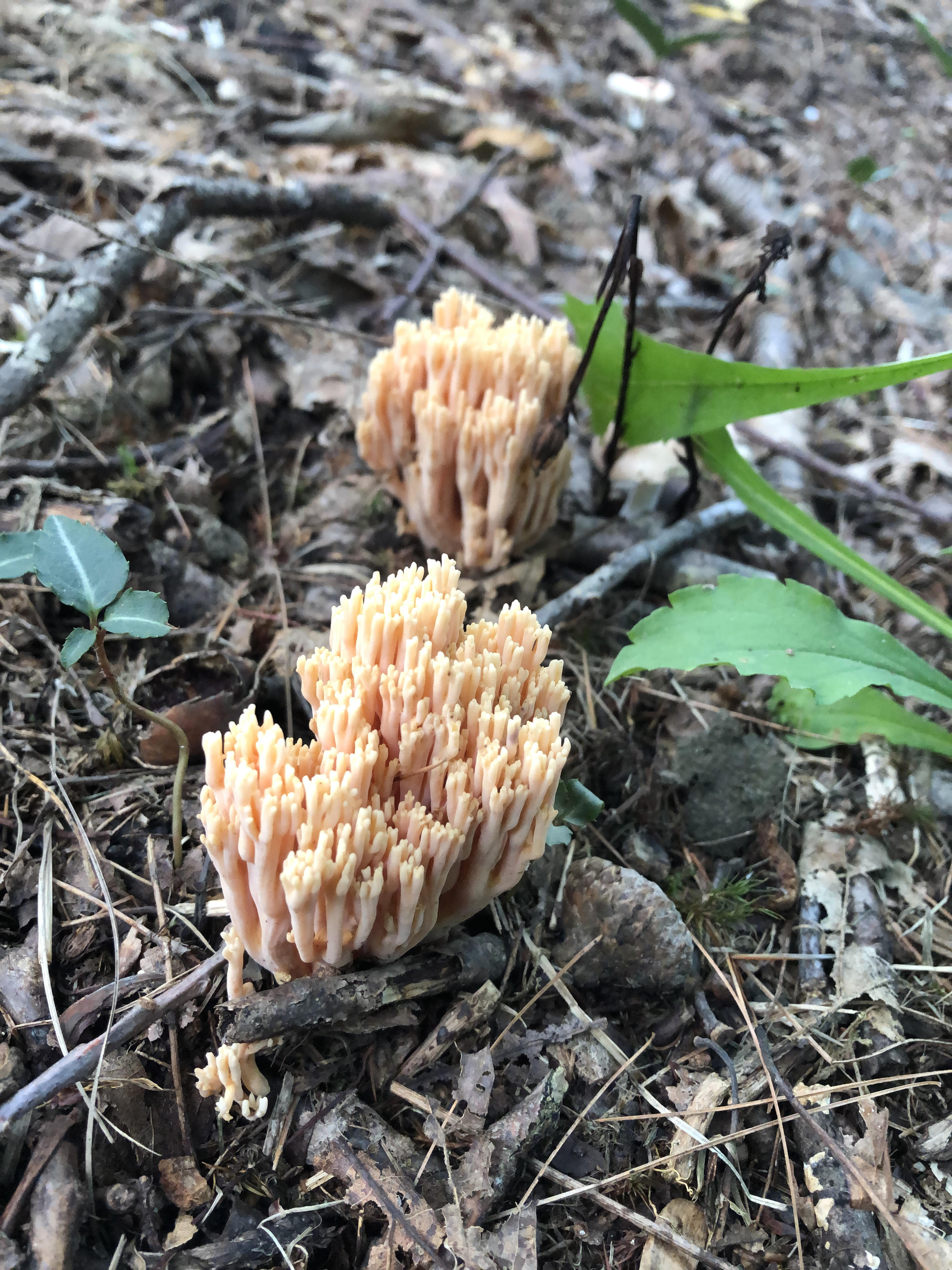
Photo: John and Suzanne’s Mom.
Fungi and algae receive less than 0.2% of conservation funding, according to a new study. Small speices never seem as cool as rhinos and elephants.
Is it human nature to pay more attention to the large and aggressive than to the small and quiet? As a female, I think so.
At the Guardian, Mariam Amini writes about how that tendency, when applied to the study of the natural world, can be harmful to the planet.
“Most global conservation funds go to larger, charismatic animals,” she says, “leaving critically important but less fashionable species deprived, a 25-year study has revealed.
“Scientists have found that of the $1.963bn allocated to projects worldwide, 82.9% was assigned to vertebrates. Plants and invertebrates each accounted for 6.6% of the funding, while fungi and algae were barely represented at less than 0.2%.
“Disparities persisted among vertebrates, with 85% of all resources going to birds and mammals, while amphibians received less than 2.8% of funding.
“Further funding bias was found within specific groups such as large-bodied mammals towards elephants and rhinoceros. Although they represent only a third of that group, they were the focus of 84% of such conservation projects and received 86% of the funding. Meanwhile mammals such as rodents, bats, kangaroos and wallabies remained severely underfunded, despite being considered endangered.
“ ‘Nearly 94% of species identified as threatened, and thus at direct risk of extinction, received no support,’ said Benoit Guénard, the lead author of the study. ‘Protecting this neglected majority, which plays a myriad of roles in ecosystems and represents unique evolutionary strategies, is fundamental if our common goal is to preserve biodiversity.’
“Alice Hughes, a coordinating lead author of the research, said: ‘The sad reality is that our perception of “what is threatened” is often limited, and so a few large mammal species may receive more funding than the near-12,000 species of reptile combined.
“ ‘Not only does this limit our ability to implement protective measures, but it closes opportunities to researchers. I have lost count of the number of times collaborators have switched taxa [organism populations] purely because theirs was difficult to fund. This leads to a chicken and egg situation – some of the groups with the highest rates of recent extinction, like freshwater snails, have the most outdated assessments.’
“The study, led by Guénard and colleagues at the University of Hong Kong, analyzed 14,566 conservation projects spanning a 25-year period between 1992 and 2016. …
“ ‘We are in the midst of a global species extinction crisis,’ said research author Bayden Russell. … ‘We need to change how we think about conservation funding. The community needs to be educated about the value of biodiversity and protecting species that are under threat.’ …
“ ‘Governments, in particular those which represent the main pool of funding, need to follow a more rigorous and scientifically driven approach in conservation funding,’ said Guénard.”
More at the Guardian, here.
And be sure to check Anna Kuchment’s Boston Globe interview with Mandë Holford, here, about a poisonous snail with lifesaving properties. It reads in part: “Some of the most powerful drugs in our medical arsenal come from animal venom. Ozempic was derived from Gila monsters, a lizard native to the southwestern US; Prialt, used to treat chronic pain in HIV and cancer patients, comes from deadly cone snails; and captopril, the first ACE inhibitor, a class of drugs used to treat high blood pressure, came from Brazilian pit vipers.”

 Suzanne's Mom's Blog