Feeds:
Posts
Comments

Posts Tagged ‘utah’

Photo: NiemanLab.
Now nonprofit, the Salt Lake Tribune has achieved something rare for a local newspaper: financial sustainability.

Yesterday we talked about getting news from a whistler in the mountains. Today we look at a more traditional approach, but one that is also seeing changes. Here’s one of NiemanLab’s deep dives into what’s going on in US news delivery.

Sarah Scire writes, “It started when Andy Larsen, sports reporter and data columnist for the Salt Lake Tribune, got annoyed with an ‘obnoxious’ ad on the Tribune’s own site. He brought his frustration about the digital clutter to someone else who happened to be working late in the newsroom — chief development officer Ciel Hunter.

“ ‘I asked her: “Hey, how much money do we make on this? Is it really worth it?” ‘ Larsen said. ‘That led into a conversation about how much we make from digital ad revenue overall, when compared to sponsorships and donations, which then led to talks on everything else. I was pretty floored and impressed with her transparency on everything over the course of the next couple of hours, which then led me to ask about making those same numbers public, and if I could help with the project.’

“That’s how Larsen ended up writing an annual report that gives the public — including nosy newshounds like you and me — a look at the inner workings of the first legacy newspaper in the U.S. to become a nonprofit.

“Larsen said he was given access to ‘internal financials and metrics of every kind.’ … He also interviewed [chief executive officer Lauren Gustus], Hunter, and director of finance Doug Ryle about the company’s finances and future plans. …

“This public-facing report is a first for the 153-year-old Salt Lake Tribune, which took inspiration from Defector and the Texas Tribune. It imagines an audience that includes subscribers, local residents, potential donors, news industry followers, and — as its origin story suggests — at least some of the Tribune’s own employees.

“News organizations have historically sought to maintain a strict separation between business and editorial operations to protect newsroom independence, and it’s been said — maybe not unfairly — that journalists don’t know much about the business of news. There are signs that is changing. … We’ve seen news organizations open communication that gives journalists a better idea of what, exactly, needs to happen for their publication to survive and thrive — and where they fit in.

“ ‘A firewall between business and editorial is essential for the integrity of the product, IMO,’ Larsen said. ‘On the other hand, that firewall can also be limiting when it comes to belief between the two groups — frankly, I think some of our own writers, including myself, had just assumed that our business was in worse shape than it was, just based on us operating in the newspaper biz in 2024. One way to get the information out to staff without breaking that firewall was just publishing everything to everyone.’

“Larsen said some expenditures stood out to him but that, mostly, he was happily surprised with what he found poking around his employer’s finances. ‘Honestly, that we were seeking donations to specifically address my biggest Tribune if-I-was-czar wants — a better website, free to all — brought me joy.’ …

“Larsen also takes time to address some common misconceptions and criticisms he encounters as a Tribune reporter, including readers who believe Paul Huntsman runs the paper (Huntsman, who rescued the paper from hedge fund ownership eight years ago, stepped down as board chair in February) or assume the Tribune is failing financially. …

“ ‘People in Utah appreciate knowing how we’re doing,’ Gustus said. ‘This is understandable, both because everyone thinks local news is on the rocks and here in Utah it’s the Tribune that can publish stories nobody else does.’ …

“The Tribune expects revenue and expenses to dip in 2024 after chief revenue officer Chris Stegman departed the Tribune in May and brought several Tribune advertising employees with him. Executive editor Gustus praised Stegman for helping turn the Tribune toward financial sustainability but said the change has allowed the newspaper to reorganize its business-side operations to better reflect the nonprofit mission, including moving philanthropy and advertising into the same division, and reduce expenses. …

“The newspaper has not made layoffs — which Larsen describes as ‘damaging to the soul of the Tribune‘ — since 2018 and has grown the newsroom by 10%.

“In July, staff at the Salt Lake Tribune announced their intention to form a union — including, as he disclosed in the annual report, Larsen himself. The newspaper’s management voluntarily recognized the Salt Lake News Guild four days later. …

“The paper edition (now printed twice a week) of the Salt Lake Tribune has 9,165 subscribers — down from 36,000 print subscribers when the Tribune ended its 149-year run as a daily paper back in 2020 and 200,000 subscribers at its peak.

“As of early June 2024, the Salt Lake Tribune also has 30,362 digital subscribers. Digital access costs $8 for the first three months and $8 per month after that. … The newspaper anticipates digital subscription revenue will edge out print revenue for the first time in 2024.”

Larsen also stated in the report, “Our goal is, at some point in the years to come, to remove that paywall. To allow all, regardless of their ability to pay, to read more Tribune journalism.” I would follow it then because Utah is a whole different world to me. “Free” is possible. Thanks to ads and donations, the nonprofit paper in my town is free to all.

More at NiemanLab, here. No paywall.

Read Full Post »

Photo: The Salt Lake Tribune.
Harvest watercraft encircle brine shrimp in Great Salt Lake using containment booms in preparation for harvesting.

Although today’s story about brine shrimp feeding the world is interesting in itself, the thing that stands out to me is thinking of Uzbek scientists. Uzbekistan feels so foreign to me, it’s like talking about scientists from the far side of the moon. That’s how limited my world view is, alas.

Here’s what Leia Larsen and Levi Bridges have to say at the Salt Lake Tribune about scientists in Uzbekistan and elsewhere who are studying brine shrimp.

“As the rising sun casts golden rays over the Aral Sea, a group of Uzbek fishermen wearing sweatshirts and knit caps gathered on a chilly beach to discuss the day’s plan.

“For two days they had waited in vain for brine shrimp. A dead calm in the first cold days of winter replaced winds that usually blow large slicks of the tiny crustaceans to shore.

“Standing and smoking cigarettes beside ramshackle cabins covered in sheets of plastic to keep out the elements, the fishermen debated whose turn it was to check if any shrimp had drifted in. Two volunteers jumped on a rattling old truck and chugged off miles into the distance to scour the beach.

“When the winds blow just right, Aral Sea fishermen work up to 36 hours gathering brine shrimp eggs, also known as cysts. They often labor with headlamps through the darkness. Winter temperatures can dip as low as minus 40 degrees Fahrenheit.

“ ‘Sometimes we get so sleepy you feel drunk,’ said Miyrbek Mirzamuratov, an Uzbek fisherman who has spent two winters gathering cysts on the Aral Sea.

“The Great Salt Lake remains the world’s largest source of brine shrimp cysts, exporting 40% of the global supply. The shrimp are a key food source used in aquaculture. Seafood is the main source of protein for billions of people across the planet, and aquaculture, fueled by brine shrimp, now produces roughly half of the world’s commercial seafood.

“But drought and decreasing water resources have put new pressure on brine shrimp in both Utah and Central Asia. In 2022, the Great Salt Lake’s shrimp populations almost collapsed due to record-low water elevation and spiking salinity.

“ ‘We’re all starting to realize just how much the lake touches us in many ways that we don’t appreciate,’ said Tim Hawkes, a former Utah state representative and current general counsel for the Great Salt Lake Brine Shrimp Cooperative. …

“Environmental challenges are also forcing scientists in Uzbekistan to devise ways to save their own brine shrimp – and help keep the world fed if Utah can’t ensure its own inland sea survives. Despite being too salty for fish, the Great Salt Lake’s aquaculture industry infuses Utah’s economy with up to $67 million each year, thanks to brine shrimp.

“That’s because their cysts, no bigger than a grain of sand, tolerate extreme conditions.

“ ‘You can boil them, you can freeze them, you can send them to outer space,’ Hawkes said. ‘And still, under the right conditions, if you put them in a little bit of salt water and give them some light, they’re going to hatch out.’

‘It makes brine shrimp cysts an ideal product to package and ship across the world, where they’re raised as an essential food source for the farmed seafood humans eat, particularly prawns and cocktail shrimp.

“Although farm-raised seafood has generated controversy due to its runoff pollution and impacts to wild fisheries, the United Nations issued a 2020 report identifying it as a critical player in global food security. It provides nutritious protein at low cost to rural and developing communities that have a hard time producing other farmed goods. …

“Globally, the average person ate 44.5 pounds of seafood in 2020, up from 31.5 pounds in the 1990s, according to the U.N. More than half of that came from farms.

“ ‘If we lost the Great Salt Lake,’ Hawkes said, ‘or we lost the ability to produce brine shrimp from the Great Salt Lake, it would have a significant impact on our ability to feed the world.’ …

‘Companies on the Great Salt Lake gather brine shrimp cysts from the water with boats and floating booms similar to those used to contain oil spills, but the work is still mostly done by hand in Uzbekistan and other Asian countries. …

‘Islambek Shumomurodov said he earns about $1.50 for every pound of Aral Sea cysts he gathers. The average annual household income in Uzbekistan is around $1,600. ‘Some people even buy new houses and cars from working here,’ Shumomurodov said.

“Although Uzbekistan’s brine shrimp production represents just a fraction of Utah’s output, the crustaceans created an economic opportunity after the Aral Sea’s traditional fishery shriveled.

“The Aral Sea, like the Great Salt Lake, has declined significantly from agricultural demand and human water consumption. Once a freshwater lake teeming with fish, the Uzbek portion of the Aral turned saline — a trend scientists don’t expect will change.

“Neighboring Kazakhstan spent millions damming off their portion of the North Aral Sea to keep the freshwater fishery viable. Brine shrimp, which likely hitchhiked to the region as cysts stuck to the feathers of visiting shorebirds, are the only creatures with commercial value able to survive in the shrinking southern Uzbek portion of the lake. …

“ ‘It’s just a matter of years now before [the Uzbek side of] the Aral Sea can no longer support brine shrimp,’ said Ablatdiyn Musaev, a biologist at the Uzbek Academy of Sciences.”

More at the Salt Lake Tribune, here. No firewall. Nice photos. There’s an audio version of the story at PRX’s The World.

Read Full Post »

Photo: J Zapell/Wikimedia.
The world’s oldest organism, a grove of Populus tremuloides (Quaking Aspen) sharing one root system. From Fish Lake National Forest website.

Here’s something that’s a little hard to believe. Unless you live in Utah, I suppose. It’s a forest with one root system, so it’s technically one tree, and its “genetic integrity has been sustained over a long period time (between 9,000 and 12,000 years),” according to Wikipedia.

I first got interested thanks to Kayleen Devlin’s story “Can Trees Really Live Forever?” at BBC Earth, which focused on ancient gingko trees, mostly in China. But Pando in Utah is said to be the world’s largest tree. And it’s really old.

Wikipedia says, “Pando (Latin for ‘I spread’), the world’s largest tree, is a quaking aspen tree (Populus tremuloides) located in Sevier CountyUtah in the Fishlake National Forest. A male clonal organism, Pando has an estimated 47,000 stems (ramets) that appear as individual trees, but are connected by a root system that spans 106 acres.

“Pando is the largest tree by weight and landmass and, is the largest known aspen clone. Pando was identified as a single living organism because each of its stems possesses identical genetic markers. The massive interconnected root system coordinates energy production, defense and regeneration across its expanse. Pando spans 0.63 miles by 0.43 miles of the southwestern edge of the Fishlake Basin in the Fremont River Ranger District of the Fishlake National Forest and lies 0.43 miles to the west of Fish Lake, the largest natural mountain freshwater lake in Utah. Pando is located at an elevation of 2,700 m (8,900 ft) above sea level.

“Pando occupies approximately 106 acres (43 ha) and is estimated to weigh collectively 6,000 tonnes (6,000,000 kg), or 13.2 million pounds, making it the heaviest known organism. Systems of classification used to define large trees vary considerably, leading to some confusion about Pando’s status. In contrast to the General Sherman Tree, the largest single stem tree, Pando is often characterized as an ‘organism’ or ‘plant.’ Pando, however, is a tree and commonly known as the ‘Pando Tree.’

“Within the United States, the Official Register of Champion Trees defines the largest trees in a species specific way, in this case, Pando is the largest aspen tree (Populus tremuloides). In forestry, the largest trees are measured by the greatest volume of a single stem, regardless of species. While many emphasize that Pando is the largest clonal organism, other large trees, including Redwoods can also reproduce via cloning. This leaves Pando in a class of its own being the largest aspen tree, largest tree by weight and, the largest by land mass, combined.

More at Friends of Pando, here, BBC Earth, here, and Wikipedia, here.

Read Full Post »

Photo: Manufactured Housing Village.
Willow Pines mobile home park in Kaysville, Utah. An empathetic woman makes the manufactured housing parks she manages truly homes.

At a manufactured housing park in Utah, as Cathy Free reports at the Washington Post, one woman is making a huge difference in residents’ sense of security.

“Pat Blake, who manages two mobile home communities in Utah, began to notice some of the children who lived there seemed hungry after parents came to her to inquire about food assistance. Blake was one of seven siblings raised by a single mom. She knew hunger personally.

“She started using some of her own money to pick up extra jars of peanut butter, cans of soup and bread at the grocery store. Then she let her residents know to come to her office and help themselves.

“ ‘It doesn’t matter whether a child lives in a mobile home or in a fancy apartment — they all deserve to be fed,’ she said, explaining that there are 120 families in one community and 45 in another at the mobile home parks in Davis County. …

“With rent increases hitting most mobile home communities in recent years, more families are finding it difficult to afford groceries and housing, she said.

“ ‘I started bringing food in for people, just a little at a time,’ said Blake, who has been managing the two parks since 2020. “And then I realized that I had a huge room behind my office that wasn’t being used, and I could do more.’

“Blake, 79, lives in a mobile home in Apple Acres, one of the communities that she manages. She said she asked a friend to help install some shelves in the large room at the second mobile home park, Willow Pines, so she could turn it into a pantry.

“Then she stepped it up a level. She contacted the Bountiful Food Pantry, which collects donated food and distributes it throughout Davis County, including in Fruit Heights City, where she lives. They started coming twice a month to offer groceries to residents.

“Blake stocked the shelves of her pantry with some of the donated items, and she told her tenants they could come by on Thursdays to pick up any extra staples they needed.

She used her savings to buy a refrigerator to hold meat, cheese, eggs and gallons of milk, she said.

“Almost three years later, she said residents at Apple Acres and Willow Pines now have enough to eat, regardless of their family size or financial circumstances. …

“Linda Wilson lives at Willow Pines and is among those who have felt the pinch of rising food and housing costs. Three years ago, Wilson, 75, took in her daughter and three grandchildren when they were going through a difficult time, she said. They are still living with her in her mobile home. …

“ ‘I’ve lived in several mobile home parks over the years, and I’ve never run across a manager like Pat,’ she said. ‘She helped me with some rental assistance, and she takes the time to get to know every resident here and what their needs are.’

“Before Blake became manager of Willow Pines, Maribel Urquizo said she often struggled to buy groceries for her three children in the week before her husband, who works with granite countertops, received his regular paycheck.

“ ‘It was a little hard sometimes to make ends meet,’ said Urquizo, 29. ‘Now we can go to Pat’s office, and she gives us what we need to get us through. Milk, eggs, snacks for the kids — she has it all.’ …

“Blake said she understands the struggles of many of her tenants because she’s been there. She dropped out of school at 13 to help look after her siblings and bring in extra money from babysitting kids in her neighborhood, she said, noting that she eventually received her high school diploma at age 29. …

“Besides keeping food in her residents’ refrigerators, Blake said she makes sure they have Christmas presents every year and that children have backpacks and school supplies.

“The families she helps often thank her by bringing her casseroles, cookies and jars of salsa made with the free groceries they pick up every other week.

“She said she can go to sleep content at night knowing that nobody at Apple Acres and Willow Pines is hungry.

“ ‘Needing groceries is nothing to be ashamed of,’ she said. ‘We could all use a boost sometimes. These families need someone, and I’m happy that I can be that person to help. More at the Post, here.

I’d be remiss if I didn’t also mention that protection from rising rents at mobile parks is often best tackled by joining with neighbors to become a Resident Owned Community. Read about how to do that here.

Read Full Post »

Photo: Rick Bowmer/AP/File.
People collect their belongings as Salt Lake County conducts a homeless camp cleanup of the Fleet Block area in 2021. Today Utah and a few other states are considering government-sanctioned tent encampments as steppingstones for those without homes.

One has to appreciate politicians who try to solve problems rather than sweep them under the rug. If people are homeless, kicking them out of an encampment with nowhere to go just creates an encampment somewhere else. Some states are considering a different approach.

Patrik Jonsson reports at the Christian Science Monitor, “When Salt Lake City began enforcing an urban camping ban several years ago, hundreds of Utahns picked up their belongings and headed toward the Jordan River.

“For centuries, the river has been a trading post, a border, and a nexus of nomadic activity. But most of all, it has been ‘a place of refuge,’ says Søren Simonsen, executive director of the Jordan River Commission.

“Today, growing numbers of encampments filled with Americans without permanent homes dot the banks of the river. And Mr. Simonsen is on the front line of what to do about it.

“A decade ago, Utah claimed it had largely ‘solved’ homelessness, reducing it by 91%. Now it is considering an idea, supported by Mr. Simonsen, that is gaining traction across the United States: outlawing unsanctioned camping and instead creating government-sanctioned tent encampments as steppingstones for those without homes to find more permanent housing.

“For much of the recent past, one assumption in addressing homelessness has been that everyone wants a solid roof. The debate over encampments is shifting those assumptions.

“Increasingly, cities and states are exploring whether there can be a sense of dignity and agency in ‘safe outside spaces’ as an end in themselves. As some carry out sweeps to clear out encampments, others are experimenting with the idea of making them more humane, hygienic, and livable as one potential part of the solution to the housing crisis. …

Says Mr. Simonsen. ‘Can’t we make space for people that aren’t ready, aren’t capable, aren’t interested in living such a fixed-address kind of lifestyle?’

“The situation is Utah is common across the country. Tent encampments have ‘definitely become more of a visible issue since the pandemic,’ exacerbated by a national housing shortage, says Courtney Anderson, an expert on social welfare law at Georgia State University College of Law in Atlanta. ‘It’s a problem that people can see, so they need a solution where they can’t see it.’

“Under pressure from voters, officials are taking action. Authorities in Rhode Island cleared an encampment from the steps of the state capitol in December. Washington, D.C., conducts regular camp removals. New York City has conducted hundreds of ‘sweeps’ under Mayor Eric Adams. Residents have largely hailed the efforts, but the majority of those affected haven’t moved into more permanent housing. …

“ ‘The raiding of camps is really tragic,’ says Professor Anderson. ‘The more you dehumanize people, the easier it is to do that kind of thing.’

“The 9th U.S. Circuit Court of Appeals ruled it is unconstitutional to ban sleeping in public if there are no other sleeping options available, and some municipal courts have made similar rulings. But this year, Tennessee made camping away from sanctioned areas a felony. Other states are following suit.

“The Georgia Senate is considering a bill that would criminalize camping and force municipalities to comply. But the bill would also allow the state to designate areas for sanctioned camps.

“In Savannah, Georgia, Shirley Walkowicz says the move to criminalize what she is doing – living in her car – ‘just shows that people don’t [care] about me and people like me.’ …

“The Georgia bill is significantly based on the thinking of Judge Glock, a senior fellow at the nonpartisan Cicero Institute. Dr. Glock saw the early potential of ‘housing first’ – an Obama-era policy that ended requirements such as drug testing for housing recipients. But he now says the policy has largely failed. An average of five homeless people die on the streets of Los Angeles every day, he says – more than twice as many as a decade ago.

“ ‘This is a crisis situation,’ he says. ‘It’s about what we can do this month, this year. We can’t just sit on our hands until the housing [shortage] is solved.’

“He points to cities such as Austin, Texas, and Portland, Oregon, which are banning makeshift encampments but creating safe spaces for people without homes.

“ ‘The argument is, if cities are going to allow it, make sure they provide the things you need: sanitation, social services, security,’ says Dr. Glock. …

“Birmingham, Alabama, has just voted to erect a tiny house village to accomplish many of these goals. For City Council member Hunter Williams, the logic is clear. …

“ ‘We don’t have to have tent cities under every overpass in America. … We can do better than that.’ ”

More at the Monitor, here. No firewall; subscriptions welcome.

Read Full Post »

Habibi Bazaar

Photo: Bianca Velasquez.
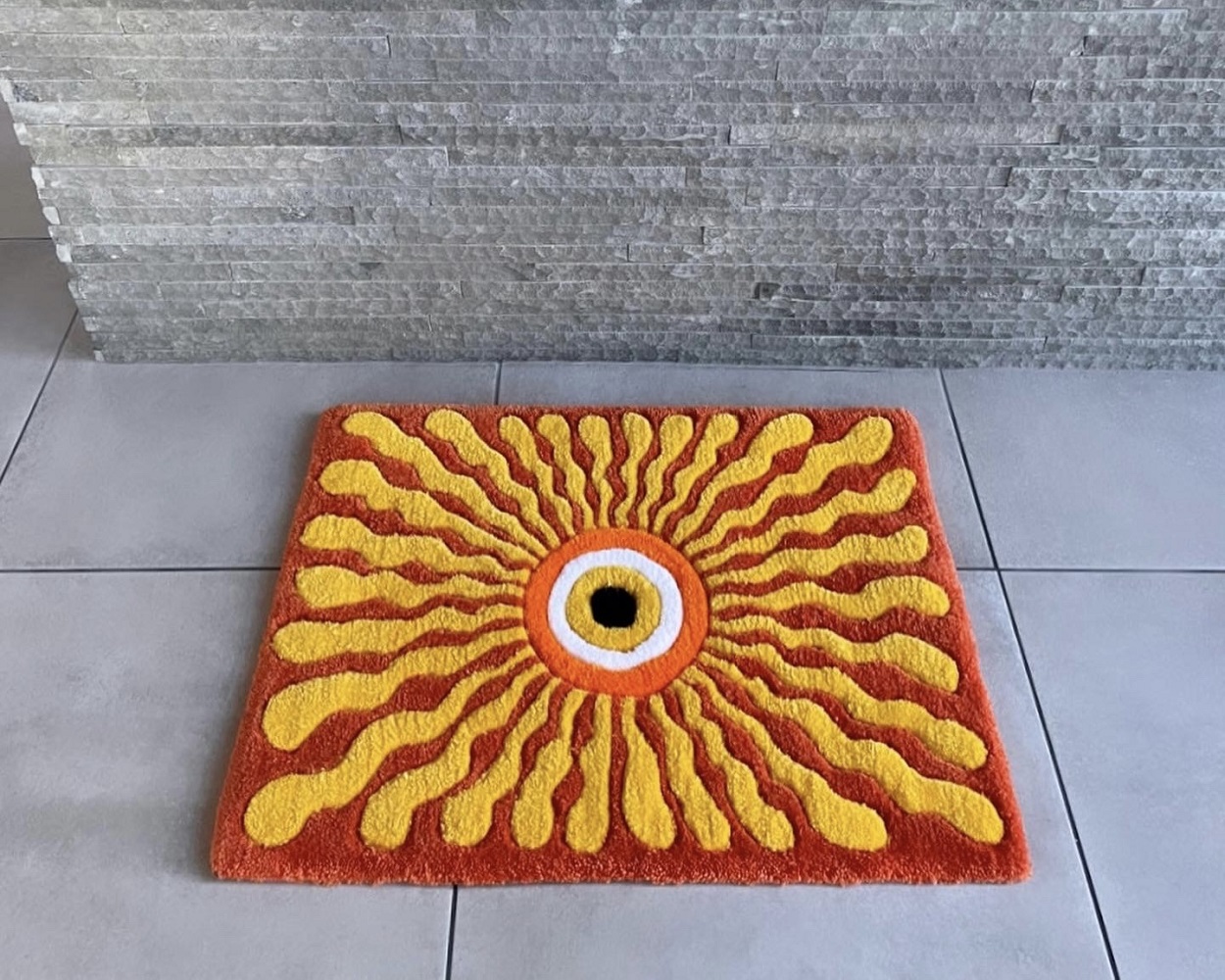
A rug called “Evil Eye,” by Pamela El Gergi.

Today’s story about beautiful craft rugs is reminding me of a college friend who was really into interior decorating. As a hobby. She got so enthusiastic about Scandinavian rya rugs that she began designing and selling her own. Nowadays, when I’m supposed to be replacing rugs with floor coverings that older people won’t trip on, I’m wishing that I had bought one one of her ryas. I could at least hang it on the wall if I was afraid of tripping. Like other crafts, rugs can hold a lot of meaning.

Bianca Velasquez reports at Hyperallergic about Utah-based Lebanese American artist Pamela El Gergi who “modernizes traditional rug-making as a way to stay connected to her heritage.

“A sweeping reclamation of traditional craftsmanship is taking place around the world,” Velasquez says, “with artists forming communities around their uses of stained glass, jewelry, beading, and textiles. Seemingly unapproachable crafts (because of restricted access to supplies or apprenticeship), such as rug-making and stained glass, have benefited from modernized and simplified techniques and technologies that make practicing these trades more accessible, creating a surge of independent creators who work at their own pace and through their own lens. …

“Among the new voices is Lebanese rug maker Pamela El Gergi, who creates her works under her business name Habibi Bazaar.

“Having relocated to Salt Lake City, Utah, from Beirut, Lebanon, in 2018, El Gergi felt an urge to keep an open connection to her hometown, which she found through the traditional craft of rug-making. … ‘Habibi Bazaar uses my own personal style, which is Oriental rugs, evil eyes (Nazar), patterns that you would see in churches and mosques in Lebanon,’ she told Hyperallergic in an interview.

“And while she applies her voice and background to rug-making in the US, El Gergi creates a new dialogue within traditional rug-making in Lebanon. ‘I’ve taken these vintage, older styles of Oriental rugs, and now I’m trying to make them more centered around Lebanese culture,’ she said. ‘We don’t have much Lebanese representation within Oriental rugs.’ …

“After finalizing her design, El Gergi projects and traces the outline onto her canvas, then uses the tufting gun to apply the yarn accordingly. After applying the carpet glue and backing to the other side of the fabric, she moves on to the final step. ‘I spend hours on each rug, shaving it properly and carving out the designs (or “sculpting” the rug). I finish it all with vacuuming, lint rolling, and doing one last quality check,’ she said.

“El Gergi is currently working on a rug collection in collaboration with her peer Samantha Nader who has created seven Oriental designs based on El Gergi’s concepts. ‘What makes this collection significant to me is the specific flower that is included in the design. This flower is printed on Lebanese coffee cups, and when you drink Arabic coffee, the grounds are collected at the bottom,’ El Gergi said. ‘Then you flip the cup over, and you let the grounds fall along the sides. After letting it sit for five minutes, it reveals a pattern that tells your fortune.’ …

“El Gergi’s pieces tend to use this medium to shed light on her experience as a Lebanese woman, as well as pay homage to and honor the cultural symbolism that has been passed down through her family for generations. 

“Creating cultural ties between Lebanon and the US does not stop at rug-making for El Gergi. Habibi Bazaar also kicked off a pronoun shirt campaign in collaboration with Mexican artist Alethia Lunares, who designed the t-shirt graphic. … She produced three different shirts saying ‘She, Her, Habibi,’ ‘They, Them, Habibi,’ and ‘He, Him, Habibi.’ El Gergi’s decision to include the term ‘Habibi,’ which translates into a non-gendered way of saying ‘my love,’ allows her to incorporate a little bit of her culture into the campaign.

“This year, Habibi Bazaar has been accepted to the 14th Annual Craft Lake City DIY Festival Utah’s ‘largest local-centric art, music, science, and technology festival.’ Not only has she been accepted as a vendor, she was also chosen to be sponsored through the Craft Lake City Artisan Scholarship Mentor Program, allowing her to be mentored by a more tenured local business owner through the entire process of tabling at a large event. 

‘[Her booth] will include her rugs, pottery, stickers, wall hanging, mirrors, and more. … Most importantly, El Gergi hopes to continue finding contemporary ways to pass down traditional Lebanese crafts to future generations.”

More at Hyperallergic, here.

Read Full Post »

Every once in a while reporter Ted Nesi adds a tidbit to his valuable “Saturday Morning Post” that doesn’t seem to fit with the news from Rhode Island and yet fits everywhere. This link from the Virginia Quarterly Review (VQR), a “national journal of literature and discussion,” is one such example.

Amanda Petrusich writes in part, “Darkness is a complicated thing to quantify, defined as it is by deficiency. … Unihedron’s Sky Quality Meter is the most popular instrument for this kind of measurement, in part because of its portability (about the size of a garage-door opener) and also because it connects to an online global database of user-submitted data.

“According to that database, Cherry Springs State Park — an eighty-two-acre park in a remote swath of rural, north-central Pennsylvania, built by the Civilian Conversation Corps during the Great Depression—presently has the second darkest score listed …

“The International Dark-Sky Association (IDA), a nonprofit organization that recognizes, supports, and protects dark-sky preserves around the world, designated it a Gold-tier International Dark Sky Park in 2008, only the second in the United States at the time, following Natural Bridges National Monument in San Juan County, Utah.

“Earlier this year, I drove the six hours to Cherry Springs from New York City to meet Chip Harrison, the park’s manager, his wife, Maxine, and a park volunteer named Pam for a 4:30 p.m. dinner of baked fish. Afterward, Chip had promised, we’d go see stars.  …

“On a clear night, from the proper vantage, watching constellations emerge over Cherry Springs is like watching a freshly exposed photograph sink into a bath of developer, slowly becoming known to the eye: a single crumb of light, then another, until the entire tableau is realized. Pam pointed the telescope toward Jupiter, which had risen over the east end of the field. The four Gallilean moons—Io, Europa, Ganymede, and Callisto—were clearly visible through the lens. …

“When I got back to New York, I visited with Matt Stanley, a beloved colleague at the university where I teach. Stanley … has a particular interest in how science has changed from a theistic practice to a naturalistic one. He leads a seminar called ‘Achilles’ Shield: Mapping the Ancient Cosmos,’ and another called ‘Understanding the Universe.’

“ ‘I’ve found that probably 95 percent of my students come from either an urban or suburban environment, which means they can only see a dozen stars at night, and no planets,’ Stanley said. ‘When you say the Milky Way to them, they imagine a spiral galaxy, which is fine, but that’s not what the Milky Way looks like — it’s a big, whitish smear across the sky. I have to do a lot of work to orient them to what human beings actually saw when they looked at the sky. They don’t know that stars rise and set. Their minds explode.’ ” More here.

In Rhode Island, New Shoreham offers a pretty good look at the night sky. There are shooting stars in August. I feel lucky about that and hope that the five nearby offshore wind turbines don’t change anything.

Photo: Gary Honis

Read Full Post »

According to Doug Donovan at The Chronicle of Philanthropy, here. the number of volunteers in the United States is at its highest level since 2005.

“More than one-quarter of Americans did volunteer work in 2011, providing 7.9 billion hours of service worth $171 billion. …

“The 1.5 million additional volunteers boosted the national rate to 26.8 percent of the population, a half percentage point higher than 2010. But the dollar value dipped by $2 billion, as the average number of hours Americans volunteered in a year dropped to 32.7 from 33.9, the Corporation for National and Community Service reported.

“Robert Grimm, director of the Center for Philanthropy and Nonprofit Leadership at the University of Maryland, said the increase was mainly the result of the growth in the American population, not a response to the economy or other factors.”

Well, that’s too bad. People who don’t squeeze some sort of volunteer work into their lives are missing out. If you find an opportunity that works for you, it can be very satisfying.

Where I work, people have been volunteering for years at an inner city school, and the experience just gets better and better. Not only do we feel like we are really helping the kids improve their skills, but we enjoy building friendships with others in our organization as we ride the van to our destination.

I don’t want to make my volunteering to sound like a bigger deal than it is. Each person gives only about an hour and a half a month, overlapping with lunchtime. My point is that even a little bit can make a difference for someone, especially when combined with the efforts of others. One and one and 50 make a million.

Photograph: Mike Brown/The Commercial Appeal/AP
Three volunteers share a laugh while they serve home-cooked meal to residents of Memphis Towers, an independent living community for the elderly and disabled in Memphis, Tenn, Dec. 10, 2012.


Read Full Post »