Feeds:
Posts
Comments

Posts Tagged ‘Vanuatu’

Photo: Minden Pictures/Alamy.
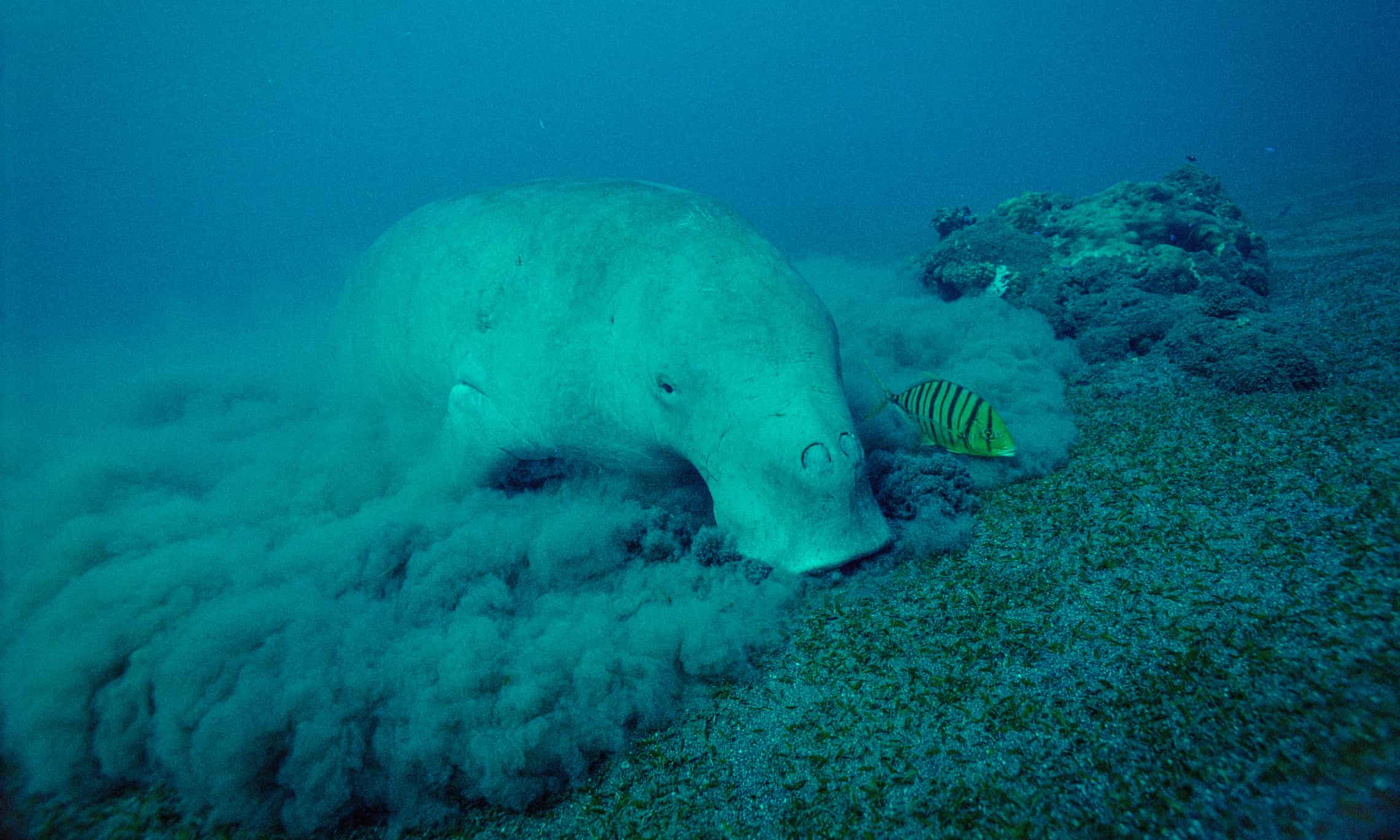
The rare sight of a dugong feeding on a seagrass meadow in Vanuatu. The gentle giants were once a common sight around the Melanesian archipelago.

Here’s an interesting story about a saltwater cousin of the shy freshwater manatee. It eats seagrass, and like most other living things in the ocean, it’s negatively affected by warming trends.

Rebecca Root writes at the Guardian, “In a bright spring day, the sun dances over the water of Havannah Bay on the island of Efate in Vanuatu. Below the surface, pockets of seagrass that can just about be seen from the shoreline, sway in the current. It’s here, if they are lucky, that onlookers may spot a dugong bobbing in the shallow water, orbiting the seagrass meadows they feed on.

“ ‘It’s wonderful seeing them swimming by and grazing off the seagrass in front of the resort,’ says Greg Pechan, the owner of a local hotel, the Havannah, which sits at the tip of the bay. Pointing out beyond the jetty that stretches into the Pacific Ocean, he says Vanuatu’s sea life is a big attraction for visitors to the Melanesian country.

“Light grey in color, dugongs, sometimes known as ‘sea cows’ and whose closest relatives are freshwater manatees, can grow up to four metres long and weigh up to 400kg (900lb). They are a ‘friendly species’ and respected by islanders, says Heidi Joy, a marine science student from Efate.

“A few years ago, it would not be unusual for Joy, who lives close to Havannah Bay, to spot a dugong in the morning and then again at sunset. That has since changed, she says. ‘We rarely see them now.’

“Dugongs are considered vulnerable to extinction by the International Union for Conservation of Nature. The exact number roaming Vanuatu’s waters is, however, unknown and this uncertainty is hindering conservation efforts, experts say.

“ ‘A lot of studies have been done where you’ve got large populations of dugongs in large seagrass meadows [such as] Australia or Abu Dhabi, but we’ve got a different dugong population. We’ve got small groups or individuals,’ says Christina Shaw, the CEO of the Vanuatu Environmental Science Society. She says that a national assessment of dugongs and seagrass in Vanuatu is urgently needed. …

“In 2023, the status of neighboring New Caledonia’s population was downgraded to ‘endangered‘ while east African dugongs have become ‘critically endangered.’ …

“In Vanuatu, however, only one aerial survey – in 1987 – has been carried out to assess the national distribution, abundance, cultural importance and threats, according to Helene Marsh, an emeritus professor in environmental science at James Cook University.

“Dugongs globally are threatened by gill-net fishing, boat traffic, coastal development and hunting. In Vanuatu, dugong meat used to be considered a source of protein, their oil used for cooking and other parts whittled into handicrafts.

“But since the 1980s, certain islands have introduced local prohibitions known as tabu, which mandates their protection. In 2010 the government also signed the Convention on Migratory Species’ dugong memorandum of understanding, committing it to protecting the sea cows and the seagrass they eat. This means hunting is now rare, says Shaw.

“Instead, another predator threatens the dugong: the climate crisis. On a spring evening in Efate, rain hammers relentlessly until nightfall, rendering the ocean a murky green. It’s downpours such as this, becoming more common, alongside storms and cyclones, that damage the seagrass so vital to the dugongs.

“Vanuatu sits in the Pacific ‘Ring of Fire,’ a tectonic belt of volcanoes and earthquakes, and a tropical cyclone region, making it prone to disasters. When these batter the bays and beaches of Vanuatu, the seagrass is swept up by the heavy winds, while the rain and debris creates sediment on the water surface, smothering the seagrass from the sunlight it needs to thrive. …

“Richard Leck, head of oceans at WWF Australia, says: ‘When that happens dugongs have no choice but to get on the move and sometimes they have to go into deeper water, expend much more effort to graze seagrass and when that happens they often get emaciated and lose condition really quickly.’ …

“As with dugongs, there is limited data on the prevalence and condition of seagrass in Vanuatu. This makes it hard, says Shaw, to advocate for investment in conservation. ‘Funders don’t like paying for studies,’ she says. ‘But how do we do [conservation] if we don’t know what’s there?’ ”

More at the Guardian, here.

Read Full Post »

Photo: Wikimedia.
Devastation on the island nation Vanuatu (near Australia) after Cyclone Pam in March 2015. Vanuatu is one of the countries most vulnerable to climate change. Already this year it was hit by two Category 4 cyclones, blamed on global warming.

Today’s story by Michael Birnbaum at the Washington Post could be subtitled The Mouse That Roared. That’s because a tiny nation vulnerable to climate change is pushing the world’s highest court to take a stand.

“The small Pacific island nation of Vanuatu won a major victory to advance international climate law [in March] after it persuaded the U.N. General Assembly to ask the world’s highest international court to rule on the obligations of countries to address climate change.

“The request for an advisory ruling from the International Court of Justice is expected to clarify the legal obligations of countries to address climate change — and to create a path for them to be sued if they fail to do so. The U.N. effort was a significant outcome for Vanuatu, an archipelago nation of 320,000 people that is suffering from climate-change-driven natural disasters. In recent weeks, it was hit by two Category 4 cyclones, the severity of which its leaders blamed on global warming. Thousands of people are still living in shelters.

“The country has used its moral authority and ability to stage action at the United Nations to achieve outsize results on climate issues. The U.N. General Assembly approved the measure by acclamation, with neither the United States nor China standing in the way of the effort despite uncertainty in advance whether they would seek a formal up-or-down vote.

“[The] decision was also a measure of how much global attitudes about the urgency of addressing climate change have shifted in recent years. A similar effort in 2011 by two other island nations, Palau and the Marshall Islands, failed at the United Nations. This time, Vanuatu obtained co-sponsorship from more than 120 countries, including Britain, France, Germany and other industrialized nations with a long history of high emissions.

“ ‘It is a matter of basic survival for us,’ Vanuatu Climate Change Minister Ralph Regenvanu said in an interview.

‘We can’t do anything economically and politically because we don’t have any power. What we can use is our sovereignty as a United Nations member state.’ …

“Having the International Court of Justice weigh in creates a ‘pretty clear pathway to recognizing that states have a duty not only not to violate fundamental human rights, but states have a duty to avoid transboundary harm through activities under their control,’ said Carroll Muffett, president of the Center for International Environmental Law, a D.C.-based nonprofit that works to use international law to address ecological issues.

“He compared an advisory ruling to consulting a lawyer while being engaged in behavior that falls in a legal gray zone.

“ ‘It’s like when you send a note to your lawyer, and you get a lawyer’s note back saying what you’re doing is illegal,’ he said. ‘It puts you on notice that you could be held accountable for your actions.’ …

“As Vanuatu gained support for the U.N. action, it was careful to try to build consensus, with its leaders saying they are not suing anyone nor seeking to create new international obligations. Instead, they say, they are seeking to clarify how preexisting international agreements apply to climate change. …

“Neither the United States, which is the world’s largest historical emitter, nor China — which is soon poised to overtake the United States on that count — opposed the measure. The two superpowers have been competing for influence among Pacific island nations as they seek to project power across that ocean, giving the small countries outsize leverage despite their minuscule economies and populations.

“But even as the United States stood aside and allowed the referral to be approved without objection, a U.S. diplomat also said the Biden administration believes diplomacy is a better way to achieve action on climate issues than inside a courtroom.

” ‘Launching a judicial process, especially given the broad scope of the questions, will likely accentuate disagreements and not be conducive to advancing our ongoing diplomatic and other processes. In light of these concerns, the United States disagrees that this initiative is the best approach for achieving our shared goals,’ diplomat Nicholas Hill told the General Assembly after the measure was approved, speaking on behalf of the State Department.

“Vanuatu’s policymakers said they had tried to craft their work in a way that would win broad acceptance.

“ ‘We have deliberately tried to make this as noncontentious as possible,’ Regenvanu said. ‘Once we get the question before the court, then the process of submissions begins, and there might be a slight change of tactic there. Because obviously we want the highest level ambition in that opinion.’

“The effort began four years ago in a classroom at the University of the South Pacific in Fiji. Law students there decided that an advisory opinion from the International Court of Justice could be an effective tool to advance climate justice. They worked to convince their governments to follow suit.

“Vanuatu has also promoted a global fossil fuel nonproliferation treaty, advocating a total phaseout of oil, coal and gas as quickly as possible. And it has been a leader on international efforts to create a system to compensate the worst-hit countries for ‘loss and damage’ from climate change.”

More at the Post, here.

Read Full Post »