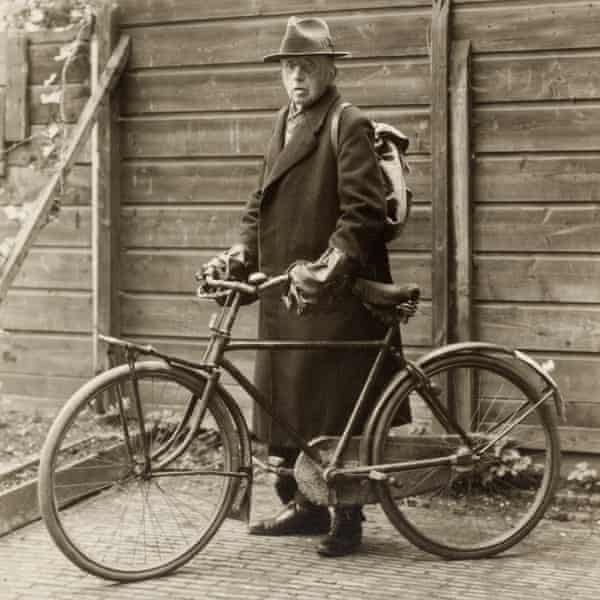
Photo: rkd/Mauritshuis.
Wilhelm Martin, the director of the Mauritshuis museum, quietly resisted by removing artworks from the museum during the Nazi occupation. And he hid people.
Today we go back to WW II to gather new information on the difficult choices that people had to make under Nazi occupation and how some Dutchmen practiced resistance while hiding in plain sight.
The Guardian‘s Senay Boztas reported the story from the Netherlands.
“The 13-year-old boy answered the doorbell,” she begins. “ ‘Tell your dad I’m here,’ said a man, who stored his bicycle and then disappeared upstairs.
“It was 1944, and right under the noses of Nazi command, people were hiding in the attic of The Hague’s Mauritshuis museum from forced labour conscription – Arbeitseinsatz – under which hundreds of thousands of men from the Nazi-occupied Netherlands were conscripted to work in Germany.
“The memories of 93-year-old Menno de Groot – a Dutch-Canadian who was that young boy – form an extraordinary part of a book and an exhibition of the secret history of the Dutch museum during the second world war.
“ ‘He must have gone all the way to the attic,’ De Groot tells his granddaughter Kella Flach in a video for the exhibition, referring to the man who he assumed had arrived to go into hiding. ‘I don’t know how many were up there. I have no idea how they lived up there, how they got there.’
“The chance find of a logbook by De Groot’s father, Mense de Groot, an administrator who from 1942 lived in the Mauritshuis museum with his wife and children, including Menno, inspired researchers to examine the museum’s history.
“ ‘People were hiding in November 1944 because of the Arbeitseinsatz, but hiding in the Mauritshuis was hiding in plain sight,’ Quentin Buvelot, a researcher and curator, said. ‘It was a house in the storm.’
“Art from the museum, including Johannes Vermeer’s Girl With a Pearl Earring, was first hidden in a bomb-proof bunker underneath the building and later stored in locations around the Netherlands. The German-born museum director Wilhelm Martin played a careful role, allowing the Nazis five propaganda exhibitions while also quietly resisting.
“A newly discovered note on Martin’s retirement in 1953 revealed he was involved in supporting people who had gone undercover on Assendelftstraat and in the museum. ‘Martin doesn’t say how many, but he says that on a daily basis, 36 loaves of bread were delivered. …
“Secret concerts were also held in the museum’s basement between 1942 and 1944, according to Frank van Vree, an author and researcher at the NIOD institute for War, Holocaust and Genocide Studies. ‘They were held to support musicians who were cornered by their resistance to German measures, especially compulsory membership of the Nazi Kultuurkamer,’ he said. …
“Mense de Groot, who was hired to work at the museum when the janitor retired, also worked for the resistance. ‘He usually got Trouw, an underground newspaper,’ Menno de Groot says in the exhibition. ‘And my dad, he copied them, made more copies. …
“Life under occupation was a series of difficult choices, according to Eelke Muller, a historian and NIOD specialist in looted art. ‘There was little knowledge [before this research] about how culture could be a political instrument for resistance from the Netherlands but also a strong ideological instrument for the occupier,’ she said. ‘Every museum, every civil servant in times of war was confronted with huge dilemmas: do you choose principled resistance, enthusiastically get behind Nazi ideas, or are you somewhere in the middle?’ More at the Guardian, here. No paywall.
Nina Siegal at the New York Times adds details about the famous Vermeer that Martin also hid.
“At first it went to a bomb shelter in the basement of a museum, then an art bunker built into the dunes on the North Sea in the Netherlands. Toward the end of the war it was hidden in a secured cave in Maastricht, a Dutch city near the Belgian border.
“Starting in 1939, as war in Europe spread and the Nazi invasion of the Netherlands loomed, leaders of the Mauritshuis, the jewel box museum in The Hague, took extraordinary steps to protect Johannes Vermeer’s ‘Girl With a Pearl Earring’ and other works central to its collection.
“Wilhelm Martin, the museum’s director at the time, removed it and other famous works … before the Germans arrived because he understood that they would be in peril, both from bombardments and from potential Nazi looting afterward.
“The survival of these works, through strategic planning, diplomatic appeasement and the German affinity with the conquered Dutch as ethnic brethren, is now the subject of an exhibit at the Mauritshuis. ‘Facing the Storm: A Museum in Wartime,’ which is on view until June 29, coincides with the 80th anniversary of the liberation of the Netherlands in 1945 and is based on extensive new research.”
I hope blogging chefs Michiel and Jeen in the Netherlands get to see this.


 Suzanne's Mom's Blog