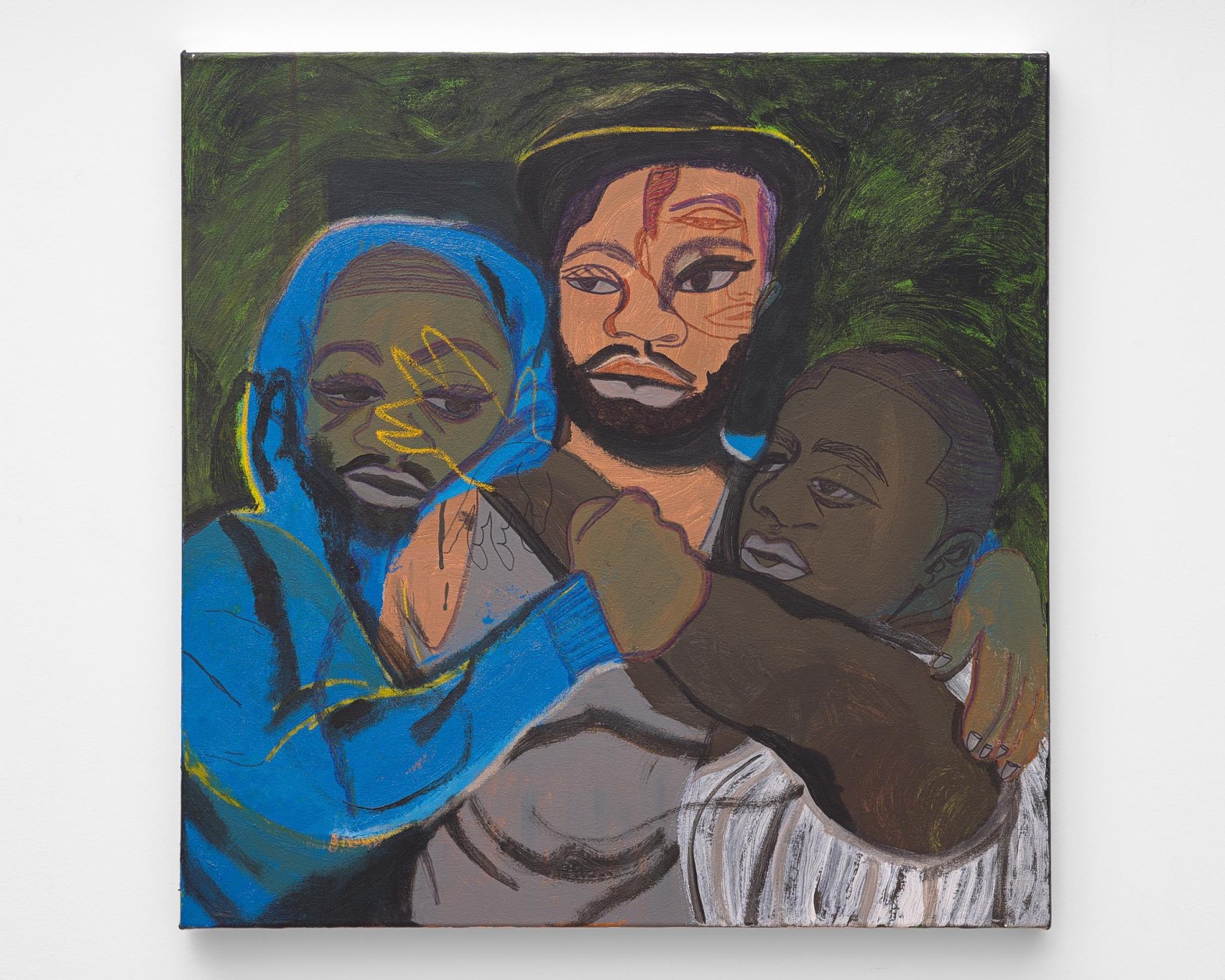
Art: Jonathan Lyndon Chase.
“Calm Touches” (2021), acrylic paint, oil stick, and marker on canvas, 20 x 20 inches. One of the pieces that students chose for the art collection at Wake Forest University.
I’ve been reading Just Kids, Patti Smith’s memoir about her life with artist Robert Mapplethorpe, and I’ve been thinking about how young artists carve out new ways, how they realize they have a different vision and develop the confidence to stick with it.
So it was with interest that I read at Hyperallergic about a university tapping youthful insights about art to form a very special collection.
John Yau reports from Winston-Salem, North Carolina, “Wake Forest University is one of the few American institutions of higher education to establish a collection of student-acquired art.
“Once every four years, a small group of students, along with faculty advisors, travels to New York City to buy art for the Mark H. Reece Collection of Student-Acquired Contemporary Art. This collection was started in 1963, at the beginning of a convulsive era in American history.
“Mark Reece, the dean of students and college union advisor, decided the school should establish a collection of contemporary art chosen by an acquisitions committee composed solely of students. In June of that year, Reece, Dean Ed Wilson, Professor J. Allen Easeley, and two students, David Forsyth and Theodore Meredith, drove to New York to visit contemporary art galleries. Working within a budget that Reece had cobbled together from unused funds, Forsyth and Meredith chose 18 works by 17 artists.
“Earlier this year, Wake Forest University celebrated the 60th year of this program — and the 16 trips that have taken place since the program’s inception — with a selection of works obtained by previous generations of students. The exhibition, Of the Times: Sixty Years of Student-Acquired Art at Wake Forest University at the Charlotte & Phillip Hanes Art Gallery, was curated by Jennifer Finkel, who also contributed to the catalog, along with Leigh Ann Hallberg and J. D. Wilson.
“The collection comprises more than 130 works, including, paintings, sculptures, drawings, photographs, and prints. Unsurprisingly, given that the acquisitions committee changes every four years, no style, movement, or material dominates. The one constant holding the collection together, though in no obvious way, is the mandate that Reece gave the first two students, which has been followed ever since: the art they buy must be ‘a reflection of the times.’
“During my time on campus, I was invited to sit on Professor John J. Curley’s class, titled Slow Looking. The small group of students, seated in a semicircle, faced Ida Applebroog’s ‘Promise I Won’t Die?’ (1987), a work on paper combining lithography, linocut, and watercolor that the acquisition group elected to buy in 1993. …
“By asking students to research an artist and carefully scrutinize a particular work of art, Curley encouraged them to go down a rabbit hole, where they can consider what they are looking at and how it communicates with them. This level of engagement is hard to achieve without being in the presence of a physical artwork. That it was chosen by a group of students 30 years ago underscores this collection’s ongoing vitality and relevance.
“On campus, I also met some of the students who participated in the most recent New York buying trip. All were genuinely excited. They talked about how they prepared for the trip, beginning with Reece’s original mandate. They began compiling the initial list of 300 artists once they had been accepted into Contemporary Arts and Criticism. Throughout the semester the list expanded and contracted until it was down to 20 names. The students met in and outside of class. Each week, they presented a short list to their two professors, Finkel and Curley.
“The students discussed what they thought art reflecting the times would look like, and who might make it, resulting in a racially diverse group. Before the trip, they made appointments with the artists’ galleries. Some dealers, I learned, were arrogant to them, treating them as if they didn’t know what they were doing. Others were warm and welcoming. At least one gallerist kept looking to the professors who accompanied them, convinced it was they who would make the final decision. …
“This immersive art-buying experience … mirrors this country’s changing demographics. For the first decades, the artists on the list were all or nearly all White. In 1989, the students bought Robert Colescott’s painting ‘Famous Last Words: The Death of a Poet’ (1988). … Four years later, the students bought ‘Untitled (Four Etchings)’ (1992) by Glenn Ligon and ‘Untitled (from the Empty Clothing series)’ (1991) by Whitfield Lovell. In 2001, they added South Korean artist Do-Ho Suh and Pakistani-American artist Shahzia Sikander to the collection. They confronted controversial subjects, such as Congolese child soldiers, photographed by Richard Mosse, and Pakistani artist Salman Toor’s paintings of queer Brown men.
“This year, the eight students chose the work of eight artists: Tunji Adeniyi-Jones, Jonathan Lydon Chase, Melissa Cody, Adebunmi Gbadebo, Emilie Gossiaux, Melvin L. Nesbitt Jr., Willa Wasserman, and Zhang Xiaoli.
“My only criticism,” Yau writes, “is that the university has no building dedicated to this collection, and it really should. Yet the diversity of artists, mediums, and practices is to be applauded. Taking their cues from Reece’s mandate, Wake Forest’s students have assembled an impressive gathering of art.”
I love how the university recognizes that young people have different sensibilities and how it honors that. More at Hyperallergic, here. No paywall. Subscriptions encouraged.

 Suzanne's Mom's Blog