What is going on with the oceans? Warming trends are bringing sea creatures further north and for longer periods.
In January, Oliver Milman reported at the Guardian about a sea snake with a suggestive name (“Why you yellow-bellied sea snake, you …!”) that has suddenly shown up in California.
“California beachgoers have been urged to steer clear of a species of highly venomous sea snake following a third, and unprecedented, instance of an aquatic serpent washing up on to the state’s beaches.
“A 20-inch yellow-bellied sea snake was discovered on a beach near San Diego … The sighting was the third reported instance since October of the species, which prefers the tropical waters of the Pacific and Indian oceans, washing up on California’s beaches.
“The only previous verified sighting of a washed-up yellow-bellied sea snake was in 1972. Experts believe the snakes have ridden a warm current of water, fueled by the exceptionally strong El Niño climatic event, farther north than they have ever previously ventured. …
“ ‘It’s been an incredibly interesting year for southern California. We’ve seen tuna and marlin and tropical bird species such as red-footed boobies,’ said Greg Pauly, curator of herpetology at the Natural History Museum of Los Angeles County. …
“Yellow-bellied sea snakes are fully aquatic snakes capable of swimming vast distances. Although they are highly venomous, their targets are small fish and it’s thought they have yet to cause a recorded human death. However, Pauly said people should keep their distance if they encounter another washed-up snake.
“ ‘They are fairly docile and it’s unlikely for someone to be envenomated,’ he said. ‘It’s rare for them to bite people, it’s usually fishermen who are carelessly pulling up fishing nets.’ ”
More here.
Photo: Carolyn Larcombe/Wandiyali Images
Seen in California after el Niño, yellow-bellied sea snakes usually live in the deep waters of the Pacific and Indian oceans. 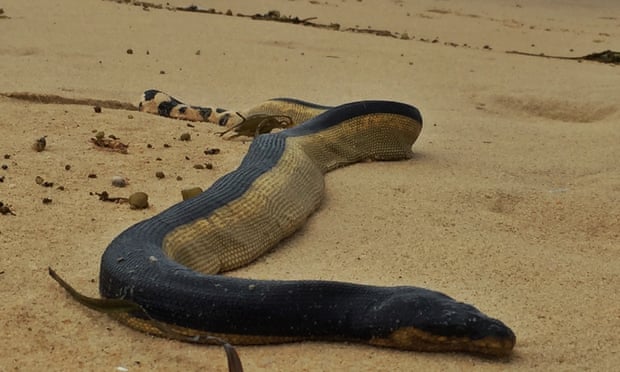

 Suzanne's Mom's Blog